
The peptide crackdown is real. The pressure just moves.
More warning letters, a federal prison sentence and a customs operation aimed only at peptide parcels. The squeeze on the grey market is real. But squeezing a market doesn’t take the demand out of it, so where does the pressure go, and what does that do to the next vial you buy?
In this article ▾

This is the written version of Peptide Crackdown Is Tightening. Here’s What Happens Next — watch it instead if you’d rather.
At the end of March, US Customs announced it had stopped a scheme to smuggle over 5,000 unapproved peptides into the country, all through one port in Cincinnati. That is one very busy loading dock in Ohio. But the people waiting on those parcels didn’t stop wanting peptides the next morning. So where does all that demand go? Because wherever it ends up is where your next vial comes from.
I work with pumps and valves as an engineer, and a squeezed system is about the most predictable thing I deal with. So let’s follow the pressure, and by the end you’ll know which way your own risk moves while the grey market is being squeezed. It is probably not the way you’d guess.
Is the crackdown actually tightening?
“Tightening” is a claim, so I checked it before using it. The FDA’s warning letters are the obvious place to start — basically the agency’s version of a very strongly worded email. In December 2024 the FDA sent warning letters to four online peptide sellers on the same day. So far this year I’ve counted 11 more. Five went out on one day in March, and another five on one day in August. That count is a floor rather than a census, because it is only what turns up in the FDA’s own database.
And it isn’t just letters any more. In July, a man in Michigan who sold research-labelled weight-loss peptides online was sentenced to 21 months in federal prison, and the US Attorney’s office for the Western District of Michigan said it would treat people like him just like street-level drug dealers. I’m not linking that release, because its web address names the defendant, and I don’t name sellers — not even the ones that got caught.
It isn’t just the US either. In June, Swiss authorities ran a whole customs operation aimed only at peptide parcels.
To be fair, the direction isn’t the same everywhere. In July an FDA advisory committee voted to recommend letting compounding pharmacies make BPC-157 and a few others, against the advice of the FDA’s own review team. I’ve written that vote up separately in why the panel overruled the agency’s own scientists. But a recommendation isn’t a rule. On the selling side, the squeeze is real.
Does a crackdown clear out the bad sellers?
The obvious next thought is: good, that should clear out the dodgy sellers and leave the better ones standing. That idea treats a crackdown like a filter. The water goes through, the grit gets caught, and what comes out the other side is cleaner. But a filter only works if the grit it catches stays caught.
Somebody has actually measured this, in a different market. A 2017 study tracked 39 dark web drug markets from late 2013 to late 2015. Two big disruptions hit during that time: a major international police operation, and the biggest market on the list simply shutting down. After the police operation, the number of sellers dropped by about 627. After the shutdown, it dropped by about 910. That is a real hit. But the sellers came back, and the researchers found that neither disruption changed how fast seller numbers were growing overall. The filter caught the grit, and the grit walked back round to the inlet.
That is illegal drugs, not peptides, so take it with a grain of salt. But there is a peptide example too. One of the biggest research-label sellers was shut down in 2024, and this summer its owner was sent to federal prison. CBS News then reported that similarly named websites had appeared since, one of them with nearly identical branding. Its operators say it has nothing to do with the old company, and that is exactly the problem. From where you’re sitting, you can’t tell the difference.
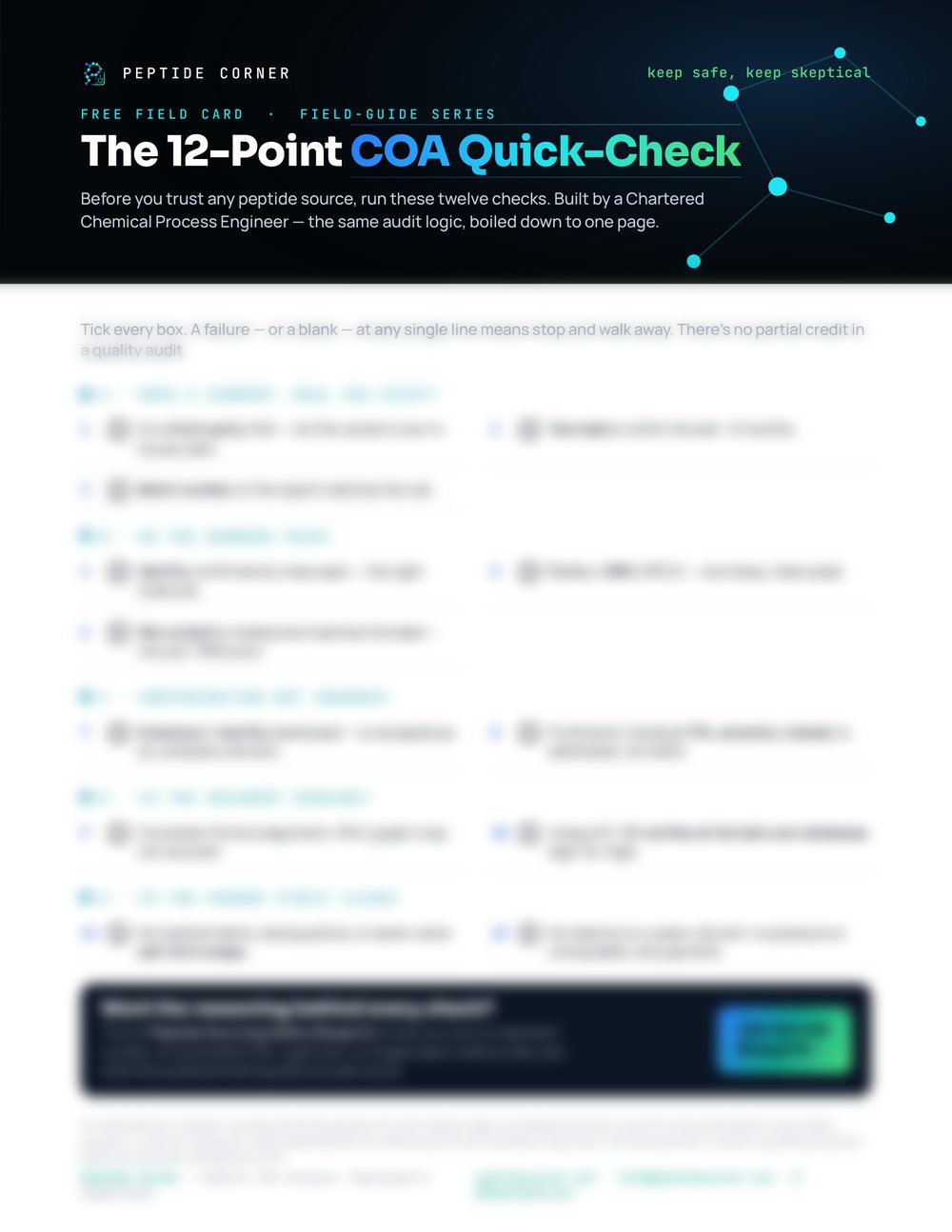
Twelve checks in the order I’d run them on any lab report, and one Pass / Ask / Stop rule. Printable, front and back. Comes with the other three free guides, for one email.
Get the free guidesThe name on the vial is where the pressure went first
When I read the FDA’s warning letters side by side, something jumped out that had nothing to do with the law. In the 2024 letters, the sellers called their products by the drug’s actual name, like semaglutide and retatrutide, or a nickname like “Sema” or “Reta”. You could tell exactly what was meant to be in the vial.
In this year’s letters, 9 of the 11 sellers were using codes instead — things like GLP-1 S, GLP-2 T and GLP-3 RT, which sound less like a drug and more like a robot from Star Wars. And it is not just a nickname with a number on it. Line the sellers up and retatrutide alone shows up under at least four different codes. One seller’s “GLP-1” product is semaglutide, while another seller’s “GLP-1” product is retatrutide. Same label, different drug.
It gets worse. GLP-2 is a real hormone, and a completely different one. One seller’s website described its “GLP-2” product as working on GLP-2, when the drug actually in it was tirzepatide, which works on GLP-1 and a gut hormone called GIP. So the code didn’t just hide the name. It put the wrong biology on the label.
Notice who that actually fooled. It wasn’t the FDA, because those sellers still got the letters. It’s the person holding the vial. Think of a plant where every contractor labels the pipes in their own colour code. The pipes still work, you just can’t trust a single label in the building.
With a peptide, you can’t engineer your way around a ban. Change the molecule and it isn’t retatrutide any more. So the pressure goes into the one part that’s cheap to change: the name.
There is a good reason to expect exactly this. When China banned a whole family of synthetic cannabinoids by their structure in 2021, researchers working with Europe’s drugs agency found that 20 of the 23 new ones that appeared over the following year were built to slip around that ban. A peptide can’t pull that trick and stay the same drug, so the label takes the strain instead.
The route the parcel takes, and the shopfront it comes from
The name is the first weak joint the pressure found. The second is the route. Back in Cincinnati, Customs’ own release says those peptides came in what are called master cartons: one big box with about 15 smaller parcels hidden inside, each already labelled with where it was going. Customs found more than 300 of those boxes. It is basically a Russian doll with a shipping label.
In Switzerland, the June operation checked 46 suspect peptide parcels, and around 80% of them came from Poland, not China. The report doesn’t say where the peptides were actually made, so I can’t tell you that. What it does show is that the last stop before your door isn’t necessarily where the journey started. I go through where a peptide can actually come from in the four places your peptide came from.
Then there is the shopfront itself. In August, Eli Lilly, the company developing retatrutide, sued six US businesses selling it, and said it had already reported more than 14,000 websites, ads, social posts and listings selling the drug in over 100 countries. That is for a drug that isn’t even approved yet.
Why a new name resets the track record
In a plant, if we change a supplier, even for something as boring as a gasket, the new one gets checked from scratch. Nobody gets excited about gaskets, right up until one fails. So every time a shop changes its name, its route or its supplier, the track record you were leaning on goes back to zero, and nobody sends you a notice. That is my reasoning as an engineer, not a study on peptide vials, but it is the same logic every quality system runs on.
One thing to be clear about: none of this is about anyone coming for the vial already in your fridge. It is about what the squeeze does to the shelf you buy your next one from. Two things change there.
- The name. If the label says a code instead of a molecule, you’ve lost the very first check before you’ve even opened the box.
- The age of the shop. A shop that has only been around a few weeks under its current name has no history for you to lean on, whatever its website says. I’ve written about why a seller’s name can’t do that job for you in where should I buy peptides.
The bottom line
The crackdown is real, and it is getting tougher. But squeezing a market doesn’t take the demand out of it. It pushes the selling into new names, new routes and new shopfronts, and every one of those resets the history you were relying on.
So, which way does your own risk move? The obvious answer is that whatever is left gets safer, but that isn’t what the evidence from other squeezed markets shows. Your next vial gets harder to predict, not safer. The vial in your fridge is the one thing in this story that doesn’t change. It’s the next one that does. The pressure doesn’t disappear. It finds the next weak joint, and right now that joint is the label, the route and the shop you’ll be buying from next.
Had a certificate sent to you? I read them — peptidecorner.net/coa-read
Sources
- US Customs and Border Protection — Cincinnati CBP foils scheme to smuggle over 5,000 unapproved peptides into the U.S. (31 March 2026) — https://www.cbp.gov/newsroom/local-media-release/cincinnati-cbp-foils-scheme-smuggle-over-5000-unapproved-peptides-us
- FDA warning letters database — the letters to online peptide sellers, searchable by issue date (December 2024; March, June and August 2026) — https://www.fda.gov/inspections-compliance-enforcement-and-criminal-investigations/compliance-actions-and-activities/warning-letters
- Swissmedic — cross-agency targeted campaign on peptide parcels: 46 packages checked, around 80% sent from Poland (30 June 2026) — https://www.swissmedic.ch/swissmedic/en/medicrime/news/warnings/schwerpunktaktion-peptide.html
- Van Buskirk J et al. The recovery of online drug markets following law enforcement and other disruptions. Drug and Alcohol Dependence, 2017 — https://doi.org/10.1016/j.drugalcdep.2017.01.004
- Andrews R et al. From JWH-018 to OXIZIDS: structural evolution of synthetic cannabinoids in the European Union. Drug Testing and Analysis, 2023 — https://doi.org/10.1002/dta.3422
- Becker’s Hospital Review — Lilly’s six lawsuits over retatrutide sales and its 14,000+ reported listings (12 August 2026) — https://www.beckershospitalreview.com/glp-1s/lilly-sues-6-companies-over-alleged-retatrutide-sales/
- DailyMed — tirzepatide prescribing information (the receptors it acts on) — https://dailymed.nlm.nih.gov/dailymed/search.cfm?labeltype=all&query=tirzepatide
Educational and research purposes only — not medical advice. Peptide Corner does not recommend any vendor, source, or dose. Keep safe, keep skeptical.


Your Peptide Came From One of Four Places. Ask Which.
Four systems can produce or handle a peptide. Each leaves a different paper trail, and one is built to leave nothing to check.
Where Should I Buy Peptides? The Answer Isn’t A Name
It is the question I get more than every other question combined, and I have never once answered it. Not because YouTube is tying my hands, but because a name is a claim about a company and what arrives at your door is one batch. Here is the line of US federal regulation that proves the point, and what happened when somebody actually measured what was in the vials.

FDA vs FDA: Why the Advisory Panel Overruled the Agency’s Own Scientists
The committee overruled the FDA’s scientific reviewers on six of seven peptides — and rejected the seventh. Inside the arguments, the one rejection that proves it wasn’t a rubber stamp, and why a vote is not a rule.