One email gets you all four. A plain-English beginner’s guide to start from, a printable card for checking a lab report, a short book on what actually degrades a peptide, and the eight questions that tell you whether a study means anything. No vendor names, no doses, no cost.
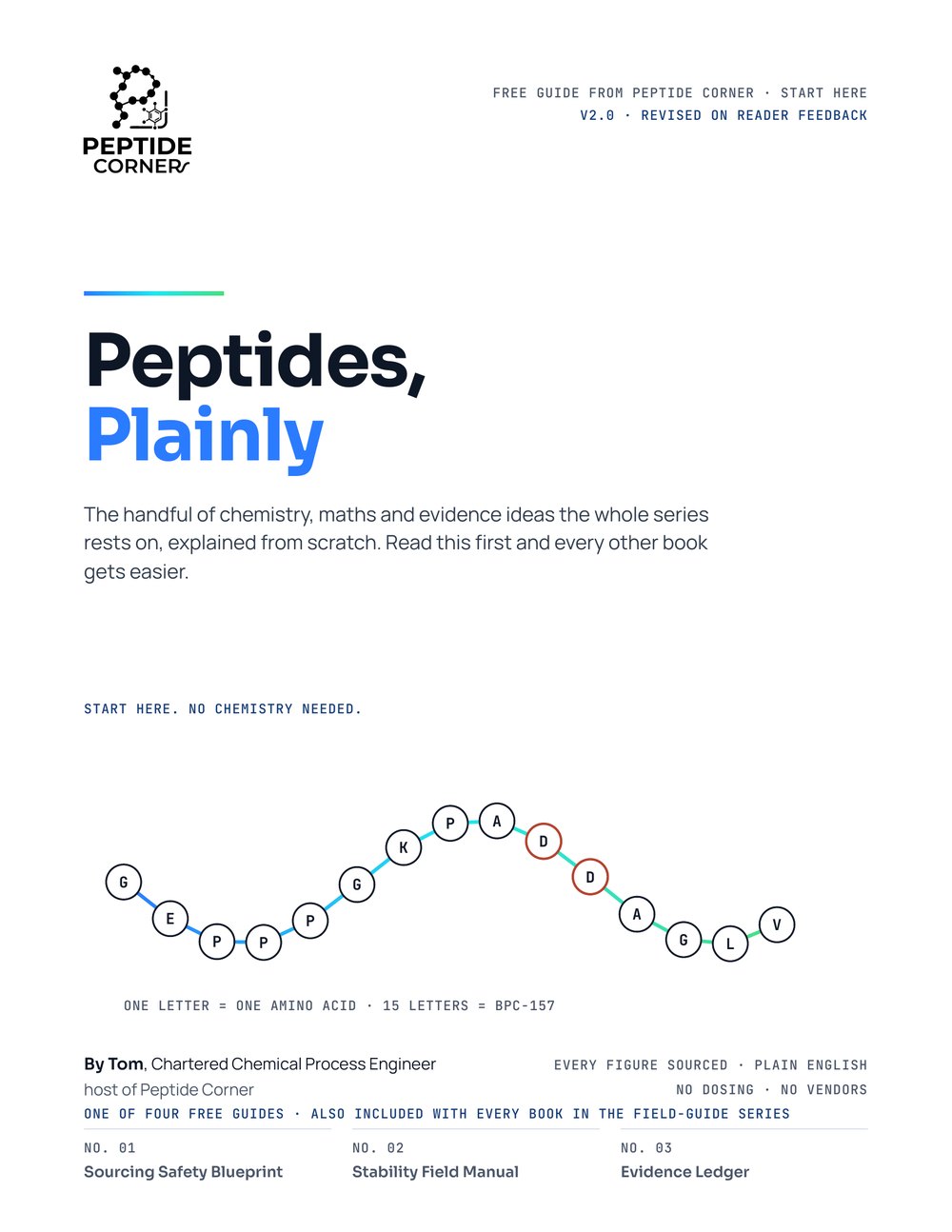
The free beginner’s guide: the handful of chemistry, maths and evidence ideas the other three rest on — amino acids, half-lives, what a lab test can and can’t see, how to read a result — explained from scratch.
Twelve checks in the order I’d run them, and one rule for every line: Pass if it’s present, consistent and traceable to the lab; Ask if it’s blank or unclear; Stop if it fails, contradicts another line, or can’t be traced to the lab.
Five things everybody repeats about storing peptides, checked against approved labels and the published literature. None of the five survives the check.
The eight questions to ask of any study before you believe its headline. Ask them once and most of the internet gets easier to evaluate.
 4 guides · free
No vendor names. No doses. Not one, anywhere, on purpose — that’s the line the whole channel is built on. Anyone handing you a shopping list is selling you something. These do the opposite: they teach you to judge a source, a vial and a study yourself, so you don’t need anyone’s recommendation.
You’ll also get a short note when a new video or guide lands. Unsubscribe whenever, no hard feelings.
It’s the guide I wish existed when I started: what a peptide actually is, why “half-life” means two different things, what a lab test can and can’t see, and how to read a result — each one explained from scratch, with nothing to buy. Read it first and the other three get easier.
Peptides, Plainly is the groundwork for all three books, and it comes inside every one of them too. Each of the other free guides is a real piece of a bigger book: the card comes out of the Blueprint, the storage guide out of the Stability Field Manual, the study guide out of the Evidence Ledger. If the free one earns its place, the paid one is the same thinking at full length.
| No. 01 · The Blueprint $17 USD · 49 pages |
No. 02 · The Stability Field Manual $37 USD · 175 pages |
No. 03 · The Evidence Ledger $49 USD · 156 pages | |
|---|---|---|---|
| The question it answers | Is it real? | Is it still intact? | Does it do anything? |
| Buy it if you’re | About to trust a lab report from a seller you don’t know. | Holding something already, and unsure whether it survived the journey. | Deciding whether a compound is worth your time at all. |
| What you’ll be able to do | Read a COA, catch a forgery, and audit the seller behind it. | Work out what a temperature excursion actually cost you, and look up your own compound. | Tell strong evidence from a confident sentence — and check any grade yourself. |
| Covers | Certificates of Analysis and vendor behaviour. | 45 compounds, profiled from their own sequences. | The same 45 compounds, graded A to E. |
| Sources | Cited throughout. | 134 numbered sources. | 301 citations, every one checkable. |
| Comes with | A printable 12-point card. | An offline calculator + a fridge card. | An offline searchable explorer + a grade card. |
| Dosing, vendors, protocols | None, ever. | None, ever. | None, ever. |
Swipe the table sideways to see all three.

I’ve just sent a confirmation email to your address. Click the link in it and all four free guides land in your inbox straight away.
It may go to junk or spam. If it isn’t in your inbox within a minute or two, check your junk/spam folder — and Gmail’s Promotions tab. Mark it “not spam” so the guides actually reach you.
Nothing arrives at all? Email info@peptidecorner.net and I’ll send them over by hand.
