
Six ways this goes wrong after 50. None of them is the peptide.
Six things go wrong when you inject something after fifty, and not one of them is about the compound. They are about the system you are putting it into — four other things already in the pipes, a kidney with no headroom left, and a drug interaction that turns out to be a curve rather than a level.
In this article ▾
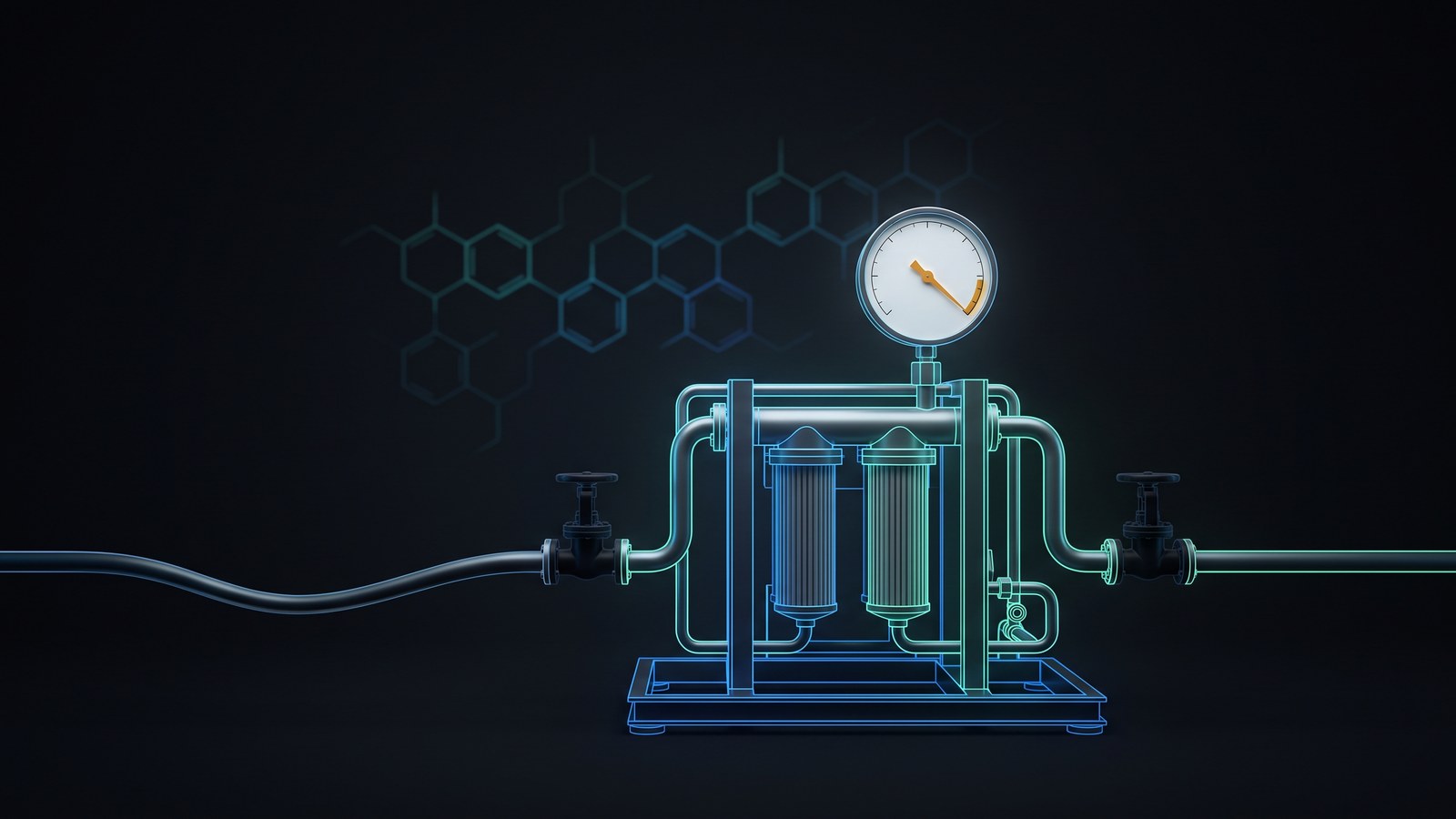
This is the written version of The Peptide Mistakes Nobody Warns You About After 50 — watch it instead if you’d rather.
Every drug label you have ever read was written against a trial population: somebody recruited a few thousand people, wrote down what happened, and the label is the summary. It is an honest process with one blind spot that gets bigger every year you age. The trial population was never you.
Not you with a knee that has been going for two years, a repeat prescription you stopped thinking about in 2019, and a vial nobody official knows about. Six things go wrong in that situation, and not one of them is about the peptide. They are all about the system you are putting it into.
What is already in there
Start with the thing that makes fifty different from thirty, and it is not your joints. It is what else is already in you.
The National Center for Health Statistics counted this. Across American adults aged forty to seventy-nine, 65.2% of men took at least one prescription drug in the past thirty days. Split by age instead of sex, the sixty-to-seventy-nines come in at 83.6% against 59.5% for the forty-to-fifty-nines. And the figure that stopped me: 34.5% of that older group are on five or more — five different medicines, at once.
So a thirty-year-old adding something is adding it to a fairly empty system. When you add it, you are adding it to a running plant that already has four other things in the pipes. Same input, completely different process.
Nobody warns you about that, because the warning has nowhere to come from. The person selling you the vial does not know what is in your bathroom cabinet, and the doctor who prescribed what is in it does not know about the vial. You are the only person holding both halves of the story.
Reserve is an engineering word
Mistake two is assuming a healthy kidney at fifty-five is the same instrument as a healthy kidney at twenty-five. It is not, and the way it is not is quite specific.
Measured in kidney donors, who are about as thoroughly screened as a human being gets, filtration rate falls by roughly 6.3 mL/min/1.73m² per decade. That is not disease. That is time.
The researchers’ own phrasing is the bit worth keeping: older kidneys have less functional reserve and are at higher risk of acute injury. Reserve is an engineering word and it means what you would think. A pump running at rated capacity is fine, right up until the day something asks it for more. Nothing is wrong with it. Nothing shows on a gauge. It has no headroom left — and headroom is what keeps a bad afternoon from becoming a hospital trip.
The free beginner’s guide: the chemistry, maths and evidence ideas everything else rests on, explained from scratch. Comes with the other three free guides, for one email.
Get the free guidesAn interaction is a curve, not a level
Mistake three is assuming that if two things interact, they interact by the same amount every day.
Anything that slows your stomach down changes how fast every tablet you swallow gets absorbed. That is not an opinion — it is in the drug interactions section of the approved labels in this class, in plain English: the drug has the potential to impact the absorption of concomitantly administered oral medications.
That sounds like nothing. Here is the size of it. On a related compound, the label reports that a single dose cut the peak blood level of a co-administered oral drug by 59%. Not five. Fifty-nine.
But that is not the mistake. The mistake is in the next sentence of that same label, and it is the one I cannot stop thinking about: the delay is largest after the first dose, and this effect diminishes over time.
That is not a side effect. That is a transient — which means the interaction is not a level, it is a curve.
Biggest at the start, fading as you go, then spiking again every time you go up a step. In process engineering this is start-up behaviour: change the residence time in the first vessel and everything downstream drifts while it finds a new equilibrium. Every engineer knows a plant is at its most dangerous during start-up and after a step change, never in the middle of a steady run.
Which is precisely why nobody catches it. Your blood pressure tablet did not change. Nothing happened, so nobody re-checks anything — while the thing that decides how much of that tablet reaches you has been quietly sliding for a fortnight.
Three controls, all shut at once
Mistake four is treating a rough couple of days as a rough couple of days. This is where the mechanisms stack.
Picture it. Nausea is bad, so you are not drinking much. You are over fifty, so your thirst signal is blunted — that is measured, and water-loss dehydration runs at 20% to 30% in older people. Then your back goes, so you take an anti-inflammatory off the shelf. Nobody in this story has done anything stupid. Except you are also on a blood-pressure tablet, and possibly a water tablet.
That combination has a name in the pharmacy literature. They call it the triple whammy, and the hydraulics behind it are the cleanest bit of plumbing in medicine.
- A kidney controls its own pressure with two valves — one on the way in, one on the way out.
- The anti-inflammatory shuts down the inlet control.
- The blood-pressure tablet shuts down the outlet control.
- The dehydration has already dropped the feed pressure.
Three independent pressure controls, disabled at the same time, on a system that already had no reserve. In a study of nearly half a million people, that combination raised the adjusted odds of being hospitalised with acute kidney injury by around a third — rising to about 60% in people currently exposed to all three.
And the label for the compound itself already records this pathway: post-marketing acute kidney injury, some of it requiring dialysis, mostly in people whose gastrointestinal symptoms led to dehydration. It is not hidden. It is just filed somewhere nobody goes to read.
“I feel fine” is not a measurement
Mistake five is using I feel fine as your starting reading. Three numbers, and they are the most quietly alarming in this whole business.
Of Americans with chronic kidney disease, the CDC puts the share who do not know they have it at as many as nine in ten. Of adults with high blood pressure, 59.2% are aware of it — so roughly four in ten are not. Of adults with diabetes, 27.6% are undiagnosed.
So when a fifty-five-year-old says “I have got no kidney problems,” what that sentence usually means, statistically, is “nobody has measured my kidneys.” Those are very different sentences, and only one of them is information.
And to be fair in the other direction, because I would rather say this than have it said to me: that decline in filtration is normal ageing, not damage. There is a real, published argument that older people get over-diagnosed with kidney disease off exactly these numbers. I am not telling you your kidneys are failing. I am telling you nobody knows, quite possibly including you.
The one that is printed on the label
Men over fifty-five are the colonoscopy demographic, the cataract demographic, the dodgy-knee demographic. There is a very good chance somebody is going to sedate you in the next few years.
On the label of the approved version of this class of drug, in the warnings, there is a post-marketing entry: pulmonary aspiration during general anaesthesia or deep sedation. Rare, but there in writing, because it happened. The mechanism is the one from mistake three. You are meant to have an empty stomach for sedation; slow the stomach down, and “empty” stops meaning what everyone assumes it means.
Here is why it is number six. An anaesthetist works from your medication list. A gray-market vial is on nobody’s medication list.
It is not that the system failed to warn you. It is that the system does not know you exist.
I am not going to tell you what to do about that, because I am an engineer with a camera and that would be a genuinely stupid thing for me to do. The mechanism exists and the label says so. What you do with a fact is your business.
The bottom line
Not one of those six is about the peptide. Every one is about the system you are putting it into — four other things already in it, less reserve than it had, a blunted thirst signal, and three conditions that might be there without anyone having looked.
If you want the neighbouring arguments, the five reasons a peptide appears not to work is the efficacy version of this list, and the blank interaction list covers what happens when a compound has no interaction data at all rather than too much.
Sources
- NCHS Data Brief 347 — prescription drug use among adults aged 40 to 79, by sex and by age group, and the share taking five or more — https://www.cdc.gov/nchs/products/databriefs/db347.htm
- Denic, Glassock & Rule, Advances in Chronic Kidney Disease 2016 — filtration falls 6.3 mL/min/1.73m2 per decade in screened healthy kidney donors, with less functional reserve and higher risk of acute injury — https://pmc.ncbi.nlm.nih.gov/articles/PMC4693148/
- Hooper et al., Mechanisms of Ageing and Development 2014 — blunted thirst with age, and the 20 to 30% water-loss dehydration prevalence in older people — https://pubmed.ncbi.nlm.nih.gov/24333321/
- Semaglutide prescribing information — the gastric-emptying and oral-absorption wording in 7.2, post-marketing acute kidney injury after dehydration in 5.6, and post-marketing pulmonary aspiration under general anaesthesia or deep sedation in 5.10 — https://www.accessdata.fda.gov/drugsatfda_docs/label/2025/209637s025lbl.pdf
- Tirzepatide prescribing information — the delay is largest after the first dose and this effect diminishes over time, in 12.2, and the 59% fall in a co-administered oral drug peak level after a single dose, in 12.3 — https://www.accessdata.fda.gov/drugsatfda_docs/label/2026/217806s042lbl.pdf
- Calvo et al., Pharmacoepidemiology and Drug Safety 2023 — the triple whammy in 480,537 people, adjusted odds of hospitalisation for acute kidney injury 1.36, rising to 1.60 on current exposure — https://doi.org/10.1002/pds.5621
- CDC, Chronic Kidney Disease — how few adults who have it know they have it — https://www.cdc.gov/kidney-disease/about/index.html
- NCHS Data Brief 511 — hypertension prevalence, awareness, treatment and control: 59.2% of adults with high blood pressure were aware of it — https://www.cdc.gov/nchs/products/databriefs/db511.htm
- CDC, Diabetes Data and Research — 27.6% of adults with diabetes are undiagnosed, about 11.0 million people — https://www.cdc.gov/diabetes/php/data-research/index.html
- Noronha et al., Frontiers in Medicine 2022 — the case that falling filtration with age is senescence rather than disease, and the over-diagnosis caution — https://www.frontiersin.org/journals/medicine/articles/10.3389/fmed.2022.769329/full
Educational and research purposes only — not medical advice. Peptide Corner does not recommend any vendor, source, or dose. Keep safe, keep skeptical.

Your Peptide “Did Nothing”? Five Reasons That Aren’t The Molecule
Before you write a compound off, rule out the five execution failures that explain most “it did nothing” reports — including the one that means your vial was already finished before it reached your fridge.

Why Your Peptide’s Interaction List Is Blank
A blank interactions field on a peptide's paperwork isn't a finding — it's an absence of obligation, and the two aren't the same thing.

Are Peptides Safe? “Safe” Is a Measurement, Not a Property
Ask whether peptides are safe and you get a shrug, a sales pitch, or a lecture. The reason is that the question is really four questions with four different answers, and only one of them comes back reassuring. Here is what the word costs to earn, and how far short the evidence falls.