
Eight peptide myths that pass the check. Here’s why they’re still wrong.
A clear vial, a real FDA number, a real lab result, a real vote. Every one of these eight peptide myths gets checked over and over, and every time it passes. So I took them apart one at a time to find out why a myth can pass the check and still be wrong, and the one question that catches all eight.
In this article ▾
This is the written version of The Truth About Peptides: 8 Myths That Won’t Die — watch it instead if you’d rather.
If your peptide looks crystal clear, it’s been in the fridge for less than a month, and it came with a certificate that says 99%, you’re good, right? That’s three myths in one sentence, and there are five more where those came from.
Here’s the strange part. Every one of these eight gets checked over and over, and when somebody checks one, it passes. So by the end of this you’ll know why a myth can pass the check and still be wrong, and the one question you can ask that catches all eight of them. I check equipment specs for a living, so let’s test them.
The checks you do at the fridge
Myth one: if it’s clear, it’s fine. Cloudiness and bits floating in a vial really are warning signs, and drug factories really do inspect injections by eye. So you hold it up to the light, it’s clear, and the check passes.
The problem is what that check can actually see. The most common way a peptide breaks down in water is called deamidation. That’s one small group on the chain swapping out, and it shifts the molecule’s weight by about 1 dalton, roughly the weight of a single hydrogen atom. It’s like trying to tell if somebody swapped one grain in your sugar bowl by looking at the bowl. Even the FDA’s own guidance says that spotting particles by eye, done by trained inspectors, is “a probabilistic process”. So a clear vial isn’t telling you it’s fine. It isn’t telling you anything. What does tell you something is a change: clear on Monday and hazy on Friday. I went into that properly in why a vial that looks fine proves nothing.
Myth two: a mixed peptide keeps for about 30 days in the fridge. The real number is 28 days, and you’ll find it in FDA and CDC guidance for opened multi-dose vials, in black and white from a regulator. But that 28 days is based on a test of the preservative: how well it keeps bacteria in check while needles keep going through the stopper. It’s a contamination clock. It doesn’t say a word about how fast your peptide falls apart, and that depends entirely on the molecule. For some it’s hours, for others it’s years. So stick to the 28 days, but it’s a clock for bugs, not for your peptide. More on that in what the 30-day rule really measures and what bac water can’t kill.
The rule that works for the wrong reason
Myth three: don’t shake your peptide, because the force snaps the molecule apart. “Don’t shake it” is good advice. It’s the reason that’s wrong, and the reason is the part that tells you what to actually avoid.
The trouble starts at the surface, where the water meets the air. Molecules up there can unfold, get sticky and clump together. So shaking doesn’t hurt it with force. It hurts it by making loads of new surface, and foam is basically surface you can see. It’s a bubble bath for your peptide, and not the relaxing kind. To be fair, most of that research was done on bigger proteins, but it points the same way.
That’s why this one survives checking. You follow the rule, nothing bad seems to happen, so it’s easy to never ask why. But if you think it’s about force, you’ll happily squirt the water straight onto the powder, or swirl it until it foams. Run the water down the side of the glass and keep the foam to a minimum. The full method is in why “don’t shake it” is only half true.
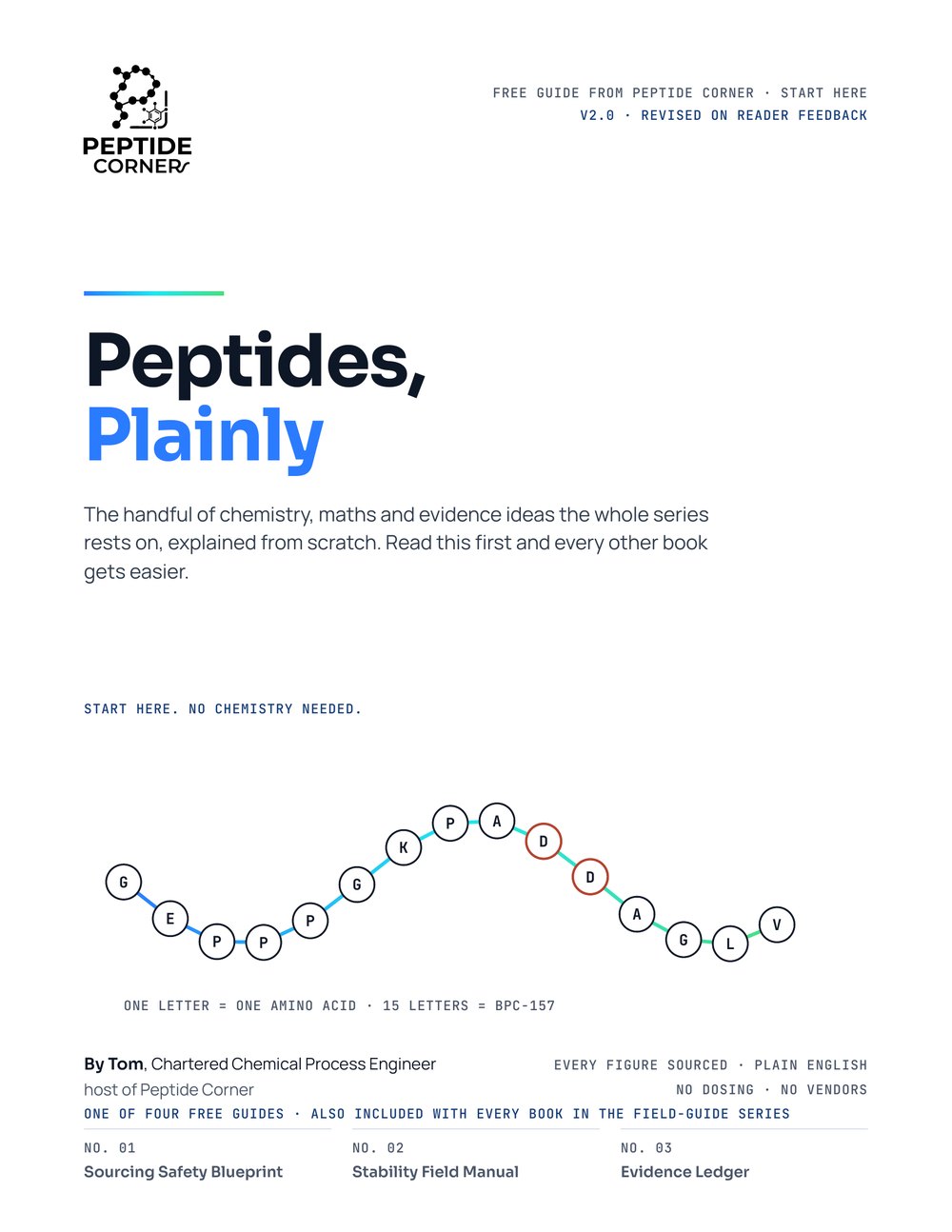
The free beginner’s guide: the chemistry, maths and evidence ideas everything else rests on, explained from scratch. Comes with the other three free guides, for one email.
Get the free guidesThe paperwork
Myth four: the certificate proves what’s in your vial. There’s usually a real lab behind it and a real number, often 99% purity. Check it, and it’s genuine. But that 99% is a share of what one detector could see, in a sample, from a batch. It’s not a test of the vial in your fridge. It’s like a restaurant passing its hygiene inspection, and you deciding that means your plate was checked.
It isn’t even the standard the professionals work to. Under US drug manufacturing rules, even the big regulated drug makers aren’t allowed to just believe a supplier’s certificate. They have to run at least one identity test of their own. If you want to know what a certificate can and can’t tell you, the free COA Quick-Check card is on the free guides page, and spotting a doctored one is in why you are the QA department.
Myth five: research grade means it’s been lab tested. The wording is real. “Research use only” is a genuine regulatory phrase, borrowed from the rules for lab test kits, and it’s right there on the label, so the check passes.
But it’s not a grade at all. It’s a statement about what the product is meant for. In US drug rules, a sterility test is required for each batch that is “purporting to be sterile”. So the test is triggered by the claim, and a label that says “not for human use” isn’t claiming anything. That doesn’t make it legal, because the FDA says the label isn’t a shield. It just means nobody has promised you that test. Where your vial actually came from is the subject of the four ways a peptide gets made.
The regulator and the molecule
Myth six: BPC-157 came off the FDA’s danger list, so it’s been cleared. Here’s what had happened when the video was filmed in October. In April, the FDA took BPC-157 and 11 other peptides off its Category 2 list, its list of ingredients that may raise significant safety risks. Then in July, an FDA advisory committee voted 8 to 6 to recommend BPC-157 for pharmacy use. Look them both up, and they’re both true.
But here’s why it came off that list: the people who had nominated it withdrew the nomination. That’s a bit like your doctor cancelling your follow-up, and you deciding that means you’re cured. And at that July meeting, the FDA’s own scientists recommended against every single peptide on the agenda. The committee’s vote is advice, not approval. What “safe” would actually have to mean is in are peptides safe?
Myth seven: peptides are just amino acids, the same stuff that’s in your steak, so how harmful can they be? Chemically, that’s true. A peptide is a short chain of amino acids. But the order of that chain and its shape are the whole drug. There are two medicines registered in Russia, both built from the same two amino acids, glutamic acid and tryptophan. One is built left-handed, the other as a near-mirror image of it. One is used to stimulate the immune system, and the other is used to suppress it. Saying it’s just amino acids is a bit like saying a novel is just letters.
When the check is you
Myth eight: if you can feel it working, it’s working. I’m not going to tell you it’s all in your head. If your elbow feels better, it really is better. The question is what gets the credit.
Nobody orders anything in a good week. You start in your worst week, and pain at its worst tends to drift back towards normal on its own. And an injection you prepare yourself on a schedule is a much bigger ritual than swallowing a pill with your coffee, and bigger rituals tend to get bigger placebo effects. There’s a tennis elbow trial where the injection group looked brilliant at six weeks, and at a year the people who’d done nothing at all were doing better. Everyone who felt great at six weeks was telling the truth. They just checked too early. How you’d actually find out is in how would you know if your peptide was working?
Why the checking keeps them alive
These eight myths don’t survive because people are gullible. They survive because every one of them passes the check people actually run. The vial really is clear. The 28 days really is in an FDA document. The certificate really did come from a lab, the vote really happened, and you really do feel better.
On a process plant there’s an instrument problem just like this. It’s not the broken gauge, because a broken gauge gets noticed and fixed. It’s the perfectly accurate gauge that somebody has plumbed into the wrong pipe. It reads true, so everyone trusts it, and it’s telling you about something else.
Every person who checks one finds the true half, and goes off and repeats it with more confidence than before. The checking isn’t killing these myths. It’s what keeps them alive.
The bottom line
So here’s the one question that catches all eight: what was that check actually measuring, and on what? Ask it of the clear vial and you get particles, not chemistry. Ask it of the 28 days and you get bacteria, not your peptide. Ask it of feeling better and you get how you feel, not what caused it. And it’ll work on the next one somebody tells you, too.
That question goes double for a certificate.
Had a certificate sent to you? I read them — peptidecorner.net/coa-read
Sources
- US Food and Drug Administration. Inspection of Injectable Products for Visible Particulates, draft guidance for industry, December 2021 — visual detection of a particulate is “a probabilistic process” — https://www.fda.gov/media/154868/download
- Wakankar AA, Borchardt RT. Formulation considerations for proteins susceptible to asparagine deamidation and aspartate isomerization. Journal of Pharmaceutical Sciences, 2006 — https://doi.org/10.1002/jps.20740
- US Centers for Disease Control and Prevention. Multi-dose vials — the 28-day discard rule for opened vials — https://www.cdc.gov/injection-safety/hcp/clinical-safety/multi-dose-vials.html
- Kiese S et al. Shaken, not stirred: mechanical stress testing of an IgG1 antibody. Journal of Pharmaceutical Sciences, 2008 — https://doi.org/10.1002/jps.21328
- 21 CFR 211.84 — testing and approval or rejection of components, including at least one identity test — https://www.ecfr.gov/current/title-21/chapter-I/subchapter-C/part-211/subpart-E/section-211.84
- 21 CFR 211.167 — special testing requirements, for each batch “purporting to be sterile” — https://www.ecfr.gov/current/title-21/chapter-I/subchapter-C/part-211/subpart-I/section-211.167
- US Food and Drug Administration. Distribution of In Vitro Diagnostic Products Labeled for Research Use Only or Investigational Use Only, Federal Register notice, November 2013 — https://www.govinfo.gov/content/pkg/FR-2013-11-25/pdf/2013-28084.pdf
- US Food and Drug Administration. Certain bulk drug substances for use in compounding that may present significant safety risks (the Category 2 page) — BPC-157 listed as nominated but withdrawn — https://www.fda.gov/drugs/human-drug-compounding/certain-bulk-drug-substances-use-compounding-may-present-significant-safety-risks
- US Food and Drug Administration. Briefing document, Pharmacy Compounding Advisory Committee, 23–24 July 2026 — https://www.fda.gov/media/193342/download
- RAPS. FDA advisory committee backs two controversial peptides, July 2026 — https://www.raps.org/resource/fda-advisory-committee-backs-two-controversial-peptides.html
- Deigin V et al. Review of the first chiral peptide pharmaceuticals with reciprocal immune activity. International Journal of Molecular Sciences, 2024 — https://doi.org/10.3390/ijms25095042
- Bisset L et al. Mobilisation with movement and exercise, corticosteroid injection, or wait and see for tennis elbow: randomised trial. BMJ, 2006 — https://doi.org/10.1136/bmj.38961.584653.AE
- de Craen AJ et al. Placebo effect in the acute treatment of migraine: subcutaneous placebos are better than oral placebos. Journal of Neurology, 2000 — https://doi.org/10.1007/s004150050560
Educational and research purposes only — not medical advice. Peptide Corner does not recommend any vendor, source, or dose. Keep safe, keep skeptical.

Your Peptide Looks Fine. That Proves Absolutely Nothing.
Cloudy, floaters, colour, smell — the four checks everyone runs. What visual inspection can and cannot detect, according to the people who do it professionally.
Are Peptides Safe? “Safe” Is a Measurement, Not a Property
Ask whether peptides are safe and you get a shrug, a sales pitch, or a lecture. The reason is that the question is really four questions with four different answers, and only one of them comes back reassuring. Here is what the word costs to earn, and how far short the evidence falls.

Your Peptide Came From One of Four Places. Ask Which.
Four systems can produce or handle a peptide. Each leaves a different paper trail, and one is built to leave nothing to check.