
How to Read a Peptide COA Like an Engineer
A Certificate of Analysis is supposed to prove what’s in the vial. Most buyers can’t tell a real one from a convincing fake — so here’s the exact read I run, in the order I run it.
In this article ▾

This is the written version of Is Your Peptide Lab Report Fake? The COA Gives It Away — watch it instead if you’d rather.
In a regulated pharmacy, a whole quality department stands between a raw batch and the person using it. In the peptide gray market, that department is you. The good news: the checks aren't mystical. They're the same evidence-and-verification habits any process engineer uses, and once you know what you're looking at, most fakes fall apart fast.
A Certificate of Analysis (COA) is the lab report a batch is supposed to come with. Done properly, it tells you what the material is, how pure it is, and who tested it. Done badly — or forged — it's a reassuring-looking PDF and nothing more. Here's how to tell the difference.
1. Start with the two numbers that matter
A COA can be dense, but for a peptide two figures carry most of the weight: the identity/mass confirmation (usually by mass spectrometry — is this actually the molecule it claims to be?) and the purity (usually by HPLC — how much of what's in there is the target compound versus everything else).
Here's the catch people miss: purity and quantity are not the same thing. A vial can be 99% pure and still be under-filled — 99% of not-very-much. Purity tells you what fraction of the contents is the right molecule; it says nothing about whether you got the amount on the label. Read the identity result first (is it even the right thing?), then purity, and keep the two ideas separate in your head.
2. Check who did the testing — and whether they exist
A real COA names the testing lab. That's a claim you can verify. Independent third-party labs are traceable: they have a real presence, and reputable ones will confirm whether a report number came from them. A vendor's own "in-house" certificate is not the same thing as independent testing — treat it as marketing until proven otherwise.
The single highest-value move on the whole page is this: take the report/batch number and verify it directly with the named lab. A forger can rebuild a PDF pixel-perfect. What they can't fake is the lab's own record of that report. This one step beats any Photoshop job.
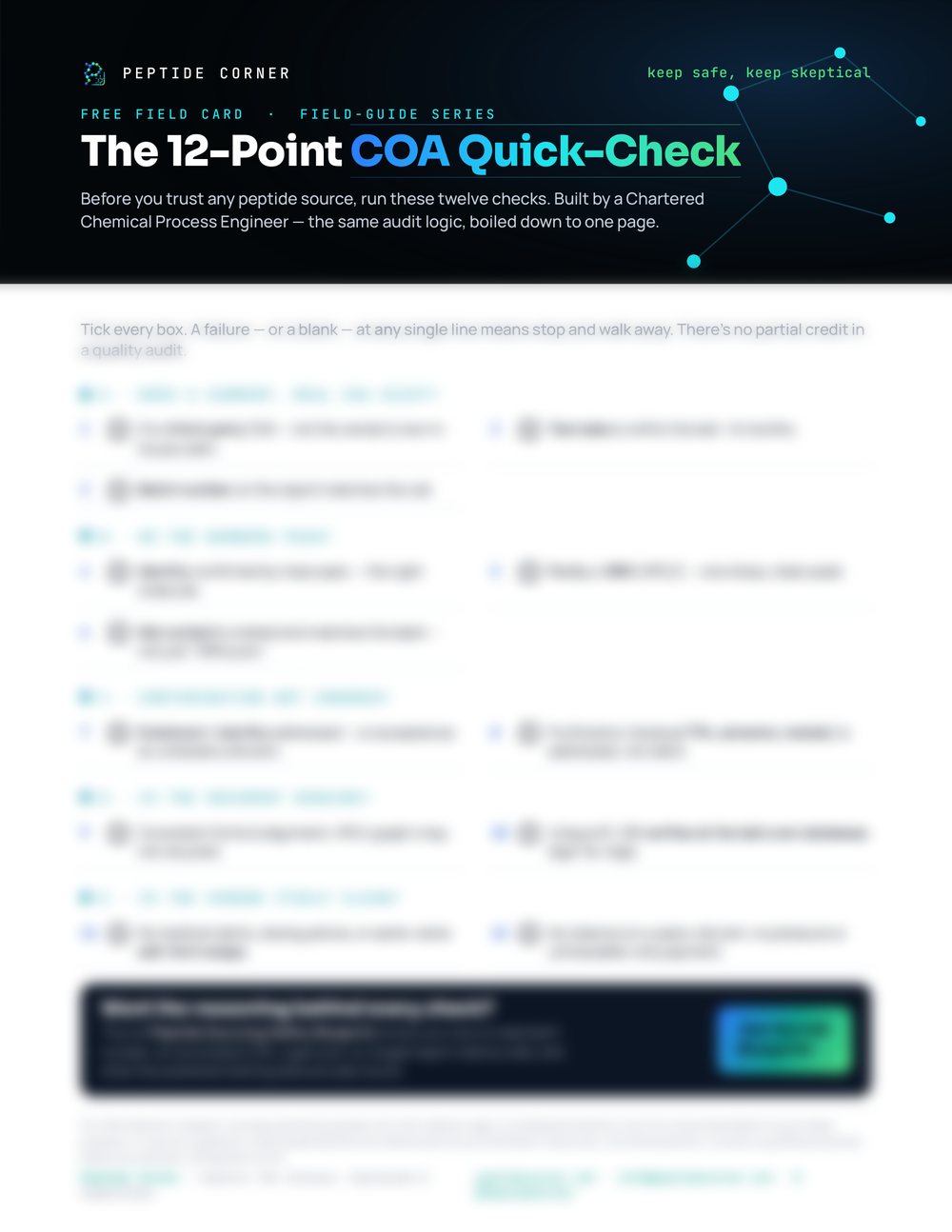
Twelve checks in the order I’d run them on any lab report, and one Pass / Ask / Stop rule. Printable, front and back. Comes with the other three free guides, for one email.
Get the free guides3. Read the document like a forgery examiner
Before you even trust the numbers, audit the paper. The common tells:
- Recycled graphs. The same HPLC or mass-spec trace showing up across different "batches" is a giant red flag — real chromatograms are batch-specific and never identical.
- The "old certificate" date scam. A report dated long before the batch you're being offered means the data doesn't describe your material. Match the dates.
- Mismatched identifiers. Batch numbers on the COA that don't match the product, or fonts/alignment that shift mid-document, point to a cut-and-paste job.
- Round, too-perfect numbers. Real analytical results are messy. Suspiciously clean figures deserve suspicion.
4. Audit the vendor's behaviour, not just the paper
Sometimes you can walk away before you ever open the lab report. Manufactured urgency ("last batch, prices rising"), medical-style claims about what the compound will do for you, and any reluctance to provide a verifiable, batch-matched COA are all reasons to stop. A source confident in its material makes verification easy, not awkward.
Trusting an anonymous forum post is a "trust me, bro" review. A verifiable report number is evidence. Learn to want the second one.
Put it on one card
That's the whole method: read identity and purity as separate facts, verify the lab and the report number at the source, audit the document for forgery tells, and read the vendor's behaviour. Run it every time and you've replaced "I hope this is legit" with an actual process.
I turned this into a print-and-tick field card — the 12-Point COA Quick-Check — so you can run the audit without re-reading this. It's free.
Had a certificate sent to you? I read them — peptidecorner.net/coa-read
Sources
- U.S. FDA, Compounding and the FD&C Act — section 503A bulk drug substances — https://www.fda.gov/drugs/human-drug-compounding/bulk-drug-substances-nominated-use-compounding-under-section-503a-federal-food-drug-and-cosmetic-act
- Ashraf et al., Quality of semaglutide products purchased from unlicensed online sellers, JMIR, 2024 — https://www.jmir.org/2024/1/e65440
- U.S. Pharmacopeia, General Chapter <85> Bacterial Endotoxins Test — https://www.usp.org/harmonization-standards/pdg/general-methods/bacterial-endotoxins-test
Educational and research purposes only — not medical advice. Peptide Corner does not recommend any vendor, source, or dose. Keep safe, keep skeptical.

Why the Peptide Gray Market Makes You the QA Department
“Research use only” is not a quality standard — it is the mechanism that moves the entire quality function from an inspected factory onto the buyer.
The FDA Peptide Vote, Explained: What PCAC Actually Decided on 23–24 July 2026
The FDA's compounding advisory committee backed six of seven peptides on 23–24 July 2026 — against its own reviewers. Here is what that vote does, and what it very much does not do.