
I followed one dollar spent on a peptide. Almost none of it reached the peptide.
In process engineering, everything that goes in has to come out somewhere. So I ran a mass balance on one dollar spent on a peptide, tagged every share with a source, and wrote “no data” wherever nobody publishes a number. Then I filled in my own tag too.
In this article ▾
This is the written version of Who Gets Paid When You Buy A Peptide? Follow The Dollar — watch it instead if you’d rather.
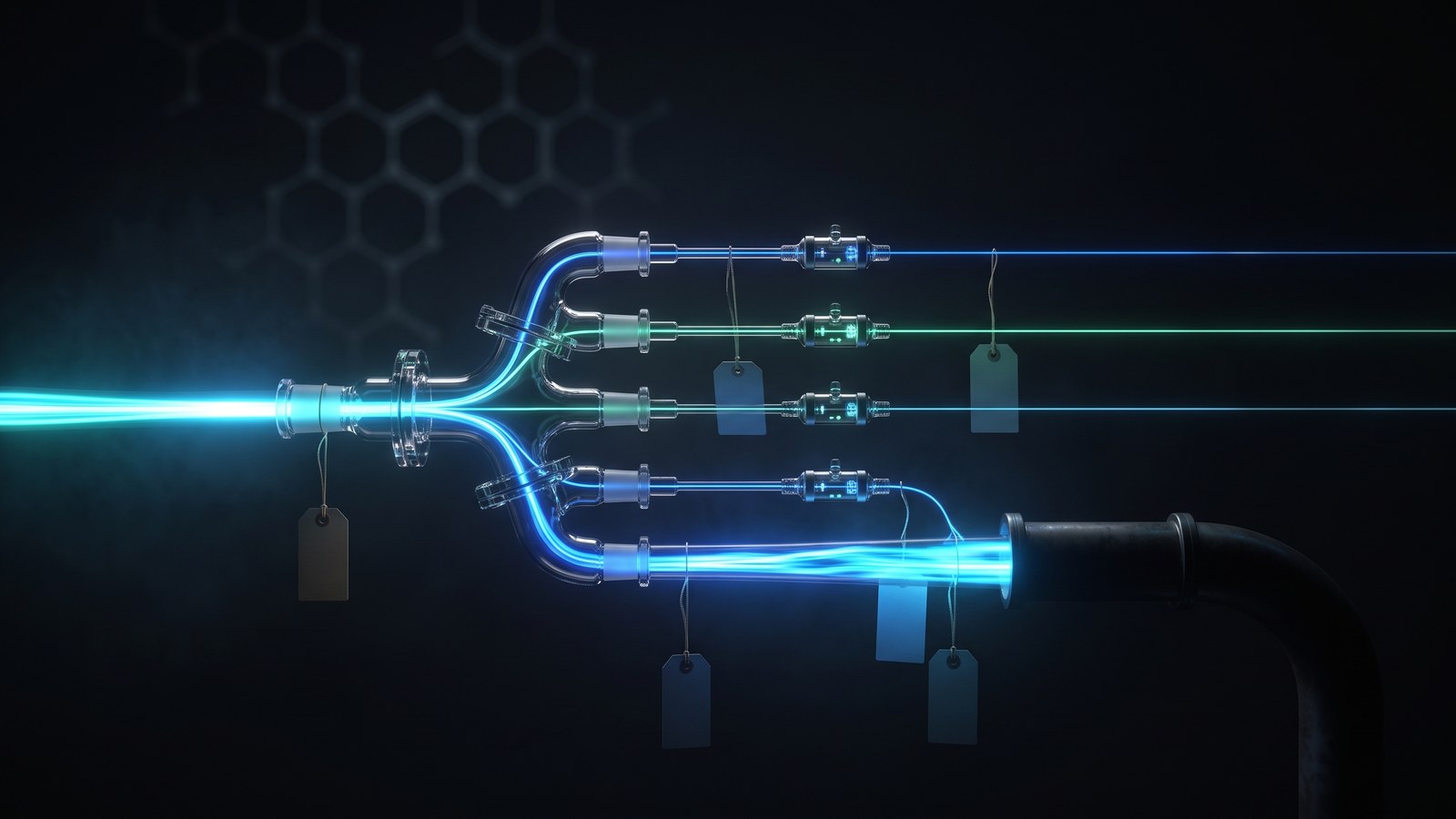
Picture a peptide vial with five blank tags tied around its neck. Each tag is somebody who got paid when you bought it. In my job there’s something called a mass balance: everything that goes into a process has to come out somewhere, and you account for every bit of it. So I ran one on a single dollar spent on a peptide.
By the end you’ll know how little of that dollar goes anywhere near the peptide, and who gets paid when somebody tells you it works. I’ll fill in my own tag as well.
The rule for this mass balance
Most people assume a peptide costs a lot because the peptide itself is expensive to make. It’s the same logic that makes a $40 bottle of wine taste better than a $10 one, and it’s a fair instinct. So I set one rule: every tag needs a number with a source I can show you, and if there’s no source, I say so. I don’t name a single seller, creator or discount code anywhere in this piece, either.
The best example right now is semaglutide, the peptide in Ozempic, because both the cost of making it and the price online have been measured. Researchers writing in the Annals of Pharmacotherapy priced it on 40 websites selling it “for research”, and the average vial came to $181. That’s the money we’re following.
Tag one: the powder
This is the tag that nearly knocked me off my chair. A Reuters investigation went through customs and trade records for licensed drug companies buying semaglutide powder from a supplier in China. One buyer was paying roughly $109 a gram, and the other closer to $900 a gram.
There’s only a tiny amount of powder in one vial, so at those prices the peptide in that $181 vial is worth somewhere between about 55 cents and $4.50. That’s my arithmetic on published numbers, not a measurement of anybody’s vial. But it puts the peptide at between about a third of a cent and 2.5 cents of your dollar.
And those were licensed companies buying the real thing. What a grey-market seller pays for its powder, nobody publishes. Why cheap peptides are cheap is a separate story, and I’ve written it up in how a peptide is actually made, and where the shortcuts are.
Twelve checks in the order I’d run them on any lab report, and one Pass / Ask / Stop rule. Printable, front and back. Comes with the other three free guides, for one email.
Get the free guidesTag two: the glass, the stopper and the filling
It looks like the expensive bit, but it’s basically a very small jam jar with a fancy lid. A cost model published in JAMA Network Open allows about 25 to 41 cents a vial for all of it in big licensed factories. Freeze-drying small batches costs more, but nobody publishes by how much. Even so, it’s under a quarter of a cent of your dollar.
To be fair to the sellers
That same JAMA study worked out that a month of the approved weekly injection could be made and sold, profit included, for between 89 cents and $4.73. The US list price is many times that, so making it is under 1 cent of every list-price dollar. It turns out the big drug companies’ dollar isn’t the molecule either.
So a markup on its own doesn’t prove anybody’s ripping you off. The difference is that in the approved world you can see what some of the rest buys. The trials get published, the factory gets inspected, and side effects get reported. In the grey market, nobody has to tell you where the rest goes.
Tag three: the test, the cheapest tag of all
The tag that tells you the most about your vial is the cheapest one. Testing means somebody checking that what’s in the vial is what’s on the label. A university core lab in Kansas charges a company customer $236 to run one sample through HPLC, the standard purity test. Spread across a batch of a few hundred vials (my assumption on batch size), that’s under a dollar a vial, or less than half a cent of your dollar.
So the one tag that actually protects you is the cheapest, and it’s the one most likely to be blank, because nothing forces anybody to fill it in. The certificate in your inbox is just the seller saying they did it, a bit like a restaurant writing up its own hygiene inspection. When I run due diligence on suppliers, a certificate they wrote themselves is where my questions start, not where they stop. I’ve covered what to look for in how a fake lab report gives itself away.
The tag that protects you is the cheapest one on the vial, and the one most likely to be left blank.
Tag four: getting it to you
Shipping is usually charged on top, and what customs seizures cost these sellers, nobody publishes. So the part of this tag I can actually measure is the payment. If you pay by card, a shop normally hands 1.5 to 3.5 cents of every dollar to the card companies, according to the Federal Reserve Bank of Richmond.
A study of online semaglutide sellers in the Journal of Medical Internet Research found some offering 5% off if you paid in crypto, and some asking buyers to mark a PayPal payment as “friends and family”. PayPal’s own rules say you’re not meant to pay for goods that way.
Tag five: by difference
Add up everything I can put a sourced number on — the powder, the glass, the test and the card fees — and it comes to somewhere between about 2 and 7 cents of your dollar. That means at least 93 cents of every dollar you spend on that vial goes somewhere I can’t see from the outside.
In a mass balance, when there’s a stream you can’t measure, you work it out by difference, and you write “by difference” next to it so nobody mistakes it for a measurement. So this tag is rent, staff, packages that go missing, profit and marketing, and nobody publishes the split. It’s basically everything on the receipt except the thing you actually bought.
But one part of it you can see from the outside: the part that talks to you. A study presented this year, published as a conference abstract in the Orthopaedic Journal of Sports Medicine, looked at 239 of the most popular peptide posts across five social media platforms. About 31% linked straight to unregulated sellers. Only 12.5% mentioned a single side effect. I guess the side effects didn’t fit in the caption.
The FTC’s guidance in the US is pretty clear: if you’re paid through a link, you’re meant to say so, in the video and next to the link. But even the FTC says a personal discount code only “probably” tells you there’s a relationship, and whether it tells you there’s money involved is “less clear”. And the commission itself? I can’t give you an independent number. The only places those rates get published are sellers’ own sign-up pages, written for the people being recruited, not for you.
My own tag
It’s only fair I fill in mine. I take no money from anybody who sells peptides: no sponsor, affiliate deal, commission or discount code from anyone in the peptide trade, and nothing of mine comes in a vial.
This channel does make money, though, and here’s exactly how. It’s the guides I write, and the COA Read, where I go through a seller’s certificate for you. As the channel grows there will be YouTube’s own ads, and maybe one day sponsors and affiliate deals — but only from companies that don’t sell peptides, and only for something I use myself and genuinely love. None of those pays me a cent more because you bought a particular vial, so when I point you at one of them, you’ll know whose tag it is. It’s mine.
Who gets paid when you use a discount code?
Picture a code on your screen, 10% off. Most people think that 10% comes out of the seller’s profit as a favour to you. But think about it like a mass balance. Before you ever typed that code in, the seller had already decided it could give 10% away and still pay the person who gave you the code. Both of those were already sitting in the price.
So that code isn’t really a discount. It’s a tracking number. It’s how the seller knows who to pay, and that person gets paid out of your dollar.
The bottom line
Most of what you pay for a peptide never goes near the peptide. The powder, the glass and the test come to a few cents. More than 90 cents goes into the one tag nobody publishes, and the part of it you can see is the part that pays people to tell you it works. So the next time somebody tells you it works, ask which tag they’re on. It’s my first due-diligence question: who’s paying whom?
And the tag I’d actually want to see filled in is the cheapest one, the test. Before any of this money moves, it’s also worth knowing which of the four places your vial came from.
Had a certificate sent to you? I read them — peptidecorner.net/coa-read
Sources
- Barber MJ et al. Estimated sustainable cost-based prices for diabetes medicines. JAMA Network Open, 2024 — vial, stopper and fill costs at licensed scale, and the cost-based price of approved semaglutide — https://doi.org/10.1001/jamanetworkopen.2024.3474
- University of Kansas Medical Center, Mass Spectrometry & Proteomics Core — fee schedule, HPLC with UV detection, price per sample for company customers — https://www.kumc.edu/research/mass-spectrometryproteomics-core-laboratory/services-and-equipment/fee-schedule.html
- Federal Reserve Bank of Richmond, Econ Focus — Should Credit Card Fees Be Regulated? (merchant fees of 1.5% to 3.5% per transaction) — https://www.richmondfed.org/publications/research/econ_focus/2025/q4_policy_update
- PayPal User Agreement (US) — personal payments are not for buying goods or services — https://www.paypal.com/us/legalhub/paypal/useragreement-full
- US Federal Trade Commission — FTC’s Endorsement Guides: What People Are Asking (paid links, and what a personal discount code does and doesn’t tell you) — https://consumer.ftc.gov/business-guidance/resources/ftcs-endorsement-guides-what-people-are-asking
Educational and research purposes only — not medical advice. Peptide Corner does not recommend any vendor, source, or dose. Keep safe, keep skeptical.


The Decision Behind Every Purity Number
A peptide is assembled one amino acid at a time, and the yields multiply rather than add. What happens next, on the purification column, is the decision that actually sets the purity number.

Your Peptide Came From One of Four Places. Ask Which.
Four systems can produce or handle a peptide. Each leaves a different paper trail, and one is built to leave nothing to check.
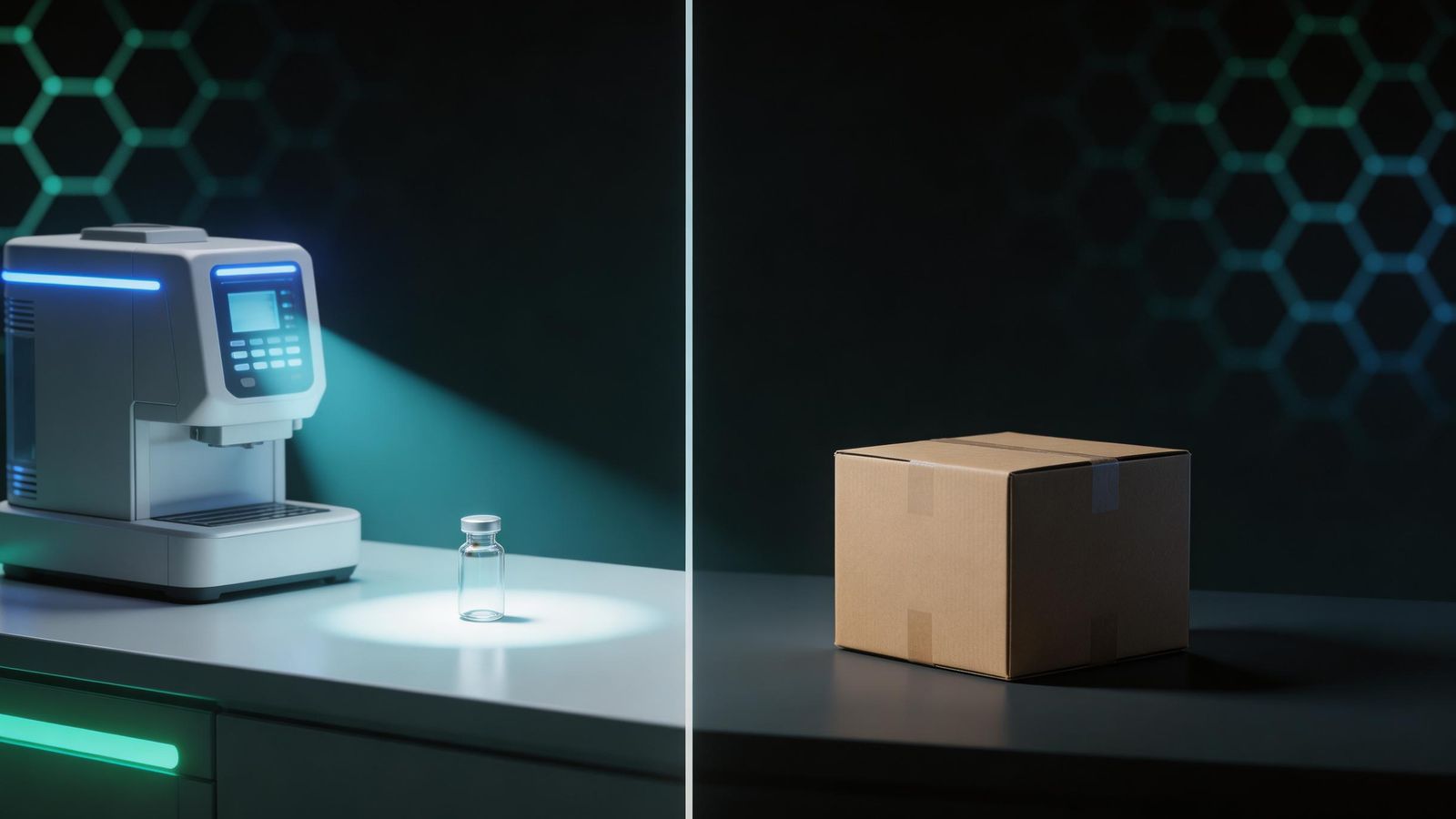
Why the Peptide Gray Market Makes You the QA Department
“Research use only” is not a quality standard — it is the mechanism that moves the entire quality function from an inspected factory onto the buyer.