49 pages that turn a Certificate of Analysis from an intimidating PDF into something you can check line by line in a few minutes — with one Pass / Ask / Stop rule for every line on the page.
Instant PDF · pay once, keep forever · 30-day money-back guarantee
Not “understand the importance of quality”. Actually do it — open a report, work through it, and reach a decision you can defend.

One box in thousands, and the only thing that speaks for it is the document that came with it. That document is what the Blueprint teaches you to read.
Four of the 49 pages, straight out of the PDF. No mock-ups, no stock photos of test tubes.
Part 05 — a specimen Certificate of Analysis, annotated line by line
Part 07 — the same report, genuine and forged, side by side
Part 02 — what 6,441 tested samples actually showed
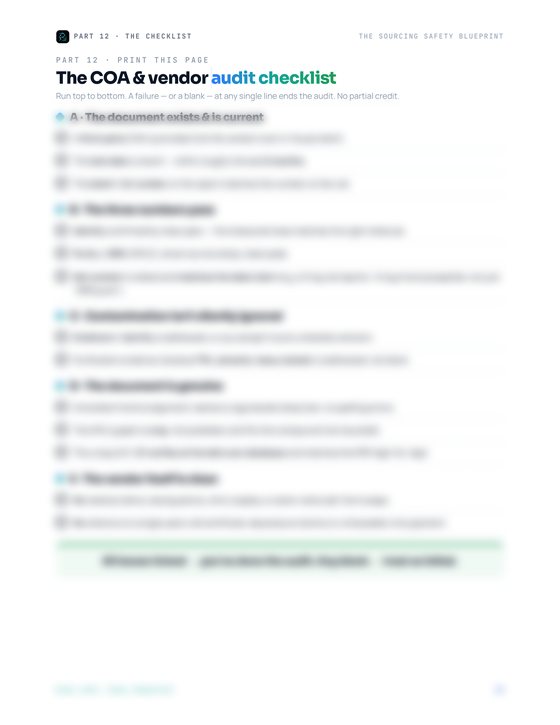
Part 12 — the audit checklist, built to print
12 parts, in the order you’d actually run an audit — the market first, the risks second, the data that rules them out third, how that data gets faked fourth.
Why the quality-control job landed on you, and what the published testing found across 6,441 samples. The answer is more interesting than either the hype or the scare stories.
The six ways a vial goes wrong, and the three questions a lab report has to answer. Name them and a COA suddenly has a job to do.
A full specimen certificate annotated line by line — plus the tests a pharmaceutical release runs that a gray-market report quietly skips, each with what a good result looks like.
The same report, unaltered and altered, side by side with every tell marked, then the 3-step drill for verifying a document at the lab instead of taking the seller’s word.
Why a genuine COA still has a hidden expiry date, and the seller-side red flags that end an audit before you open a single PDF.
The 2026 regulatory picture in plain English, then the whole audit as a checklist built to print and tick.
Every future edition is included free, for life — I revise whenever the evidence moves.
The card is the twelve checks. The Blueprint is everything behind them — the reasoning, the worked examples, and the parts a checklist has no room for.
| The COA Quick-Check Free · front and back | The Sourcing Safety Blueprint $17 USD · 49 pages | |
|---|---|---|
| What it is | A checklist you tick. | The manual that teaches you to read one. |
| The 12 checks | All twelve, in order, with one Pass / Ask / Stop rule. | All twelve, plus why each one works and what it misses. |
| Reading an actual COA | — | A full specimen certificate, annotated line by line. |
| Spotting a forgery | Names the tells. | A genuine and a faked report side by side, every tell marked. |
| Verifying a document | Says to verify it. | The 3-step drill for checking a report at the lab, not the seller. |
| What testing found | — | What 6,441 tested samples actually showed, with citations. |
| Contamination | Flags it. | The tests a real release runs that gray-market skips, and why purity is blind to them. |
| Storage & degradation | — | Why a genuine COA still has a hidden expiry date. |
| Vendor red flags | Two lines. | A full section — the scams that end an audit before you open a PDF. |
| Best for | Keeping next to you when a COA lands. | Actually understanding what you're looking at. |
Swipe the table sideways to see both columns.
Yes, and that’s deliberate. If you want the groundwork first, start with Peptides, Plainly, the free beginner’s guide — it’s free, and it also comes inside the download. The Blueprint itself opens with a plain-English “New here? Read this first”, defines every bit of jargon the moment it turns up and has a glossary at the back. And if you go on to the Stability Field Manual, its Part 00A, “The chemistry you need”, starts from zero. You need to be able to read a table, which you can.
A 49-page illustrated PDF, 12 parts, delivered by Gumroad the second you check out, with the COA Quick-Check card and Peptides, Plainly, the free beginner’s guide, in the same download. Read it on anything, print the checklist, keep it forever. Every future edition is included free, for life — I revise whenever the evidence moves.
No. The card is a checklist — it tells you what to look at. The Blueprint shows you an actual report pulled apart section by section, puts a genuine one next to a forged one with every tell marked, walks through verifying a document at the lab itself, and covers the things a card physically can’t: what the tested data found, contamination a purity number can’t see, and why a real COA still expires. The comparison table above lays it out line by line.
No, and it never will. That’s a hard line across everything I make. It teaches you to evaluate a source and a lab report yourself, which is more useful than a recommendation anyway — recommendations go stale, a method doesn’t.
Email support@peptidecorner.net within 30 days and I’ll refund you. No form to fill in, no explanation needed.
Because I’d rather it was in a lot of hands than a few, and because this channel lives or dies on being trusted rather than on what I can charge. It also does one job. The two bigger books in the series are $37 and $49 because they took months of reading rather than weeks. Every price on this site is in US dollars.
30-day money-back guarantee · instant download · or get all three books for $79 USD
Bought it and stuck on something? support@peptidecorner.net.