Whoever sold you your peptide emailed you a Certificate of Analysis. It is sitting in your inbox right now — a technical document written for somebody else, because the laboratory’s client is the seller, not you. And then you were left to interpret it alone.
So you do what anyone would do. You find the biggest number, see that it is high, and stop. The trouble is that the four things people assume that number covers are four different measurements — and most certificates in this market establish one or two of them at most.
Send it to me and I will tell you, in plain English, exactly what your document establishes, exactly what it leaves open, and the precise questions to put back to the person who sold it to you.
Read and signed by a Chartered Chemical Process Engineer · 5 business days · The Peptide Evidence Ledger ($49 USD) included free · one certificate, one vial, one batch, one report
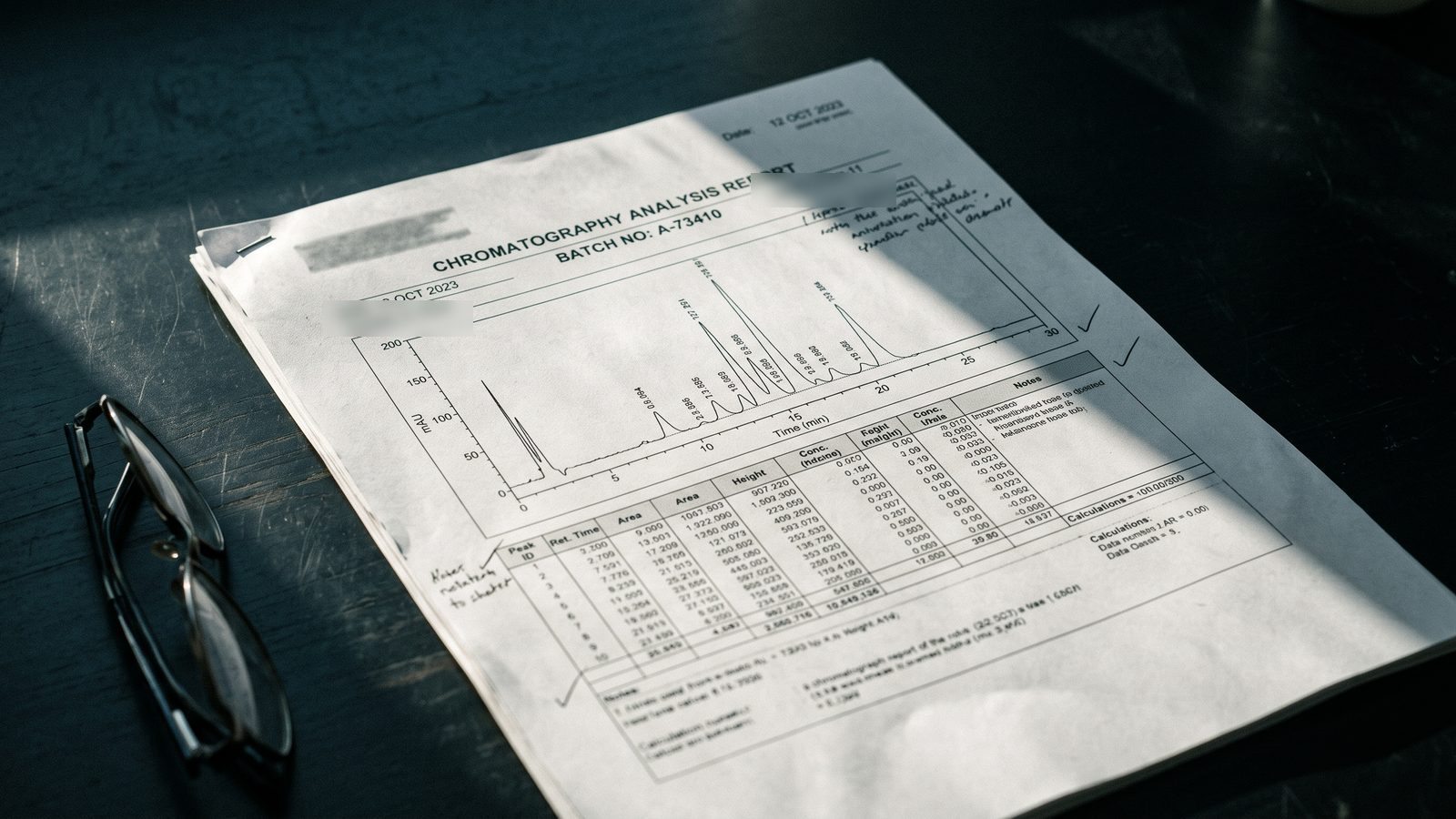
These get collapsed into one word — “pure” — and that single confusion is responsible for more misplaced confidence in this market than anything else. They are four separate questions, answered by four separate methods, and a certificate can answer any combination of them.
Of everything the detector saw, what proportion was one peak? Says nothing about which molecule that peak is — and nothing at all about anything the detector cannot see.
Is the molecule in the vial the molecule on the label? This needs mass spectrometry or sequencing. A retention time and a UV match are consistent with the right molecule. They do not establish it.
How many milligrams are actually in your container? Only answered if the whole vial was dissolved and assayed — not if a weighed scoop of powder was tested.
Two more separate tests again. “Not detected” is not a result until you know the limit it was not detected at, and those limits vary by orders of magnitude.
Not a verdict. Something more useful than a verdict: you will understand your own document, and you will be holding the exact questions that make a seller either produce evidence or go quiet.
Both outcomes tell you something. That is the whole point — you stop depending on anybody’s reassurance, including mine, because you can see what the paper does and does not carry.

This matters more here than on anything else I sell. A book is judged by what is in it. A signed opinion is judged by who signed it.
Chartered Chemical Process Engineer. Chartered Engineer is the United Kingdom’s registered professional engineering title. It is awarded by the Engineering Council, protected under Royal Charter, and has to be maintained. If you are in the States, the closest thing you already know is a licensed Professional Engineer.
For the first decade of my career I did the hands-on technical work — process and systems modelling, dynamic and steady-state simulation, CFD, mostly on oil and gas projects. Reading analytical data and picking holes in it was the job. These days I work on the commercial side, turning around engineering projects that have gone wrong, which is mostly the same skill applied to why something was signed off when it should not have been.
I am not a doctor, a pharmacist or a clinician, and nothing I write is medical advice. What I am is someone who has spent a career deciding whether a document actually supports the claim written on the front of it.
A certificate of analysis is not a medical document. It is a quality-control document — the same species as the material certificates, calibration records and batch releases that engineering runs on.
So the questions it turns on are engineering questions:
Those are not questions a clinician is trained to ask, and they are not questions the internet can answer for you. They are the questions I have been paid to ask for years — about documents that mattered a great deal more than a vial.
All of these came off documents people were sent with an order — and every one was invisible to the person holding it. No seller and no laboratory is named here, or anywhere in your report.
The summary page said >99.8%. The attached peak table, from the same run, said 100.000%. One is a reporting convention — a floor the lab is willing to certify. The other is what the integrator actually returned. They are not the same claim.
Buried in an attachment: “Force through Zero: Disabled”, with a negative intercept. That offset adds to every result rather than scattering either side of it — and on that certificate it was worth about 2.5% of the reported content, in the vial’s favour.
A detailed, competent, honest-looking document — with nothing anywhere in it that establishes identity. Identity is the one thing nearly everybody assumes a certificate proves.
The same certificate carried two endotoxin limits and reported against the looser one. “Not detected” is meaningless until you know what it was not detected at.
Sampled in August, published days later, read by the buyer roughly twelve months on. The certificate describes a moment. Whether it still describes your vial is a separate question, and the answer is on the paper if you know where to look.
Two certificates I read came from the same laboratory in the same week and produced materially different reports. These are not interchangeable. Yours is read as your document, not against a template.

One numbered PDF, written for you, signed. It leads with the plain-English summary and the questions — because that is what you actually need — and puts the working behind it, so you can check any of it.
First page, no jargon. What your document is, what it establishes, what it does not, and the single thing on it most worth knowing. If you read nothing else, you have had your money’s worth.
Second. A short numbered list, written to be forwarded as-is. Specific, answerable, and impossible to fob off with “it’s third-party tested”.
Every claim on your certificate tested against what the stated method can actually support. The arithmetic re-derived. Internal inconsistencies named. Absences called absences rather than defects.
What that specific molecule is vulnerable to inside a vial — deamidation, oxidation, hydrolysis, aggregation — derived from its published amino-acid sequence, with the rule set shown so you can follow it.
What the human evidence for your compound actually amounts to, graded A to E on the same scale as the Evidence Ledger, with citations you can look up.
The $49 USD book — 114 pages, 45 compounds graded A to E with 288 citations — lands in your account the moment you order, so you have something substantial to read while your report is written.
Four steps. Nothing to install, no account to create, no portal to log into.
Checkout takes about a minute. The Evidence Ledger is in your account immediately.
Email it to coa@peptidecorner.net. Best is the seller’s original PDF, forwarded exactly as it arrived — just hit forward. A clear phone photo works too: one page per photo, normal camera mode.
You get your order reference and the date your report is due. If you do not hear from me, it did not arrive — send it again.
One email, PDF attached, numbered and signed, within 5 business days of me confirming your certificate is readable. Save it somewhere — it is written for you and nobody else has a copy but me.
Most people start with one. If you hold several vials from several orders, the multi-read packs also get you something a single read structurally cannot: a section comparing your documents against each other. And any of them can be put on a 48-hour clock.
$149 USD per read
$126 USD per read · save 15%
$115 USD per read · save 23%
per read, not per order
Ask for it in the same email — I send the link once I have your certificate.
On a three- or five-read pack you can put one read on the fast track and leave the rest at the normal pace. It is priced per read precisely so you are never paying up front for urgency you might not need.
Yes. Email coa@peptidecorner.net and ask for the sample, and I will send you a full redacted report built from a real certificate — the same thing you would receive, with the compound and the batch changed. There is no money-back guarantee on this, so it is only fair you get to see what you are buying first.
No — the certificate is the whole input. Ask whoever sold you the vial for the Certificate of Analysis for your batch number; in this market it is almost always free and usually already in your order confirmation email. If they will not produce one, you have learned something for nothing.
No. Your seller is never contacted, never named in your report, and never sees anything. The report is written for you and is yours to do whatever you like with — including forwarding it, which is why it names nobody.
Then that is the finding, and it is a valuable one. A one-page document with a percentage and no method is telling you something very specific, and the report says exactly what. So no, I do not refund for a thin certificate — reading it properly is the work. What I do refund in full is a job I decline to take. If what you send is not a certificate at all — an invoice, a vial label, a screenshot of a listing — or it is in a language I cannot read, I hand it back and you get your money back, or your credit back unused. That is not a guarantee, it is me not taking work I cannot do.
coa@peptidecorner.net for anything to do with a COA Read — sending a certificate, chasing one, asking about your report. It comes straight to me. The other two addresses on this site are for general questions and for the books.
The seller’s original PDF, forwarded exactly as it arrived. That is always the best version — nothing is lost to a camera, the attached data pages come with it, and the text stays selectable, which matters for the parts of a certificate printed small. A clear phone photo is a perfectly good second best: normal camera mode, one page per photo, flat on a table, square-on. If your file is over 15 MB, send the original PDF rather than photos. And if you do not get a reply within one business day, it did not arrive — just send it again.
When I confirm your certificate is readable, not when you pay. I confirm within one business day, and the report follows within 5 business days of that. If something is illegible I will tell you straight away rather than let the days run down.
There is no money-back guarantee on this, and I would rather say so on this page than bury it — once I have read your certificate the work exists and cannot be un-done. What I do instead: tell me within 30 days of getting it and I will read it again from scratch, free. I hold your certificate for 60 days, and the re-read window is the first 30 of those — so there is always a copy to work from, and I never delete one while a re-read is open.
I keep it while I am working on your report and for a short window afterwards in case you want it read again, and I delete it within 60 days of issuing your report. I keep the report itself, because it is my record of the work — and it names no seller, no laboratory and nobody at all.
It depends on whether they are in the same vial.
One vial containing two molecules — a blend — is ONE read. If you bought a combined vial and it came with a single certificate covering what is in it, that is one product, one batch and one read at $149 USD. You still get both sequence profiles and both evidence grades in the same report, because that is what is in your vial.
Two separate vials on one combined certificate is TWO reads. A seller who tests several products and puts them all on one PDF has sent you several documents stapled together. Two vials means two batch numbers, two sets of findings and two sets of questions to ask — so it is priced as two.
The same logic applies to batches: one compound across two batch numbers is two reads, because the batch number is the only thing tying any certificate to any particular vial.
If you are not sure which you have, just send it. I will tell you before I start, and before anything else is charged.
The research and the first draft are machine-assisted. I will not pretend otherwise, because the honest answer is more reassuring than the marketing one: what you are paying for is the judgement and the signature. I read your certificate and I read the report myself before either goes anywhere, I change what needs changing, I am accountable for every word of it, and the review is logged against the report’s number. Nothing goes out that I have not been through. What I will never claim is that a machine is the equivalent of a qualified engineer — that is exactly the claim this whole page exists to argue against.
They answer different questions, so yes — but be clear about which is which. A laboratory test measures your vial. This reads your paperwork. If you have had a test done, send the certificate anyway: comparing what the seller’s document claims against what an independent test found is one of the more interesting reads there is.
Signed by a Chartered Chemical Process Engineer · 5 business days · or start with the books for $79 USD