Every compound has a confident paragraph written about it somewhere. Almost none of those paragraphs tell you how good the underlying evidence is. This book grades 45 of them A to E on the strength of the human evidence — and prints the citations so you can check any grade yourself.
Instant download · pay once, keep forever · every future edition free · 30-day money-back guarantee
Grades change as trials report. The method doesn’t. Part 1 teaches you to read a study the way somebody who reviews evidence for a living reads one — and once you can do that, every claim you meet afterwards gets easier to judge, including mine.
A grade of E doesn’t mean a compound does nothing. It means nobody has shown that it does. These describe evidence strength, not safety, and they are not recommendations.
Replicated, adequately powered, controlled trials in people.
9 of 45Real human studies, but small, uncontrolled or the powered version failed.
11 of 45A genuine preclinical literature, no usable human efficacy data.
9 of 45Cell culture, receptor pharmacology, or a biochemical surrogate.
10 of 45No usable evidence for the claims — or a base that collapses on inspection.
6 of 45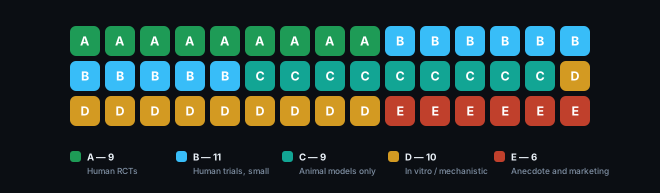

All five are in the book with the citations attached, and all five took reading the papers rather than reading the summaries.
One compound’s phase II trials are referenced in dozens of papers. Every one of those citations is self-referential. The only public description sits in a regulator’s briefing document, not the literature.
The most-cited papers showing it works in men are retracted or under formal expression of concern. Strip them out and that half of the evidence base is empty — while the other half earned an FDA approval.
One popular longevity peptide has never been administered to a person in the published literature. Not once. It has been in the popular longevity press as established since 2001.
Sold as the more natural alternative to growth hormone — and beaten by it head-to-head in randomised children before being withdrawn. A narrow regulatory finding is now quoted as an endorsement.
Only nine compounds rest on replicated randomised human trials. Twenty-five are graded C or below — animal work, cell culture, or nothing usable for what they’re actually sold for.
Every entry answers “what was not shown”. A surrogate is not an outcome, a diseased population is not a healthy one, and an injected rat is not an oral human. That section is the reason the book is worth money.
A reference book, a way to search it, and a card for the wall.
114 pages, 45 compounds in alphabetical order with a printed thumb index, 288 citations. Every entry answers the same five questions, so you can compare any two compounds directly.
An offline web page holding every word of all 45 entries. Search them all at once — try retracted, primary endpoint or WADA and see what surfaces. Filter by grade or class. Nothing installs, nothing uploads.
Two printable pages: all 45 grades on the front, the questions to ask of any study on the back. The thing you’ll actually glance at when somebody mentions a compound.
45 of them, chosen as the ones people actually ask about: the incretins and metabolic compounds, the healing and repair peptides, growth hormone secretagogues, longevity and mitochondrial compounds, melanocortins, and several that turn out not to be peptides at all. The full list is on the Gumroad page.
It’s a judgement, and the whole book is built so you can overturn it. The scale is printed, the reasoning is in the entry, and the PubMed IDs are right there. If you think a grade is wrong, look them up. A reference work that asks to be trusted rather than checked isn’t a reference work.
No. It means nobody has shown that it does, which is a different claim and an important one. Some E-graded compounds may turn out to work perfectly well; the point is that today you’d be deciding on inference rather than evidence, and you should know which one you’re doing.
The free one teaches you the eight questions to ask of any study — it’s the method, in five pages. The Ledger is those questions applied 45 times, with the answers written out and cited. Start free if you want to see how I think first.
Grades move, including against compounds I currently grade well, and you get the new edition free. Corrections are made visibly rather than quietly — when I got something wrong in the first edition of the Stability Manual, the correction is printed in the book saying so.
Email support@peptidecorner.net within 30 days and I’ll refund you. No form, no explanation needed.
30-day money-back guarantee · instant download · or get all three books for $79 USD