
You want a name. A name can’t do that job.
The most heavily regulated manufacturers on earth are forbidden by federal regulation from accepting a supplier’s certificate at face value. They have to run their own identity test, on every incoming lot. You and I read a certificate and believe it.
In this article ▾
This is the written version of What No One Tells You About Buying Peptides — watch it instead if you’d rather.
There is one question I get more than every other question combined, and I have never once answered it. It arrives in the comments, in the inbox, in replies to videos that had nothing to do with sourcing. Tom — where should I buy? Most people assume that is YouTube tying my hands. It isn’t, or not mostly. The answer simply does not exist in the shape you want it. You want a name, and a name is the one thing that cannot do that job.
Here is the shape of the mismatch. A name is a claim about a company. What actually turns up at your door is one batch — made on one day, on one machine, by one operator, and shipped through one particular route. Those are not the same object. And the entire regulated pharmaceutical industry knows they are not the same object, which is why it has a rule about it.
The one line written for the biggest drug makers on earth
Picture a regulated manufacturer — the kind with an inspection schedule. It buys raw material from a supplier, and the supplier ships a certificate of analysis with it: we tested this, here is what it is, here is how pure it is. What does a regulator let that manufacturer do with that certificate? Most people guess — file it, and carry on. That is not the answer at all.
Title 21 of the US Code of Federal Regulations, Part 211, Section 84: “At least one test shall be conducted to verify the identity of each component of a drug product.” Their own test. On their own bench. On every incoming lot. And they are only permitted to lean on the supplier’s certificate for the rest of it once they have separately validated that supplier’s results at appropriate intervals.
Translated out of regulator into English: you may trust the paperwork exactly as far as you have personally caught it being right. And in case that sounds like my interpretation rather than the regulator’s, the FDA has written almost exactly that sentence to a company in a warning letter — that the firm may not rely on its suppliers’ certificate to verify the identity of its components. I am not linking that letter, because the web address spells out the company’s name and this channel does not name companies. The letter is real, it is on the public record, and it is dated March 2025.
The most heavily regulated manufacturers on the planet are legally forbidden from doing the exact thing you and I do by default: read a certificate and believe it.
What a batch actually is, in law
The word doing all the quiet work here is batch, and it has a legal definition. A batch is a specific quantity intended to have uniform character and quality, produced according to a single manufacturing order, during the same cycle of manufacture. One order, one cycle. Not a company, and not a product line.
The companion definition is the one worth sitting with. A lot number is defined as the distinctive combination of characters from which the complete history of manufacture, processing, packing, holding and distribution can be determined.
Read that again, because the whole argument is hiding in it. The lot number is a key. It is an index into a filing cabinet somewhere; it is not itself the record. It is the number on the spine of a folder you have never been allowed to open.
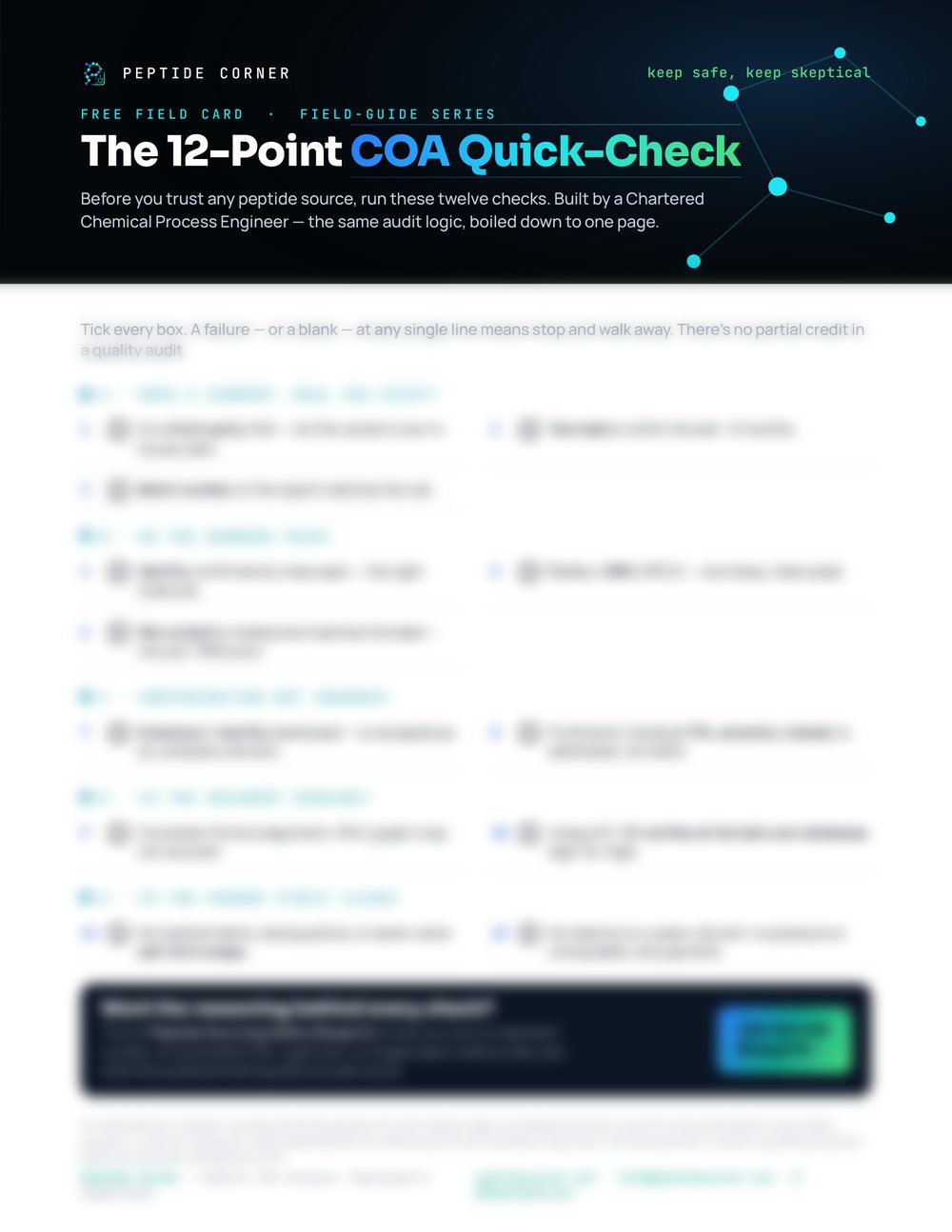
Twelve checks in the order I’d run them on any lab report, and one Pass / Ask / Stop rule. Printable, front and back. Comes with the other three free guides, for one email.
Get the free guidesThey keep a piece of every batch. You inject all of it.
Here is the part of the regulated world I find genuinely impressive. A manufacturer has to keep physical reserve samples of every batch it releases — at least twice the quantity needed to run all the required tests, held a full year past the expiry date, and examined at least once a year for any sign of deterioration.
Think about what that admits. They keep a piece of every batch because they assume a batch can go wrong after it was released. The industry that invented certificates has built an entire retention system around the possibility that the material later stopped matching its own paperwork.
You keep nothing. You inject all of the evidence. That is not a criticism of anyone; it is just the asymmetry, stated plainly. It is also the reason a vial that looks completely normal tells you almost nothing, which I went through separately in what a visual inspection actually proves.
A batch number is a string of characters
I have made videos about hunting red flags in batch numbers, and I stand by every one of them. But there is something about that method I would rather you heard from me.
In 2024 the World Health Organization issued an alert on falsified units of a very well known weight-loss drug, listing three batch identifiers it had found. The first, the manufacturer did not recognise at all — a fabricated number, and the kind of thing a check catches. The second carried a serial number that did not match the manufacturing records. Fine so far.
The third was a genuine batch number. A real one, confirmed by the manufacturer, printed on falsified product.
That is the whole problem in one line. A batch number is a string of characters, and a string of characters is the easiest thing in the world to copy. It has no defence mechanism. It does not know it has been stolen.
And before anyone says that this is just the wild west of the internet — no. The FDA has warned about counterfeit units of that same drug found inside the legitimate American supply chain. Licensed wholesalers. Serialisation. A pharmacist at the end of it. All of that, and it still got through.
What happened when somebody actually measured
Three sets of numbers, from people who stopped reading documents and put the contents in an instrument.
- Test purchases from illegal online sellers. Six orders placed; three arrived, and the other three simply took the money. All three that arrived were labelled 99% purity. Measured purity ran from 7.7% to about 14% — the label and the measurement differing by roughly a factor of ten. Endotoxin was detected in all three.
- 110 products seized from a European black market. Of the 75 pharmaceuticals among them, a third were substandard, another third were outright counterfeit, and under a fifth were confirmed as the real thing.
- 559 samples of a licensed peptide, from 15 countries, inside a legal supply chain. Median failure rate against quality testing: 45.6%.
That third one changed my mind about something. These were not black-market vials — they were a licensed product with a legal chain behind it. And the failures clustered by where in the chain the sample was taken, not by who made it: nearly 38% failing at the far end against 22% at the central distributor. Same product, same manufacturers. The damage happened downstream of the certificate, in transport and in storage, where no document is looking.
Two fair objections
The first: reputation is not worthless, and it isn’t. The black-market failure rates above are catastrophically worse than the legal ones. Reputation genuinely moves the odds. What it does not do is resolve the vial in your hand.
The second is better, and it is the one I had to think about. Documents obviously work — they are how those counterfeits got caught in the first place. Somebody compared a serial against a register. True.
So here is the honest framing. Documents are epidemiology, not diagnosis. They find the outbreak. They cannot tell you whether you personally have it. If you want the practical half of this — how to read the document you were actually sent, and spot the ones that fall apart — that is reading a COA like an engineer, and the argument about who is holding the responsibility is why you are the QA department.
The bottom line
There is no name I could give you that would answer the question you are actually asking, because the question is about a vial and every available answer is about a company. A certificate is a claim about a batch you probably do not have, and the industry that invented certificates does not accept them at face value either — it has federal regulation telling it not to.
That does not mean give up. It means know what you are holding: a probability, not proof. Knowing that difference is worth considerably more than any name I could have given you.
I take no money from anybody who sells peptides — no sponsorships, no affiliate links, no commissions, no discount codes, and no pointers to where to buy anything. What I do instead, when somebody asks, is go through the document itself.
Had a certificate sent to you? I read them — peptidecorner.net/coa-read
Sources
- 21 CFR 211.84 — the identity test required on every incoming lot, and the only conditions under which a supplier’s certificate may be relied on — https://www.ecfr.gov/current/title-21/chapter-I/subchapter-C/part-211/subpart-E/section-211.84
- FDA, Questions and Answers on Current Good Manufacturing Practice — Control of Components — the same rule in the FDA’s own plain English — https://www.fda.gov/drugs/guidances-drugs/questions-and-answers-current-good-manufacturing-practice-requirements-control-components-and-drug
- 21 CFR 210.3 — the legal definitions of “batch” and of “lot number”, the key from which a batch’s complete history can be determined — https://www.ecfr.gov/current/title-21/chapter-I/subchapter-C/part-210/section-210.3
- 21 CFR 211.170 — reserve samples: twice the quantity needed for all tests, held a year past expiry, examined once a year for deterioration — https://www.ecfr.gov/current/title-21/chapter-I/subchapter-C/part-211/subpart-I/section-211.170
- WHO Medical Product Alert No. 2/2024 — three batch identifiers on falsified units, the third confirmed genuine by the manufacturer — https://www.who.int/news/item/19-06-2024-medical-product-alert-n-2-2024--falsified-ozempic-(semaglutide)
- FDA drug alert — counterfeit units found inside the legitimate US drug supply chain, first issued December 2023 and updated since — https://www.fda.gov/drugs/drug-alerts-and-statements/fda-warns-consumers-not-use-counterfeit-ozempic-semaglutide-found-us-drug-supply-chain
- Ashraf et al., Journal of Medical Internet Research, 2024 — six test purchases from illegal online sellers, three delivered, measured purity 7.7% to 14.37% against 99% claimed, endotoxin in all three — https://doi.org/10.2196/65440
- Fabresse et al., Forensic Science International, 2021 — 110 seized products; of the 75 pharmaceuticals, 33% substandard, 32% counterfeit, 19% confirmed original — https://doi.org/10.1016/j.forsciint.2021.110771
- Torloni et al., BJOG, 2016 — 559 samples of a licensed peptide from 15 countries, a median 45.6% failing quality tests, 37.9% at facilities against 22.0% at central distributors — https://pubmed.ncbi.nlm.nih.gov/27006180/
Educational and research purposes only — not medical advice. Peptide Corner does not recommend any vendor, source, or dose. Keep safe, keep skeptical.

Why the Peptide Gray Market Makes You the QA Department
“Research use only” is not a quality standard — it is the mechanism that moves the entire quality function from an inspected factory onto the buyer.

How to Read a Peptide COA Like an Engineer
A Certificate of Analysis is only as good as your ability to read it. Here’s the two-number test, the forgery tells, and why 99% purity can still mean you got shorted.
Your Peptide Looks Fine. That Proves Absolutely Nothing.
Cloudy, floaters, colour, smell — the four checks everyone runs. What visual inspection can and cannot detect, according to the people who do it professionally.