
Everybody worries about the X-ray. It’s the wrong stage.
Your vial gets X-rayed, loses up to a quarter of the air pressure around it, and can bake then chill in a checked bag. I walked one through every stage of a flight to work out which one actually matters, and one of them can end with it destroyed on purpose.
In this article ▾
This is the written version of Traveling With Peptides: The Real Risk Isn’t The Flight — watch it instead if you’d rather.
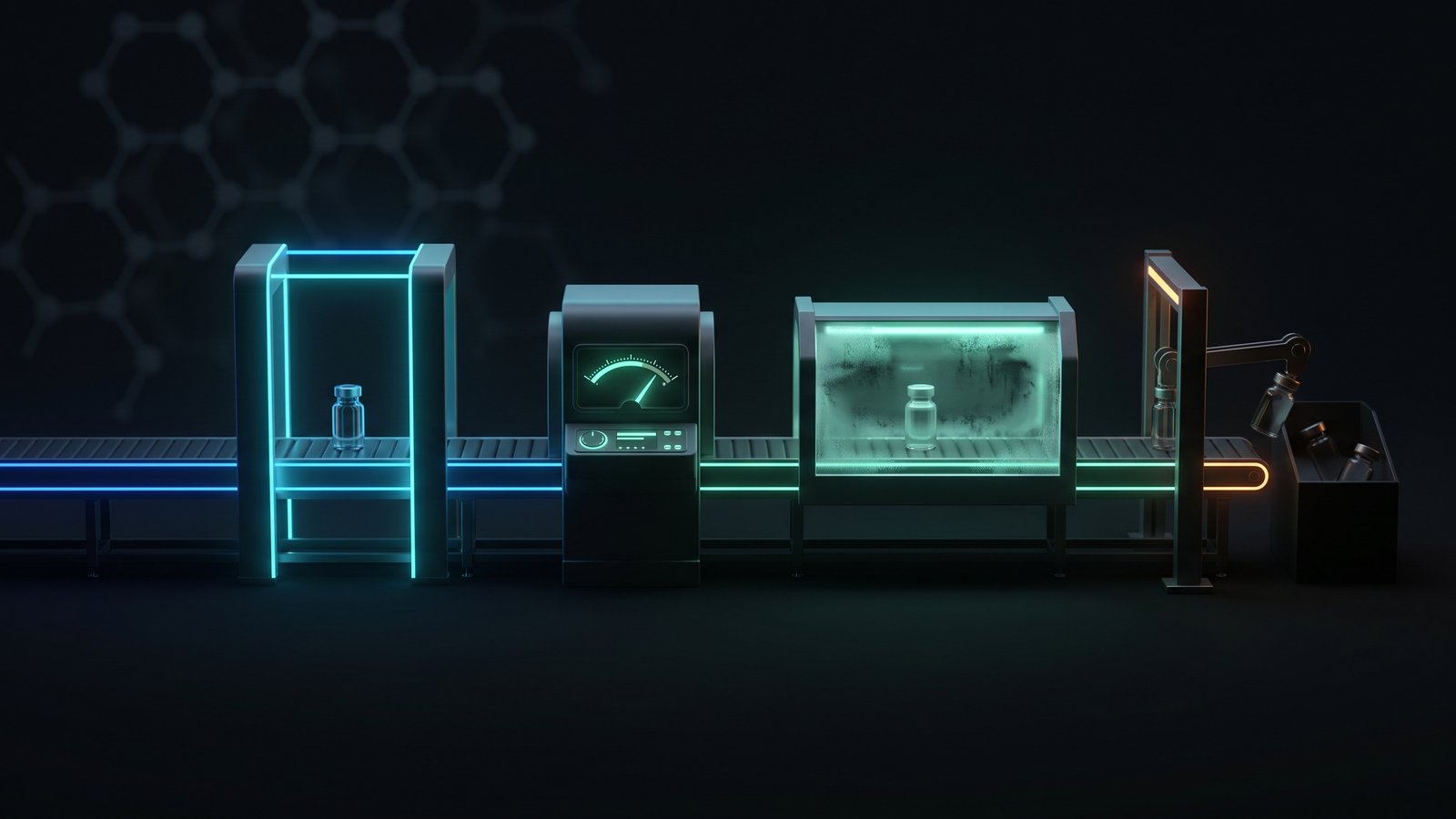
Think about what your peptide vial goes through on a flight. It gets X-rayed. The air pressure around it drops by up to a quarter. And if it’s in a checked bag, it can bake on the ramp and then chill in the hold. It’s had a rougher day than you have.
Everybody worries about the X-ray. Of all those stages, it’s the one I’d worry about least. As an engineer I work with sealed containers under pressure, so I took a vial through the trip one stage at a time, on paper, to see which one actually matters. One of them can end with the vial destroyed on purpose, and it isn’t a physics problem.
Do airport X-rays damage peptides?
The TSA’s own website says its X-ray machines don’t adversely affect food or medicines. That’s reassuring in roughly the way a restaurant rating its own soup is reassuring, so I went looking for somebody who’d actually measured it.
A drug company’s lab took antibody drugs, liquid and freeze-dried, in vials and in syringes, and hit them with about 200 times the exposure a US safety standard recommends. Then they checked particles, purity and chemical changes. Nothing moved.
Two honest caveats. The company paid for the study itself, and antibodies are huge proteins, not the short peptides most people travel with. Testing a cargo ship doesn’t tell you much about the canoe.
The closest match I found came from a German team using CT scanners to look inside freeze-dried drugs. One of their samples was freeze-dried insulin, their model peptide, and even after a stability test the X-rays hadn’t damaged it. Nobody has X-rayed the exact short peptides people carry, but two very different molecules were tested and neither flinched. The scanner comes off my worry list.
What cabin pressure does to a vial
The FAA rule for airliners says the cabin can’t go above the pressure you’d feel at 8,000 feet in normal operation, and the FAA’s pilot handbook puts that at roughly three-quarters of sea-level pressure.
The sealed vial of powder is the one that surprised me. Freeze-dried drugs are often sealed with some of the air pumped out, so the inside can already sit below any pressure the cabin will reach. Your powdered vial was effectively at altitude before it left the factory.
A mixed vial is different, because it can have air sitting above the liquid at ground pressure. With the cabin at its 8,000-foot limit, that trapped air pushes outward with about a third more pressure than the cabin pushes back.
Then there’s the stopper you’ve already put a needle through. Those stoppers are built to reseal. One hospital pharmacy study found they kept resealing through dozens of punctures, often more than 100, and the thicker the needle, the sooner the seal gave up. But that was tested at ground pressure. I couldn’t find a single test of a pierced vial at cabin altitude, so what follows is engineering reasoning, not a published test.
If a puncture doesn’t fully close, whatever is touching it is what gets pushed out. Keep the vial upright and that’s air. Lay it on its side and it’s your solution. On the way down the flow reverses and cabin air gets pulled back in. Keeping a pierced vial upright is the cheapest fix in this whole article.
Five things everybody repeats about storing peptides, checked against approved labels. None of the five survives. Comes with the other three free guides, for one email.
Get the free guidesCarry-on or checked bag?
Pressure is a factor you can manage. The bigger decision is where the vial rides. A checked bag bakes on the ramp like a lizard on a rock, rides in the dark with strangers, and turns up late, if it turns up at all.
The closest measured data comes from an unlikely place: researchers at Johns Hopkins logged the temperature every minute on 103 air shipments of lab mice. About half got hotter than 85 °F, about one in seven got colder than 45 °F, and six in ten swung by roughly 20 degrees or more. That’s freight, not suitcases, so don’t over-read it. But the CDC’s travel advice for insulin says it plainly: don’t keep it in a checked bag, because it can get too cold there. What a warm spell does to a peptide is its own story, and I covered it in the piece on a vial that arrived warm.
Temperature isn’t the only risk in the hold. The US Department of Transportation counts the bags that don’t arrive properly: lost, damaged, delayed or pilfered. In the one month it reported on, US airlines handled about 40 million checked bags and mishandled 0.38% of them. That sounds tiny until you do the multiplication. It’s roughly 150,000 bags in a single month.
How to pack a vial so it survives the flight
- Carry it on. It dodges the hold’s temperature swings and the lost-bag lottery. Your suitcase has a social life you know nothing about.
- Travel with the unmixed form where you can. For protein drugs the solid state is the preferred way to store them, because taking the water out slows a lot of the chemical and physical damage that happens in solution. Once a vial is mixed the clock runs faster, which I went through in the piece on what starts when a vial is mixed.
- If it needs keeping cool, use the TSA’s rule. Ice packs, freezer packs and gel packs for medically necessary items can come through frozen, partly frozen or melted, and they still get screened. So yes, a melted gel pack is allowed to exist.
- Never press a frozen pack against the vial. The CDC says not to store insulin directly on ice, and freezing is its own kind of damage, because the surface where ice meets water can unfold a protein. Put a layer between the pack and the vial. The freezer piece has the rest.
- Protect it from breakage and light. Glass doesn’t enjoy a bag being thrown into an overhead bin, so use a rigid padded case. Light can damage several amino acids, including tryptophan and tyrosine, so keep it in its box, in the dark. Your vial isn’t going on holiday for the tan.
- A pierced vial rides upright, for the pressure reasons above.
- Keep it in its original labelled packaging, with its paperwork. The TSA says clear labels help the screening. That one habit turns out to matter far more than anything the scanner or the cabin can do.
Does getting through security mean it’s legal?
People imagine security as a bouncer with a list of banned peptides. It’s more like a metal detector with opinions. The TSA says its screening is focused on security. Its officers don’t search for illegal drugs, but if they find something illegal they refer it to law enforcement.
Getting through security isn’t a legal check, and it isn’t a permission slip. The X-ray machine has never once issued a legal opinion.
Crossing into another country is a different game. The FDA says that in most circumstances it is illegal for individuals to bring drugs into the US for personal use. It can use discretion, but only under conditions: a written statement that it’s for personal use, generally no more than a three-month supply, either a US doctor responsible for the treatment or evidence that it’s continuing treatment started abroad, and no known commercialization or promotion of the product to people in the US.
In Australia, the TGA’s traveller rules say personal use, original packaging and no more than three months’ supply, and for prescription medicines, carry the prescription or a doctor’s letter. The TGA regulates peptides as therapeutic goods. Its Personal Importation Scheme can consider unapproved peptides, but only if they’re clearly and accurately labelled and every other condition is met, including a prescription where one is required. It also says a “research use only” label doesn’t permit importation. Calling it research only works about as well as calling your suitcase “not luggage”. And some hormones, growth hormone among them, need a separate permit from Australia’s Office of Drug Control for every shipment.
Notice what nobody said. Nobody said a prescription is the only route everywhere. Each regulator sets its own, so check your destination’s official rules before you fly.
The stage that destroys a vial on purpose
Here’s the stage I promised at the start. In a recent safety warning, the TGA said poorly labelled peptide vials are seized and destroyed. Not damaged by the flight. Seized and destroyed, on purpose.
That’s the stage that isn’t physics. It’s paperwork. And the original labelled packaging that protects the vial from light and knocks is exactly what the Australian rules ask for and what the TSA recommends.
The bottom line
The X-ray isn’t the problem. Cabin pressure is a factor you manage by keeping a pierced vial upright, and the hold is where the temperature swings and the lost bags live. So carry it on, store it the way its label says, never let it freeze, and keep it in its box.
The scanner, the cabin and the hold are all trying to damage your peptide by accident. The border is the one stage that checks what’s in the vial against a rule book, and the only one that will bin it on purpose. Read that rule book first. And if the vial comes out the other end looking perfect, that proves less than you’d think.
Sources
- TSA, What Can I Bring? — Baby Formula — the statement that TSA X-ray machines do not adversely affect food or medicines — https://www.tsa.gov/travel/security-screening/whatcanibring/items/baby-formula
- Fuentes et al., Pharmaceutical Research, 2025 — antibody drugs, liquid and freeze-dried, X-rayed at about 200 times the ANSI-recommended exposure; no significant change in particles, purity or charge variants; funded by the manufacturer — https://doi.org/10.1007/s11095-025-03867-7
- Wenzel et al., Journal of Pharmacy and Pharmacology, 2021 — freeze-dried insulin as a model peptide, no damage from micro-CT X-ray exposure, directly after drying or after stability testing — https://doi.org/10.1093/jpp/rgaa004
- 14 CFR 25.841 — pressurised cabins: cabin pressure altitude not more than 8,000 feet under normal operating conditions — https://www.ecfr.gov/current/title-14/section-25.841
- FAA, Pilot’s Handbook of Aeronautical Knowledge, chapter 4 — standard pressure at sea level and at 8,000 feet — https://www.faa.gov/sites/faa.gov/files/regulations_policies/handbooks_manuals/aviation/phak/06_phak_ch4.pdf
- Crist, PDA Journal of Pharmaceutical Science and Technology, 1994 — freeze-dried products are often sealed under reduced pressure — https://pubmed.ncbi.nlm.nih.gov/7804818/
- Ponto, Journal of the American Pharmacists Association, 2013 — how many punctures a vial stopper reseals through, tested at ground pressure — https://doi.org/10.1331/JAPhA.2013.12064
- Syversen et al., Journal of the American Association for Laboratory Animal Science, 2008 — temperatures logged every minute on 103 air shipments — https://pmc.ncbi.nlm.nih.gov/articles/PMC2652616/
- CDC, Tips for Traveling with Diabetes — don’t keep insulin in a checked bag, and don’t store it directly on ice — https://www.cdc.gov/diabetes/about/tips-for-traveling-with-diabetes.html
- US Department of Transportation, Air Travel Consumer Report: October 2024 Numbers — bags handled and the mishandled rate — https://www.transportation.gov/briefing-room/air-travel-consumer-report-october-2024-numbers
- Bureau of Transportation Statistics — what counts as a mishandled bag — https://www.bts.gov/content/mishandled-baggage-reports-filed-passengers-largest-us-air-carriersa
- Butreddy et al., International Journal of Biological Macromolecules, 2021 — why the solid state is the preferred way to store protein drugs — https://doi.org/10.1016/j.ijbiomac.2020.11.188
- Arsiccio & Pisano, Journal of Pharmaceutical Sciences, 2020 — the ice–water interface and protein stability — https://doi.org/10.1016/j.xphs.2020.03.022
- Kerwin & Remmele, Journal of Pharmaceutical Sciences, 2007 — light damage to amino acids including tryptophan and tyrosine — https://doi.org/10.1002/jps.20815
- TSA, Disabilities and Medical Conditions — ice, freezer and gel packs for medically necessary items, and clear labelling — https://www.tsa.gov/travel/tsa-cares/disabilities-and-medical-conditions
- TSA, What Can I Bring? — Medical — labels recommended but not required — https://www.tsa.gov/travel/security-screening/whatcanibring/medical
- FDA, Personal Importation — illegal in most circumstances, and the conditions for enforcement discretion — https://www.fda.gov/industry/import-basics/personal-importation
- TGA, Entering Australia — the traveller’s exemption for medicines — https://www.tga.gov.au/resources/consumer-information-and-resources/travelling-medicines-and-medical-devices/entering-australia
- TGA advisory, 13 April 2026 — importing, compounding and supplying unapproved peptide products — https://www.tga.gov.au/safety/safety-monitoring-and-information/safety-alerts/understanding-your-responsibilities-when-importing-compounding-and-supplying-unapproved-peptide-products
- TGA safety alert, 7 May 2026 — the risks of importing unapproved peptide products — https://www.tga.gov.au/safety/safety-monitoring-and-information/safety-alerts/tga-warning-risks-importing-unapproved-peptide-products
- Office of Drug Control (Australia) — import permits for anabolic and androgenic hormones and other controlled substances — https://www.odc.gov.au/anabolic-androgenic-hormones-and-other-controlled-substances
Educational and research purposes only — not medical advice. Peptide Corner does not recommend any vendor, source, or dose. Keep safe, keep skeptical.

Your Peptide Arrived Warm. That’s Not the Real Problem.
A melted ice pack is not a verdict. How the pharmaceutical industry actually measures heat exposure — and why the thing doing the damage is probably in your kitchen.
Reconstitution Maths Isn’t the Hard Part — The Clock After It Is
Milligrams, millilitres and syringe units are three scales for one vial — which is the whole reason the maths feels hard. Here is the ratio, the trap that doubles a dose without moving the plunger, and why degradation is the real constraint.
Your Peptide Looks Fine. That Proves Absolutely Nothing.
Cloudy, floaters, colour, smell — the four checks everyone runs. What visual inspection can and cannot detect, according to the people who do it professionally.