
Reconstitution maths isn’t the hard part — the clock after it is
Three units, one vial, and a forum full of people insisting you can shatter a peptide by mixing it too hard. The arithmetic here is a ratio you already know how to do — mass over volume. The part that actually catches people is what happens after the water goes in, because that is when the clock starts and nothing on the label tells you it has.
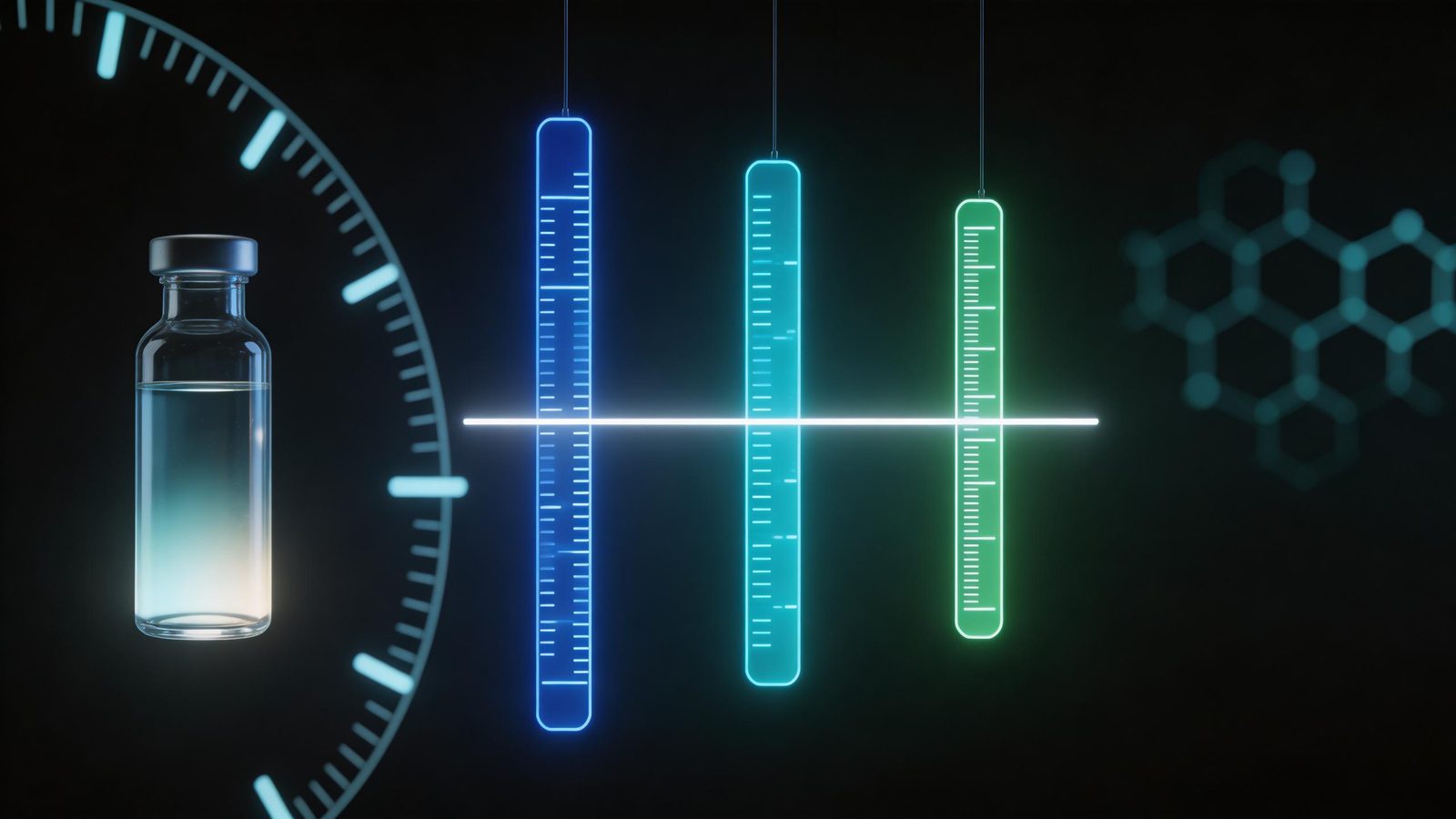
This is the written version of Your Peptide Started Dying The Day It Was Mixed — watch it instead if you’d rather.
Concentration is my day job. I am a chartered chemical process engineer, which means I spend my working life on fluid systems, mass transfer and getting a number of grams into a number of litres. On a plant, if the concentration drifts by a fraction, the batch is scrap. Nobody argues with the arithmetic there, because everyone can see the tank.
A glass vial is the same problem at a smaller scale, and yet it generates more confusion and more forum mythology than almost anything else in this space. So here is the honest version: the maths is genuinely easy, and it is not the part that catches people out.
First, you cannot shatter a peptide by mixing it
You will find anonymous posts insisting that if the water hits the powder too fast, or if you swirl the vial too enthusiastically, the peptide "shatters like glass" and you have destroyed it. It is a wonderfully vivid image and it is not what is happening.
A peptide is a chain of amino acids held together by covalent peptide bonds — the same class of bond doing structural work throughout your body. Breaking one takes chemistry: an enzyme, a strong acid, sustained heat. It does not take a wrist. Run the water gently down the inside of the glass rather than firing it straight into the powder, give it a slow swirl instead of a shake, and you are well inside the envelope. Unless you are putting the vial in an industrial paint mixer, you are not fracturing anything.
The gentleness is worth doing anyway — violent agitation of any protein solution encourages foaming and surface denaturation at the air-liquid interface, which is a real if modest effect. But "be gentle" is good practice, not a rescue from catastrophe.
Three scales, one vial — that's the whole difficulty
Here is where the confusion actually comes from, and once you see it the problem dissolves. You are juggling three different units that describe the same object:
- The peptide mass is in milligrams. That number is fixed the moment the vial is filled.
- The water you add is in millilitres. That number is entirely your choice.
- The syringe is graduated in units, not millilitres — on a standard 100-unit insulin syringe, 100 units is 1 mL.
Nothing here needs algebra. It needs one ratio: concentration = mass ÷ volume. Put 2 mL of bacteriostatic water into a vial holding 5 mg and you have 5 ÷ 2 = 2.5 mg per mL. That is the entire calculation. Everything after it is reading your own number off a scale.
Then, because the syringe is marked in units, you convert once: 100 units is 1 mL, so 10 units is 0.1 mL, which is a tenth of your 2.5 mg — 0.25 mg, or 250 micrograms. Multiply the concentration by the fraction of the syringe you have drawn. That is it.
The trap: doubling the mass doubles the dose without moving the plunger
This is the one genuinely important consequence, and it is why the ratio is worth understanding rather than outsourcing entirely.
Suppose the same peptide arrives in a 10 mg vial instead of a 5 mg one, and you add the same 2 mL of water out of habit. You have doubled the mass and held the volume constant, so the concentration doubles: 10 ÷ 2 = 5 mg per mL. Now draw to exactly the same 10-unit mark you have used a dozen times. Identical volume of fluid, identical position on the scale — and twice the active mass.
Nothing visible changed. The liquid looks the same, the plunger sits in the same place, muscle memory is satisfied. This is precisely the failure mode that catches careful people, and it has nothing to do with being bad at maths. It comes from treating a mark on a syringe as if it were a dose. It never was. It is a volume, and what that volume contains depends entirely on a decision you made when you added the water.
The clock starts when the water goes in
Here is the half of this subject that gets far less attention than it deserves. A lyophilised powder sitting dry and cold is stable and patient. The moment you introduce water, it stops being patient. Hydrolysis, oxidation and aggregation all need a solvent to work in, and you have just supplied one.
How fast that matters is a function of the molecule, not of the brand on the vial. Broadly, and this is the useful mental model rather than a schedule:
- The larger metabolic peptides — the GLP-1-class compounds — are comparatively robust in solution. For the FDA-approved products you do not have to guess: the prescribing information gives an explicit in-use period once a pen or vial is first punctured, and it is measured in weeks, kept refrigerated and out of light.
- The repair-type peptides — the short, structurally simple ones — also hold up reasonably well refrigerated, on the order of weeks rather than days.
- The fragile ones degrade quickly. The growth-hormone secretagogues, the mitochondrial peptides, and anything closer to a full protein than a short chain have shorter usable lives in solution, and freezing rather than refrigerating is what buys time.
Two things follow. First, "how long does it last" has no single answer, so a claim that something keeps indefinitely is a claim about the seller, not the chemistry. Second, the failure here is silent: a degraded solution looks exactly like a good one. There is no smell, no colour change, no warning. You do not get a bad result — you get a result that looks like the peptide simply did not work, which is a much more expensive conclusion to draw.
Two habits that remove the human error
Since the arithmetic is a ratio, there is no virtue in doing it by hand under time pressure. A reconstitution calculator — enter the vial mass, the water you added, the target amount and the syringe type, and read off what to draw — eliminates the transcription slips and decimal-place errors that cause almost all real-world mistakes. Use one. Understanding the ratio is what lets you notice when a tool's output looks wrong; it is not a reason to insist on mental arithmetic.
And the second habit costs nothing: write the reconstitution date on the vial the moment you mix it. Not on a note, not in your head — on the vial, where the vial can tell you. The date is the only piece of information in this whole process that cannot be reconstructed later, and it is the one that determines whether what you have is still active or is now expensive water.
A mark on a syringe is a volume, not a dose. What it contains was decided when you added the water.
The bottom line
Reconstitution is not the technical hurdle it gets made into. It is one ratio, one unit conversion, and a date written on glass. Mix gently, know your concentration rather than your favourite mark, let software do the sums, and track the clock.
But hold onto the thing that makes all of it conditional. Perfect arithmetic on a vial that arrived underdosed, contaminated, or containing something other than what the label claims is perfect arithmetic applied to nothing. The maths assumes the mass on the label is real — and that assumption is the part nobody in this supply chain is verifying for you. If you want the honest version of that problem, start with why the gray market makes you the QA department, and then how to actually read a certificate of analysis.
Keep safe, keep skeptical.
Sources
- FDA, OZEMPIC (semaglutide) injection — full prescribing information (in-use storage and discard-after period) — https://www.accessdata.fda.gov/drugsatfda_docs/label/2017/209637lbl.pdf
- FDA, MOUNJARO (tirzepatide) injection — full prescribing information (storage and handling) — https://www.accessdata.fda.gov/drugsatfda_docs/label/2022/215866s000lbl.pdf
- Drugs.com, Elamipretide (SS-31) dosage and administration reference — https://www.drugs.com/dosage/elamipretide.html
Educational and research purposes only — not medical advice. Peptide Corner does not recommend any vendor, source, or dose. Keep safe, keep skeptical.


How to Read a Peptide COA Like an Engineer
A Certificate of Analysis is only as good as your ability to read it. Here’s the two-number test, the forgery tells, and why 99% purity can still mean you got shorted.
Why the Peptide Gray Market Makes You the QA Department
“Research use only” is not a quality standard — it is the mechanism that moves the entire quality function from an inspected factory onto the buyer.
Coming Off GLP-1s: Why the Weight Comes Back, and What Actually Protects You
The withdrawal trials predicted post-GLP-1 rebound before anyone posted about it. Here is the real mechanism, the honest numbers, and why the boring fundamentals beat the peptide add-ons.