
MOTS-c and SS-31: what the mitochondrial peptides actually do
Everyone argues about how much fuel goes in the door. Almost nobody inspects the machinery that burns it. MOTS-c and SS-31 aim straight at that machinery — the mitochondria — and the mechanism is genuinely elegant. Here is what each one really does, what the FDA has and hasn't approved, and why the human evidence is thinner than the marketing suggests.
In this article ▾
This is the written version of MOTS-c & SS-31: The Peptides They Call Exercise In A Bottle — watch it instead if you’d rather.
Every process engineer has met the plant that looks fine on the balance sheet and is quietly falling apart on the floor. Throughput down, utility bill up, and management's answer is to order less feedstock. Nobody walks down to the boiler house to ask why the burners are running rich. That, more or less, is what most metabolic advice does to your body — it argues about how much fuel goes in the door and never inspects the machinery that burns it.
Which is why MOTS-c and SS-31 get so much airtime in the longevity corner of the internet. Both aim at the mitochondria — the micro-powerplants inside your cells — rather than at your appetite. One is pitched as the repair crew, the other as the construction crew. It is an elegant story with real science underneath it. There is also a wide gap between an elegant mechanism and a proven result in humans, and that gap is where this article spends most of its time. I walk through it on camera in the video above; this is the written version, with the receipts.
The bit that actually breaks is the assembly line, not the fuel
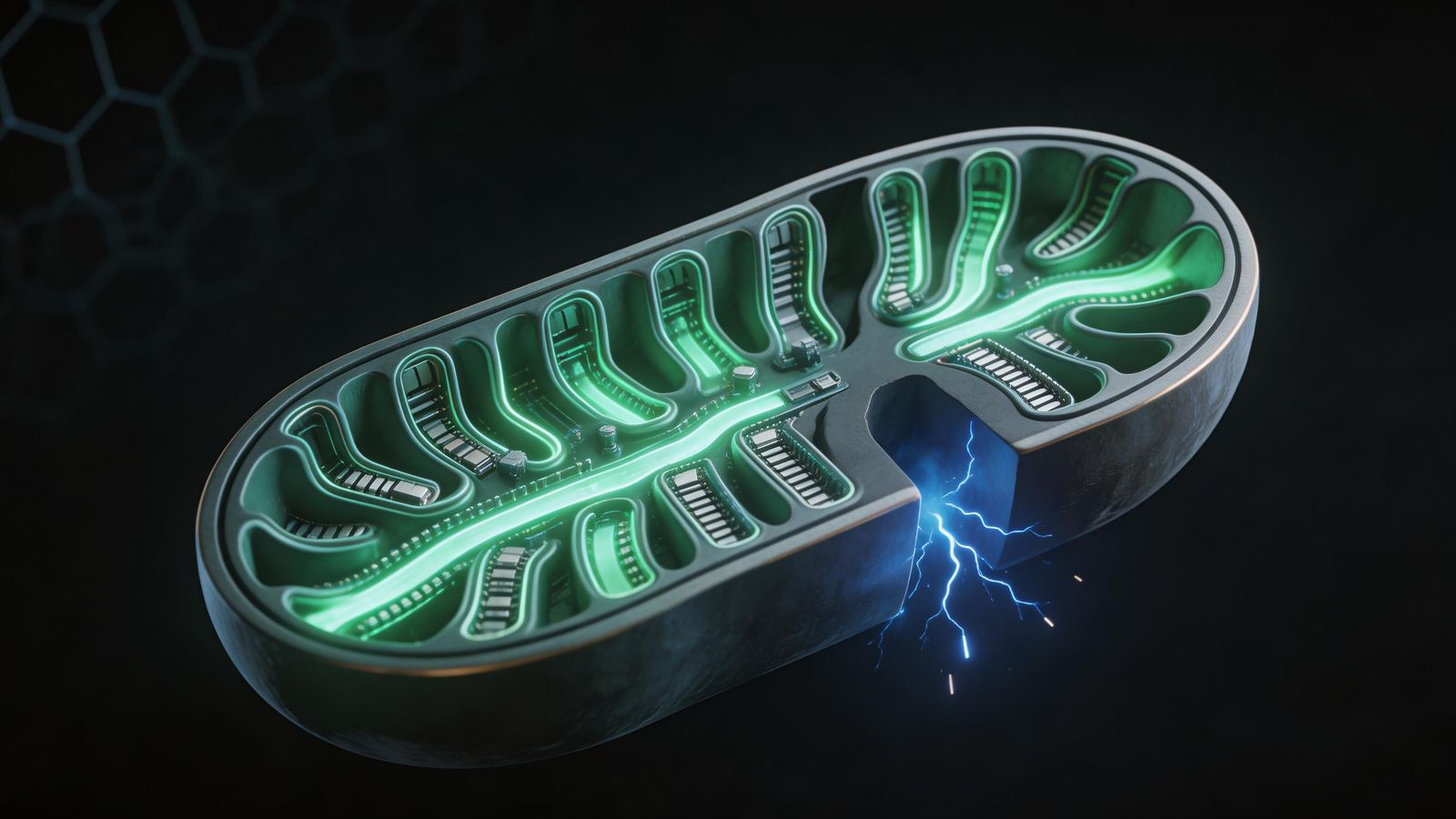
Mitochondria turn the food you eat and the oxygen you breathe into ATP — the molecule your cells actually spend. That happens on the inner mitochondrial membrane, which is less a bag than a tightly folded assembly line. Bolted along it are the respiratory complexes: four electron-transport complexes, plus ATP synthase, the turbine at the end of the line that mints the ATP.
Here is the part the hype videos skip. Those complexes only work properly when held in tight physical alignment, and the thing holding them there is an odd four-tailed phospholipid called cardiolipin. Think of cardiolipin as the gasket-and-mounting-rack of the whole rig — it seals the joints and keeps every unit square to the next. It is also unusually easy to oxidise. When it degrades, the rack sags, the joints leak, electrons drop off the line early, and instead of clean ATP you get reactive oxygen species, which go on to oxidise more cardiolipin. Engineers have a word for that: a runaway. Optimise the fuel all you like — a leaking rig is still a leaking rig.
SS-31: a peptide that goes and sits on the gasket
SS-31 — research name for the drug elamipretide — does not dock onto a receptor on the cell surface and shout a message inward. It is cell-permeable and positively charged, so it walks in and concentrates in the inner mitochondrial membrane, where it binds cardiolipin directly. Once there it acts like a protective clamp: shielding cardiolipin from oxidation, helping stop the cristae — the folds of that membrane — collapsing, and, in animal models, preserving the cell's ability to make ATP again after an insult. Rodent and cell work across kidney ischaemia, atherosclerosis and heavy-metal toxicity all points the same way.
Here is the part worth getting exactly right, because it is the strongest card in the deck and it is routinely oversold. Elamipretide is now an approved drug. In September 2025 the FDA granted it accelerated approval, marketed as Forzinity, to improve muscle strength in patients with Barth syndrome above a minimum body weight. Barth syndrome is an ultra-rare X-linked disorder in which the enzyme that finishes building cardiolipin does not work — the most on-the-nose indication a cardiolipin-binding drug could possibly have.
Now read the small print, because the small print is the whole story. Accelerated approval means the FDA accepted a measure — knee extensor strength — as reasonably likely to predict real benefit, and required a randomised confirmatory trial to prove it does. That trial is not due to report until the end of this decade. The drug arrived on its third submission, after a rejection in May 2025. And in the larger Phase 3 trial in a broad group of adults with primary mitochondrial myopathy, elamipretide showed no significant benefit overall; a signal appeared only in a genetic subgroup identified after the fact. So: a real approval, in one rare genetic disease, on a provisional basis. Not a general-purpose mitochondrial tune-up, and not evidence about healthy people at all.
The free beginner’s guide: the chemistry, maths and evidence ideas everything else rests on, explained from scratch. Comes with the other three free guides, for one email.
Get the free guidesMOTS-c: a memo from the boiler room
MOTS-c is a different kind of object, and this is the bit I find genuinely lovely. Almost every peptide in your body is written from genes in the cell nucleus. MOTS-c is not. It is a sixteen-amino-acid peptide encoded inside a short open reading frame in the mitochondrial 12S ribosomal RNA gene — the mitochondrion's own small, separate genome. The boiler room has its own letterhead, and MOTS-c is a memo it sends up to head office.
The message is roughly "we are under load, adjust accordingly." In the original 2015 work from Changhan Lee and Pinchas Cohen's group, MOTS-c does not flip AMPK — the cell's master fuel-sensing switch — directly. It blocks the folate cycle, an intermediate called AICAR piles up, and it is AICAR that switches AMPK on. Downstream sits better glucose uptake in muscle and the PGC-1-alpha pathway that drives mitochondrial biogenesis — building new powerplants rather than patching old ones. Hence the tidy pairing: SS-31 as maintenance, MOTS-c as capital expenditure.
"Exercise mimetic" is the phrase that sells MOTS-c, and it is not invented — researchers genuinely use it. But look at what supports it. In mice, MOTS-c treatment prevented age-related and high-fat-diet insulin resistance and diet-induced obesity, and injections improved running performance in young, middle-aged and old animals. In humans the finding runs the other way round: exercise raises the MOTS-c you already make, in muscle and in blood. That is good evidence MOTS-c is part of the exercise response. It is not evidence that injecting it substitutes for the exercise.
Here's the catch
Two catches, and both are load-bearing.
The first is the human-evidence gap, which for MOTS-c is enormous. Essentially every headline result you have seen quoted — the insulin sensitivity, the new mitochondria, the running performance — is rodent or cell-culture. The human literature is almost entirely observational: researchers measure the peptide people already produce and watch it move with training, with a fat infusion, with disease state. There is no body of published randomised trials in which humans were given MOTS-c and came out measurably healthier. So when someone says a compound "commands your body to build brand new mitochondria," the question is simply: whose body? So far, a mouse's.
The second catch is regulatory, and it moved after the video went out. On 23 July 2026 the FDA's Pharmacy Compounding Advisory Committee voted 7-5-2 to recommend MOTS-c for the 503A bulks list — the roster of substances compounding pharmacies may legally work with — for proposed uses in obesity and osteoporosis, alongside BPC-157, KPV and TB-500. Read that carefully before anyone tells you peptides just became legal. The vote is advisory, it ran against the FDA's own scientific reviewers, and nothing changes until the agency moves through formal notice-and-comment rulemaking. As things stand, MOTS-c is still an unapproved drug. This article reflects the position as of late July 2026.
Which leaves the practical reality. Neither compound reaches an ordinary buyer through a pharmacy. Approved elamipretide exists for a tiny rare-disease population under specialist care; everything else circulates through the Peptide Wild West as "research chemical" material of unverified identity, purity and sterility. Buy from that world and you have quietly taken a second job — congratulations, you have just been hired as that company's quality and safety manager, unpaid, with no analytical lab and no recourse. And that is before the deeper unknown: nobody can tell you what repeatedly firing a mitochondrial stress signal does in a healthy person over years, because nobody has run that study.
Mitochondria are the right target. That does not mean the peptides aimed at them have earned the claims being made for them.
The bottom line
The mechanism is real and beautifully engineered. Cardiolipin genuinely is the rack holding the respiratory assembly line square. SS-31 genuinely binds it. MOTS-c genuinely is a peptide your mitochondria write with their own DNA. None of that is hype — it is a decade of solid molecular biology.
What does not follow is the leap from mechanism to outcome. One provisional approval in an ultra-rare cardiolipin disease, confirmatory trial still years away, is not "proven mitochondrial repair." A stack of mouse studies plus human correlations is not "an exercise mimetic that works in you." An advisory vote is not a legal, quality-controlled supply. Those three gaps are where almost all the marketing lives.
So treat this as one of the most interesting stories in the field and one of the least settled. If what you actually want is more and better mitochondria, the intervention with the strongest human evidence is the one that made people's own MOTS-c rise in those studies: training. Not glamorous, not proprietary, extremely well documented. Watch the confirmatory Barth trial and watch what the FDA does with that compounding recommendation — between them they will tell us far more than another round of forum anecdotes. Until then, keep safe, keep skeptical.
Sources
- Lee C et al., The mitochondrial-derived peptide MOTS-c promotes metabolic homeostasis and reduces obesity and insulin resistance, Cell Metabolism, 2015 — https://doi.org/10.1016/j.cmet.2015.02.009
- Reynolds JC et al., MOTS-c is an exercise-induced mitochondrial-encoded regulator of age-dependent physical decline and muscle homeostasis, Nature Communications, 2021 — https://doi.org/10.1038/s41467-020-20790-0
- FDA, FDA Grants Accelerated Approval to First Treatment for Barth Syndrome, 2025 — https://www.fda.gov/news-events/press-announcements/fda-grants-accelerated-approval-first-treatment-barth-syndrome
- FDA, Accelerated approval letter, NDA 215244 (elamipretide / Forzinity), 2025 — https://www.accessdata.fda.gov/drugsatfda_docs/appletter/2025/215244Orig1s000ltr.pdf
- Karaa A et al., Genotype-specific effects of elamipretide in primary mitochondrial myopathy: post hoc analysis of MMPOWER-3, Orphanet Journal of Rare Diseases, 2024 — https://doi.org/10.1186/s13023-024-03421-5
- Liu S et al., Novel cardiolipin therapeutic (SS-31) protects endothelial mitochondria during renal ischemia, Am J Physiol Renal Physiol, 2014 — https://doi.org/10.1152/ajprenal.00697.2013
- FDA, July 23-24 2026 Meeting of the Pharmacy Compounding Advisory Committee (agenda and materials) — https://www.fda.gov/advisory-committees/advisory-committee-calendar/july-23-24-2026-meeting-pharmacy-compounding-advisory-committee-07232026
- Hyman, Phelps & McNamara (FDA Law Blog), PCAC approves four bulk drug substances for the 503A list, July 2026 — https://www.thefdalawblog.com/2026/07/peptide-l-wave-pcac-approves-four-bulk-drug-substances-for-the-503a-list/
Educational and research purposes only — not medical advice. Peptide Corner does not recommend any vendor, source, or dose. Keep safe, keep skeptical.


Coming Off GLP-1s: Why the Weight Comes Back, and What Actually Protects You
The withdrawal trials predicted post-GLP-1 rebound before anyone posted about it. Here is the real mechanism, the honest numbers, and why the boring fundamentals beat the peptide add-ons.

Top 5 Gym Performance Peptides, Ranked by Evidence — Not Hype
Five gym-performance peptides ranked by what the evidence actually supports — including the hyperplasia claim I got wrong the first time round.