
The shaking is not the weapon. It just builds one.
Every guide tells you to swirl, not shake, and almost none of them say why. The reason usually given — that shear snaps the molecule — turns out to be wrong. The real mechanism is a sheared air/liquid interface, and it changes which precaution actually matters.
In this article ▾
This is the written version of I Found The Real Reason You Shouldn’t Shake Your Peptide — watch it instead if you’d rather.
Every guide you will ever read says the same thing: swirl it, don’t shake it. And almost none of them tell you why. That silence is how you know most of them are copying each other rather than thinking about it.
When somebody does offer a reason, it is almost always some version of “shear force snaps the molecule.” It is the explanation everybody repeats, and it is wrong — wrong in a way that actually matters, because it points you at the wrong fix.
The explanation everyone repeats, and why it doesn’t hold
Shear is a real thing. It is what happens when layers of liquid slide past each other at different speeds, and the folk story is that this drags a peptide apart the way you’d snap a cracker. It sounds plausible. It even feels mechanically satisfying, which is usually a warning sign in this field rather than a reassurance.
The trouble is that when researchers build rigs to isolate pure shear on its own, away from every other variable, they keep running into the same caveat: shaking and stirring a vial by hand does not produce clean, isolated shear. It produces messy, uneven conditions, and — critically — it produces an air/liquid interface. Ha and colleagues, writing in the Journal of Biological Chemistry in 2024, describe exactly this: real-world agitation creates heterogeneous shear conditions, including air-liquid interfaces that denature proteins, and they show a protein can aggregate at flow-shear levels well below what it would take to unfold it by shear alone.
Read that twice, because it is the pivot the whole argument turns on. The shaking itself isn’t the weapon. The shaking is what builds the weapon.
What is actually happening at the surface
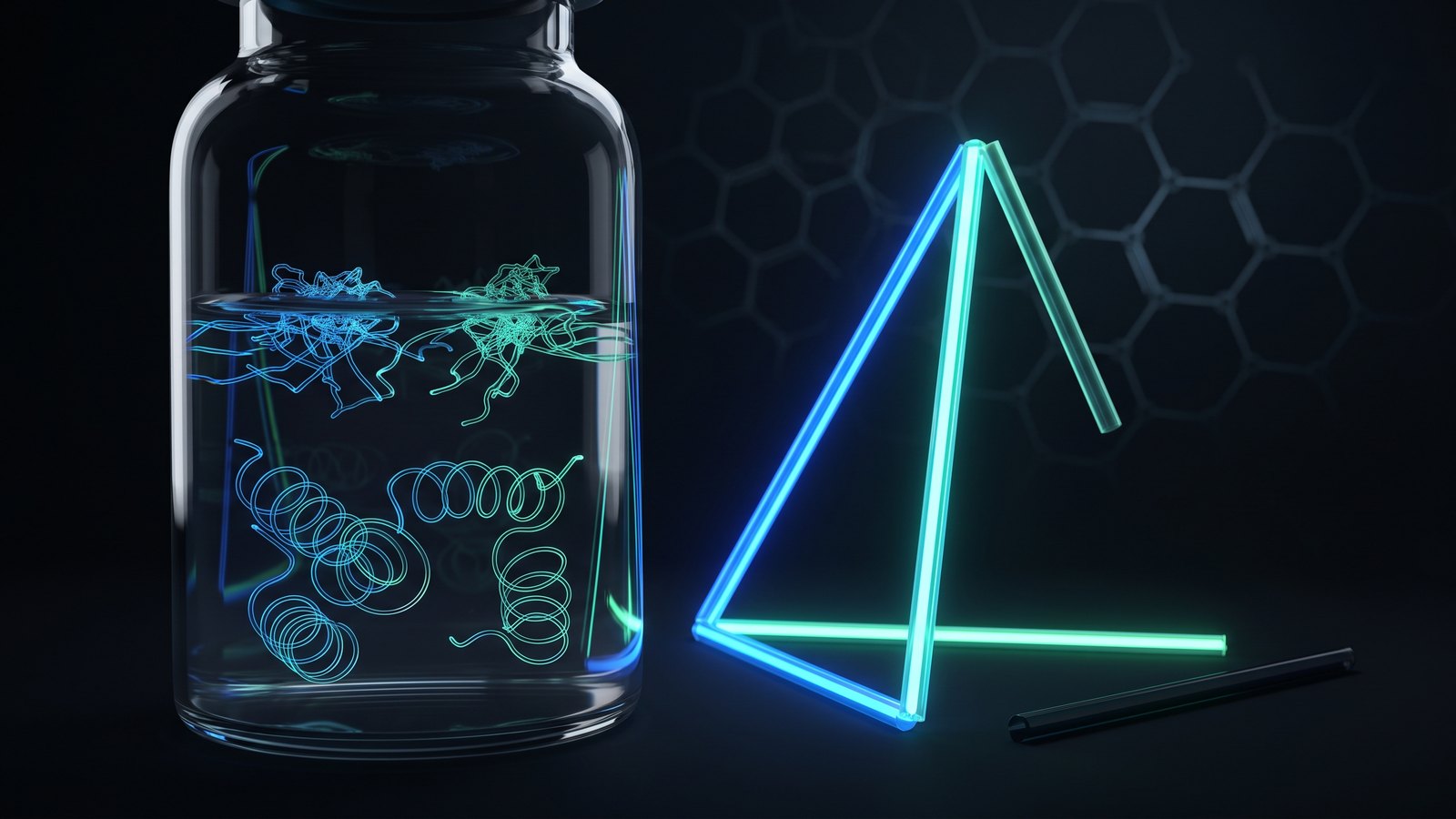
Picture a folded peptide sitting in the middle of a drop of water. It is comfortable there — water on every side, folded up the way it prefers. Now move it to a surface, where there is water on one side and air on the other. Suddenly the water-hating parts of the molecule have somewhere to go: out, towards the air. So the molecule unfolds to reach it. And a peptide that has unfolded at a surface is sticky in a way the folded version never was. It grabs the next unfolded molecule that drifts past. That is aggregation, and it starts at the boundary, not in the bulk liquid.
This is not a hunch. It was tested at a scale that is genuinely unusual for this kind of question. Schvartz and colleagues, publishing in Scientific Reports in 2023, ran the experiment across roughly six thousand different proteins at once, plus a set of purified proteins studied individually, across four different container materials, under controlled agitation. Their conclusion, in the sense of their own words, was that the loss was not primarily due to aggregates nucleating quietly in solution — it was proteins destabilising at the material surface, then aggregating at the sheared air/liquid interface. The boundary, not the bulk.
Two honest caveats belong here, because the video is careful about them and this post should be too. First, that study was run on soluble proteins in laboratory tubes, not on reconstituted peptides in sealed vials — the physics of an air/liquid interface generalises, but nobody has run this exact experiment on a peptide vial, so treat the mechanism as transferable, not as a direct measurement of your own kit. Second, one of the four container surfaces tested was a low-binding tube — a specialised plastic sold specifically so that proteins don’t stick to the tube wall. It did not prevent the loss.
Five things everybody repeats about storing peptides, checked against approved labels. None of the five survives. Comes with the other three free guides, for one email.
Get the free guidesWhy the expensive plastic didn’t save anything
That result is the whole point of this article, and it is worth sitting with. Low-binding tubes are a perfectly sensible idea on their own terms: an engineered surface that resists protein adhesion, sold at a premium, bought by researchers who have every reason to want it to work. And in this study, it didn’t stop the loss, because it was solving the wrong part of the geometry. It treats the wall. The killing is happening at the air. You can specify the finest low-adhesion plastic on earth and it will not protect a molecule from a boundary you keep manufacturing yourself, by hand, every time the vial gets agitated.
The three-leg problem, and the one leg you own
This is the part of the mechanism I actually like, because it turns a messy problem into a tidy one. The damage needs three things present at once: a material surface, some air, and agitation. Schvartz and colleagues put it plainly — remove any one of the three, not all three, just one, and the protein is preserved.
So run the audit on your own bench. Can you remove the material? No — the peptide has to live inside a vial made of something. Can you remove the air? Not really either — there is a headspace above the liquid by design, and it isn’t going anywhere. Which leaves exactly one leg of the stool that you actually control: the agitation. That is the real, mechanistic reason behind “swirl, don’t shake.” It was never folklore. It is the only leg of the tripod you are able to kick out, because the other two are bolted to the floor before you ever pick the vial up.
It also explains the foam. Foam is not cosmetic, and it is not a sign the powder has gone in nicely. Foam is surface area — you have taken what was a small, ordinary boundary and manufactured an enormous one, on purpose, with your own hand. If you see foam, you have not mixed the vial. You have assaulted it.
The honest caveat
None of this means swirling gets you to zero. There is still a surface inside that vial, and you are still moving liquid across it every time you turn your wrist. Swirling does not eliminate the risk — it minimises it. Given that two of the three legs of the stool are fixed in place before you start, minimising the third is the entire game available to you. It is a smaller win than careful-handling advice usually implies, and a more honest one.
Given all that, the practical habit worth keeping is a plain one: introduce the water down the inside wall of the glass rather than firing it straight onto the powder, and roll the vial rather than rattling it. I want to be straight about the status of that specific piece of advice — it follows logically from the interface mechanism above, and it is standard bench practice, but no paper in this article’s source list tested pouring technique directly. Treat it as reasoned practice, not as a cited result.
The wider context for all of this — aggregation mechanisms and what they mean for a protein’s biological activity once aggregation has happened — was mapped out well before either of the studies above, in Cleland, Powell and Shire’s 1993 review in Critical Reviews in Therapeutic Drug Carrier Systems. It is the older, foundational picture that the newer proteome-scale work builds directly on top of.
If you want the fuller, per-molecule version of stability — which sequences are more prone to this kind of interfacial unfolding, and why — that detail sits in the Stability Field Manual on the site rather than in this post. And if what actually goes into the vial in the first place, rather than how you move it once it is there, is the bit you want next, the reconstitution maths article is the natural companion to this one.
So the bottom line: the first sixty seconds after reconstitution are where you have the most control and the least information about what is actually going on inside the vial. You cannot remove the vial wall. You cannot remove the headspace above the liquid. You can remove the agitation, and that single, small choice is doing more work than most of the guides that tell you to make it ever bother to explain.
Sources
- Schvartz M, Saudrais F, Devineau S, et al. — Sci Rep 2023;13(1):1227 — https://pubmed.ncbi.nlm.nih.gov/36681766/
- Ha J-H, Xu Y, Sekhon H, et al. — J Biol Chem 2024;300(5):107231 — https://pubmed.ncbi.nlm.nih.gov/38537700/
- Cleland JL, Powell MF, Shire SJ — Crit Rev Ther Drug Carrier Syst 1993;10(4):307-77 — https://pubmed.ncbi.nlm.nih.gov/8124728/
Educational and research purposes only — not medical advice. Peptide Corner does not recommend any vendor, source, or dose. Keep safe, keep skeptical.

Reconstitution Maths Isn’t the Hard Part — The Clock After It Is
Milligrams, millilitres and syringe units are three scales for one vial — which is the whole reason the maths feels hard. Here is the ratio, the trap that doubles a dose without moving the plunger, and why degradation is the real constraint.
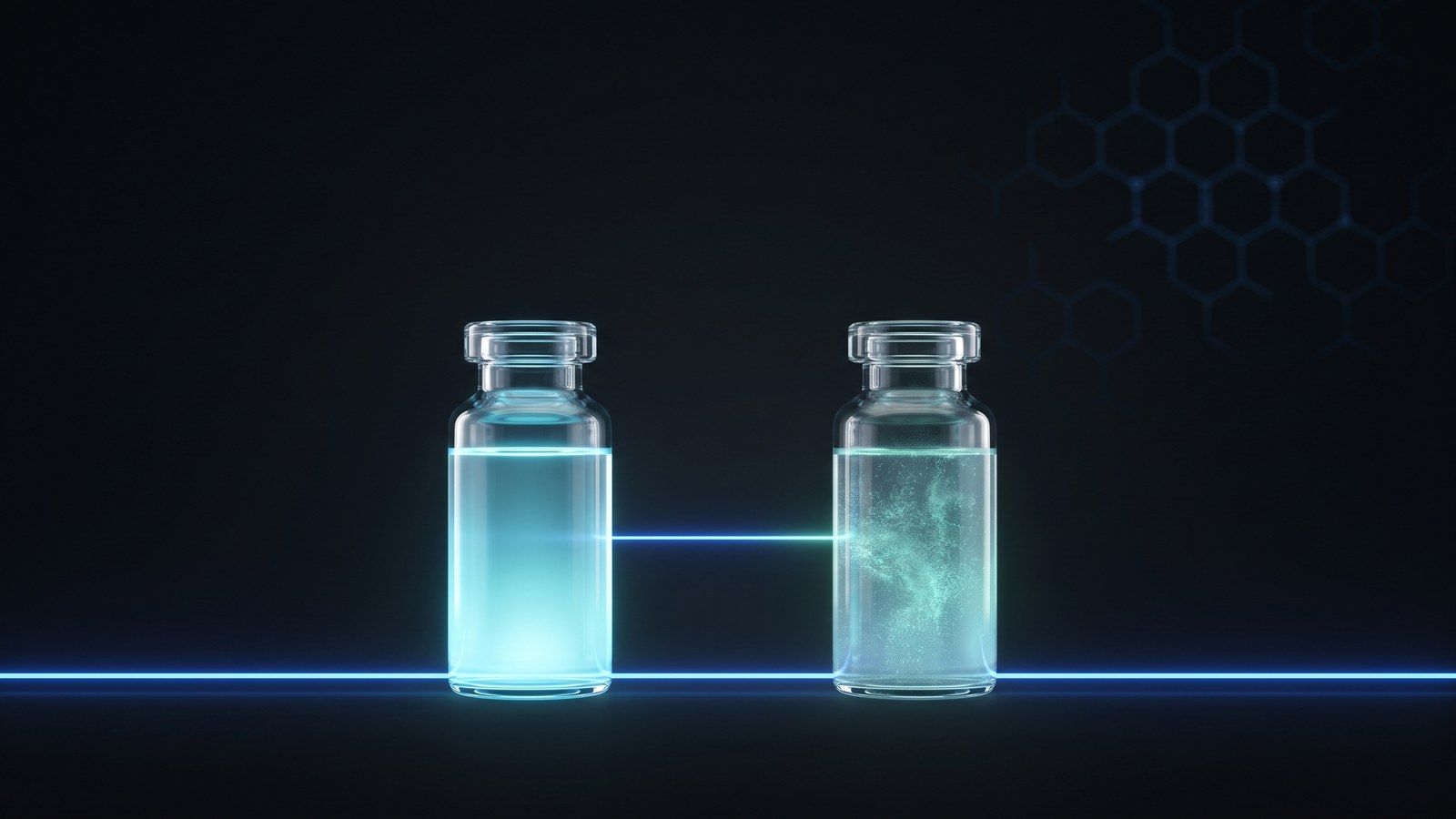
Your Peptide Looks Fine. That Proves Absolutely Nothing.
Cloudy, floaters, colour, smell — the four checks everyone runs. What visual inspection can and cannot detect, according to the people who do it professionally.
Your Peptide Arrived Warm. That’s Not the Real Problem.
A melted ice pack is not a verdict. How the pharmaceutical industry actually measures heat exposure — and why the thing doing the damage is probably in your kitchen.