
Every peptide fits six boxes and some of them aren’t peptides
You do not need fifty peptide names memorised. You need six boxes — and a warning about the loudest names on this shelf that were never peptides at all.
In this article ▾
This is the written version of Every Peptide Type In One Map — Start Here — watch it instead if you’d rather.
Every week somebody asks me about a peptide I have never heard of, and every week the answer is the same: I do not need to know the name yet, I just need to know which box it goes in. That is the whole trick behind this piece. There is no way to memorise fifty acronyms as they come at you — BPC, TB, GHK, CJC, KPV — but there are only about six jobs a peptide can actually be asked to do. Learn the six boxes once, and every new name you meet from here on just slots into one of them. Stick with me to the end too, because there is a twist: several of the most hyped “peptides” doing the rounds right now are not peptides at all, and I will show you the tell. Think of this as the process map I would draw on a whiteboard before touching any actual equipment — sort the inputs by function first, then worry about the individual parts.
What a peptide actually is
Strip away the mystique and a peptide is a short chain of amino acids — a small molecular message your body sends to tell a cell what to do next. That is it. It is the shortness that separates a peptide from a full protein, not some exotic property. A 2025 review of the peptide drug-development pipeline puts the field at more than a hundred approved peptide medicines already on the market, with several times that many peptides working their way through clinical trials worldwide, and a parallel look at just one year’s regulatory approvals found a fresh batch of peptide and oligonucleotide drugs cleared most years, not as a rarity. So no, the shelf is not endless nonsense — it is a genuinely large and growing drug class, and that length is exactly why sorting by function rather than by name is the only approach that scales. The trouble is that nobody sorts it for you before selling it to you. I do.
Mailbox one: healing and recovery
This is the BPC-157 and TB-500 corner — the internet’s favourite claim that a torn tendon can bounce back overnight. The real mechanism is genuinely interesting: these peptides signal the body to grow new blood vessels and lay down repair tissue faster. Here is the catch. A recent narrative review of the BPC-157 evidence found the field overwhelmingly preclinical — animal and lab work stacked deep, while robust, well-controlled human efficacy trials are still missing. That is not the same as “it does not work.” It is “promising, not proven,” and that distinction matters more than any before-and-after photo. I have gone deep on BPC-157 on its own if this is the mailbox that interests you.
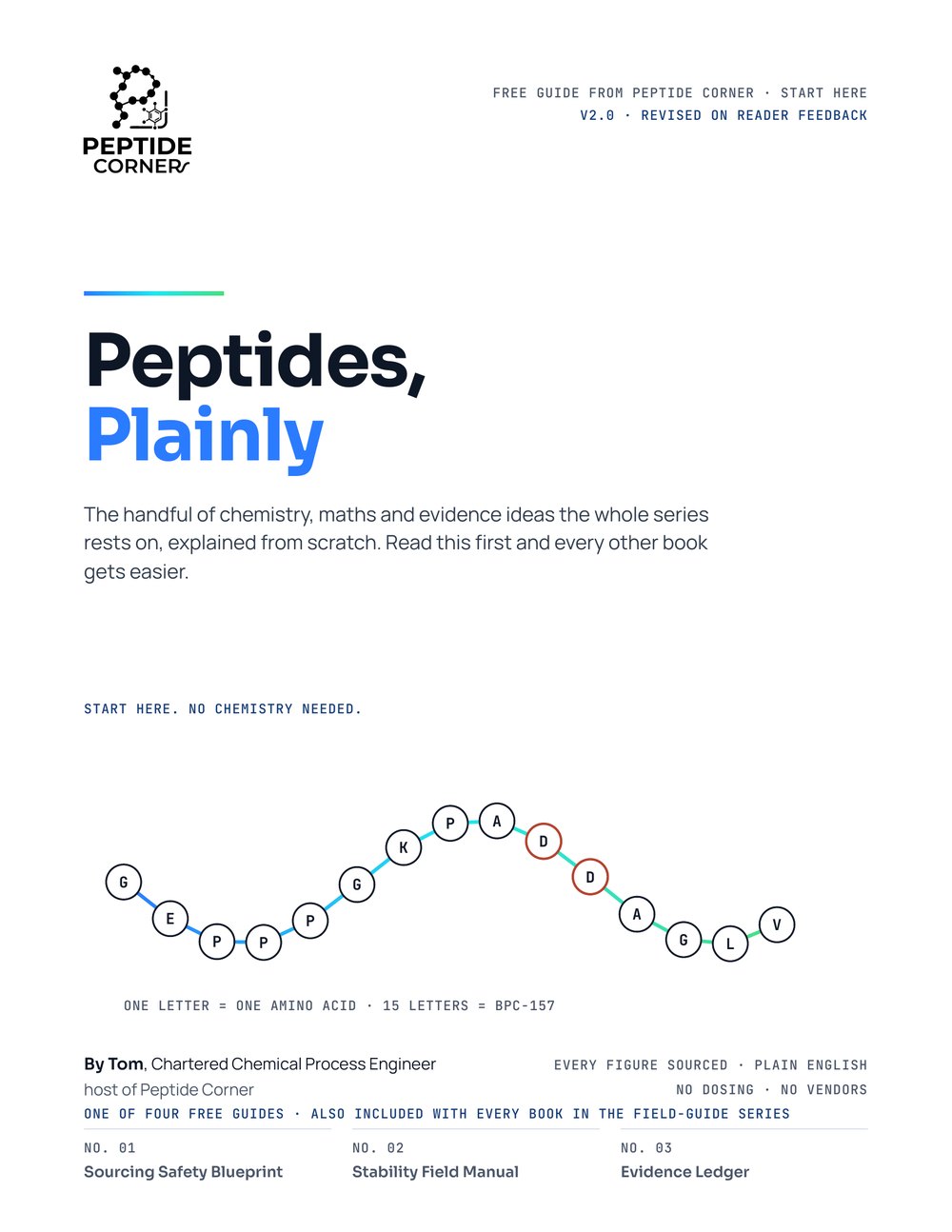
The free beginner’s guide: the chemistry, maths and evidence ideas everything else rests on, explained from scratch. Comes with the other three free guides, for one email.
Get the free guidesMailbox two: growth hormone
CJC-1295, Ipamorelin and Sermorelin live here. Picture your growth-hormone system as a plant with an accelerator pedal and a brake. These peptides press the accelerator, nudging your own pituitary gland to release its own growth hormone in natural pulses, rather than injecting the hormone directly. The theoretical upside of nudging your own gland, rather than injecting the hormone outright, is that your body keeps some say in how much comes out and when. The catch is the obvious one: more growth hormone signalling is never a free lunch, and regulators have been steadily tightening the rules around this entire category. It is worth understanding the accelerator, but understanding it is not the same as pulling on it.
Mailbox three: metabolic and GLP-1
Semaglutide, tirzepatide and the newer retatrutide sit in the metabolic drawer. These copy gut hormones that tell your brain you are full and help regulate blood sugar — the closest thing on this whole map to reverse-engineering a signal your body already sends itself, at industrial scale. Here is the fairness beat, because an anti-hype channel has to give credit where it is earned: this is the one mailbox where the human evidence is genuinely enormous — large, controlled human trials, not a handful of rat studies. When I am hard on the other five categories for thin human data, it is worth remembering that this corner built its reputation properly. That is also precisely why it is the most counterfeited and misused peptide category on the market, but that is a story for another day.
Mailboxes four and five: anti-ageing and cognitive
Mailbox four is anti-ageing — GHK-Cu and Epitalon. GHK-Cu is a copper-carrying peptide that does genuinely nice things for collagen in a dish and on skin. Epitalon is the stranger one: it pokes at telomerase, the enzyme involved in maintaining the caps on the ends of your DNA. The catch is that GHK-Cu’s best evidence stays topical and in vitro, and Epitalon’s human data is a handful of small, older studies. Interesting, not gospel — I unpack both properly in the GHK-Cu and Epitalon video.
Mailbox five is the brain peptides — Semax and Selank. Developed in Russia, and actually approved and prescribed there for focus and anxiety, they nudge brain-signalling molecules like BDNF, which is a bit like fertiliser for your neurons. The catch you can probably guess by now: Western clinical data on both stays thin, so a fair amount of what circulates about them is enthusiasm that has outrun the trials.
Mailbox six: the everything-else drawer
Every system needs a junk drawer, and this is it. KPV is a tiny anti-inflammatory fragment that essentially tells an over-reacting immune system to calm down. MOTS-c and SS-31 are aimed at the little battery packs inside your cells, the mitochondria, rather than at any single organ or tissue. Clever biology across the board, and mostly still preclinical, which is worth remembering the next time a drawer-six compound gets marketed as if it were as thoroughly proven as the metabolic mailbox. That is the whole map: six mailboxes, and if you can sort a new peptide into one of them, you already know more than most of the comment section.
The twist: not everything called a peptide is one
Now for the payoff I promised at the start. Some of the loudest names in this space do not fit into any of the six mailboxes above, for the simple reason that they are not peptides at all. MK-677, sold under the name ibutamoren, is an oral small molecule engineered to mimic ghrelin’s effect on growth hormone release — it is not a chain of amino acids, it is a synthetic pill pretending to belong on this shelf. 5-Amino-1MQ is a different small molecule again: the study that first characterised it identified it as an inhibitor of an enzyme called NNMT, with no peptide bond in sight. And SLU-PP-332, the “exercise in a pill” everyone is currently excited about, is a pan-ERR agonist — a completely different class of research compound built to flip on some of the same genetic switches that exercise does. None of that makes these molecules fake or worthless. It makes the label sloppy, and a sloppy label is usually where marketing starts doing more work than chemistry. Klotho gets sold the same way, which is exactly why I gave it its own explainer rather than squeezing it into a mailbox it does not belong in. As an engineer, mislabelling a component is not a cosmetic error — it is the first sign that whoever wrote the spec sheet was more interested in the sale than the substance.
If a compound will not drop cleanly into one of the six boxes, that is your first clue the label is lying to you.
The bottom line
Do not try to memorise the list. Learn the six mailboxes — healing, growth hormone, metabolic, anti-ageing, cognitive, and the everything-else drawer — and every acronym you meet after this has somewhere to go, along with an honest starting question: how good is the human evidence for this particular box? Some categories, like the metabolic one, have earned real confidence. Others, like healing and recovery, are still mostly a preclinical promise. And a few of the names shouting the loudest were never peptides to begin with. That is the whole map, and now you have got it.
Sources
- Advance in peptide-based drug development — delivery platforms, therapeutics and vaccines, 2025. The review behind the scale of the field: how many peptide drugs have been approved, and how many are in trials — https://pmc.ncbi.nlm.nih.gov/articles/PMC11880366/
- 2025 FDA TIDES harvest — the year’s approved peptide and oligonucleotide drugs, counted and categorised — https://doi.org/10.3390/ph19020244
- BPC-157 in musculoskeletal healing — a narrative review, 2025. The evidence base is overwhelmingly preclinical, and robust human efficacy trials are still missing — https://pmc.ncbi.nlm.nih.gov/articles/PMC12446177/
- 5-amino-1MQ as a small-molecule inhibitor of nicotinamide N-methyltransferase — the primary study. A small molecule, not a peptide — https://pmc.ncbi.nlm.nih.gov/articles/PMC5826726/
Educational and research purposes only — not medical advice. Peptide Corner does not recommend any vendor, source, or dose. Keep safe, keep skeptical.

BPC-157: What the Evidence Actually Says About the “Wolverine Peptide”
BPC-157 has spectacular animal data and almost no human data — here is the mechanism, the evidence, and the honest verdict as of late July 2026.
GHK-Cu And Epitalon: What The Evidence Actually Says About Copper Peptides And Telomeres
The copper peptide and the telomere peptide, graded honestly — real mechanisms, a database lookup masquerading as 4,000 effects, and a Russian trial record nobody has replicated.
They Sell Klotho As A Peptide. It’s 1,012 Amino Acids.
It arrives in a vial labelled peptide, and the sequence runs to 1,012 amino acids with seven glycosylation sites. That is not a long peptide. It is a different manufacturing category.