
TB-500: one blade off the Swiss Army knife
TB-500 gets sold as thymosin beta-4 in a smaller box. It isn't. It's a seven-residue snippet from the middle of a 43-amino-acid protein, it has never been through a human trial of its own, and a 2024 metabolism study suggests it may not even be the active molecule. Here's the chemistry, the evidence, and where the FDA landed in July 2026.
In this article ▾
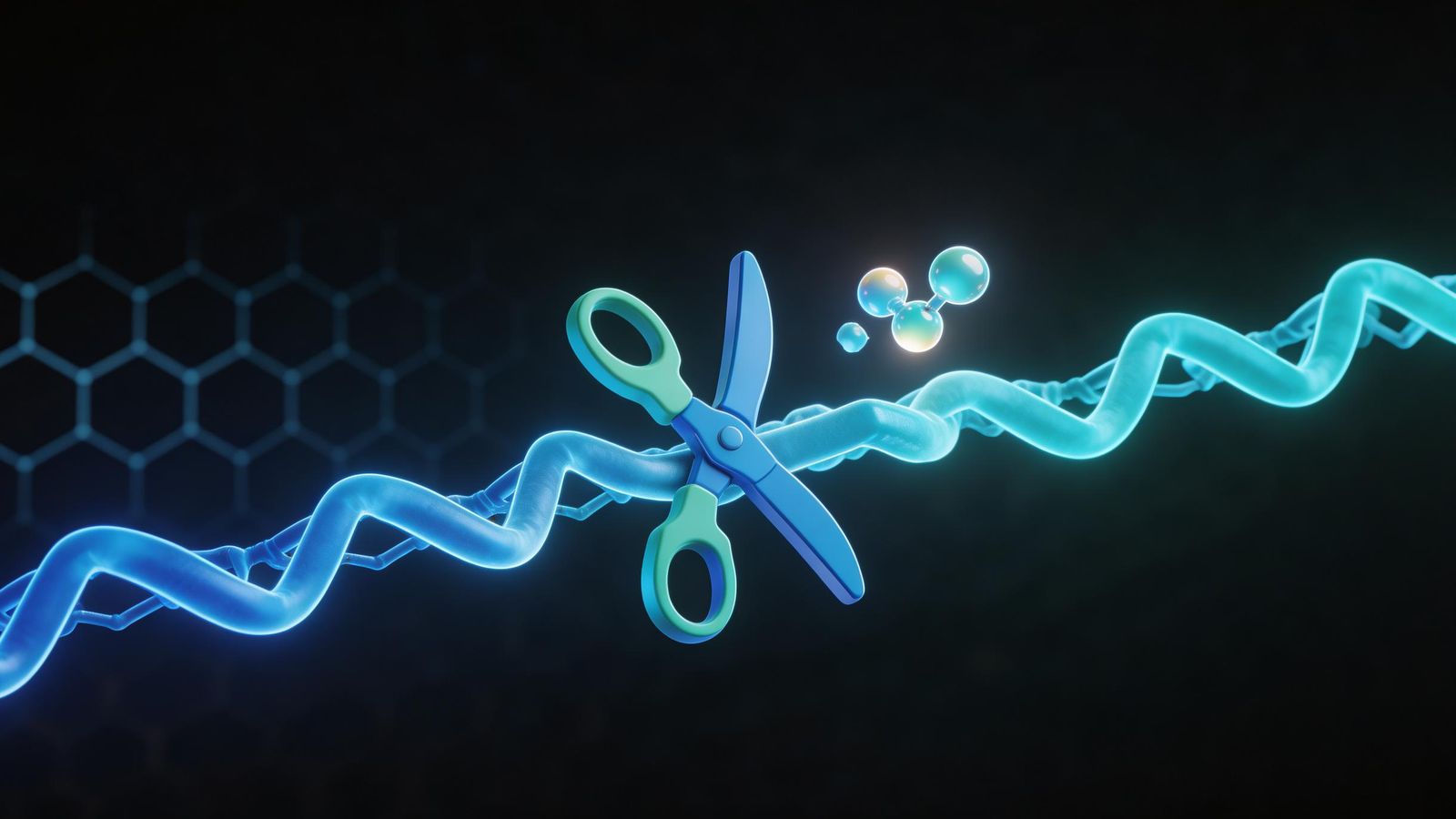
This is the written version of TB-500: The Racehorse Peptide That Isn’t Thymosin Beta-4 — watch it instead if you’d rather.
Every gym has one. The bloke with the dodgy shoulder, the elbow that sounds like a bag of gravel, and one answer for all of it: TB-500. The pitch never changes — it's just the healing bit of a protein your body already makes, so what could go wrong?
I'm a chartered chemical process engineer, which mostly means I'm paid to be suspicious of the word "just." So let's read the spec sheet properly. Because once you look at TB-500's actual chemistry, this stops being a story about healing and becomes one about mistaken identity — plus a quiet 2024 metabolism paper that pulled the rug out from under the whole thing. I walk through the molecular side on camera in the video above.
Two different molecules wearing the same name
Thymosin beta-4 — I'll call it Tβ4 — is real, and it's yours. It's a 43-amino-acid protein your platelets and macrophages dump into the wound the moment you injure yourself. It's an intrinsically disordered protein — no fixed 3D shape until it grabs something, then it folds around its target like cling film. That floppiness is a feature: it lets one small protein do several unrelated jobs.
TB-500 is not that protein. What's sold under that name is a synthetic seven-residue snippet — Ac-LKKTETQ, confirmed by mass spectrometry in a 2012 anti-doping analysis — corresponding to residues 17 to 23 of the parent chain. It weighs roughly 889 daltons against Tβ4's roughly 4.9 kilodaltons. Think of Tβ4 as a full Swiss Army knife and TB-500 as one blade snapped off and sold separately. The blade still cuts. It just doesn't do the other eleven things.
And here's the bit that matters most. Tβ4's celebrated anti-scarring activity doesn't live at residues 17–23 at all. It lives at the opposite end, in a four-residue tail called Ac-SDKP that two enzymes — meprin-alpha, then prolyl oligopeptidase — snip off the protein's front. TB-500 comes from the middle. It does not contain Ac-SDKP and cannot be cleaved into it.
The actin trick, and why it's genuinely clever
Picture a builder's yard with a huge stack of bricks and a foreman whose whole job is stopping anyone touching them until the order comes in. That foreman is Tβ4 — the cell's main actin-sequestering protein. It binds free actin monomers, G-actin, the loose bricks, and holds them in reserve so they don't assemble into filaments at the wrong moment.
When an injury signal arrives, a partner protein called profilin takes the monomers off the foreman's hands and feeds them onto the growing ends of actin filaments. That hand-off is the actual mechanical engine of cell movement: the cell builds new cytoskeleton at its leading edge, throws out a lamellipodium, and crawls toward the wound. The seven-residue fragment keeps that actin-binding motif, and in isolated human liver stellate cells it was the 17–23 stretch — not the N-terminal piece — that blocked the fibrotic response.
The migration numbers are worth getting right, though. In the classic Boyden chamber work from 1997, full-length Tβ4 acted as a chemoattractant for human endothelial cells and increased migration roughly four- to sixfold over media alone. That's the parent protein, not the fragment.
The free beginner’s guide: the chemistry, maths and evidence ideas everything else rests on, explained from scratch. Comes with the other three free guides, for one email.
Get the free guidesThe 2024 plot twist — a prodrug, but not the one you've heard
Here's the study that reframes everything. In 2024, a Korean doping-control group ran TB-500 through human serum, a panel of enzyme systems and live rats, then tracked every fragment that came out the other side. TB-500 gets chewed apart fast: the dominant early metabolite was a two-residue stub, and a three-residue piece was still detectable three days later. Then they took each metabolite to a fibroblast wound-healing assay to see which ones actually did anything.
Only one did — Ac-LKKTE, a five-residue chunk. Not the parent. The authors' own conclusion is that the wound-healing activity previously credited to TB-500 "may be due to its metabolite Ac-LKKTE rather than the parent form." So the prodrug thesis survives, but the metabolite is Ac-LKKTE, not Ac-SDKP — different peptides, from opposite ends of a different molecule.
Caveats, because this is one paper: cell culture and rats, the wording is "may be," and nobody has replicated it. But if it holds, TB-500 is flat-pack furniture that only works if the delivery driver assembles it correctly on the way — and the same paper says most of what your enzymes produce is inert offcuts.
Here's the catch: the human evidence isn't TB-500's
Every impressive human result in this space belongs to the parent protein. RGN-259, a Tβ4 eye drop, produced statistically significant corneal healing against placebo in a phase 3 neurotrophic keratopathy trial — but a later European phase 3 missed its primary endpoint of complete corneal healing at four weeks, which the sponsor blamed on an unexpectedly strong placebo response. It is not approved anywhere. Separately, a recombinant full-length Tβ4 called NL005 cleared a phase 1 study in healthy volunteers: well tolerated, dose-proportional pharmacokinetics, no dose-limiting toxicities. That's an intravenous drug being developed for heart attack, tested in healthy people, at phase 1.
Meanwhile a 2026 scoping review went looking for human interventional studies of Tβ4 or TB-500 in tendon, ligament, muscle, bone, cartilage or spinal disc, and found none — direct TB-500 evidence came down to a single laboratory study. So the headline claim holds: there are no completed, published human trials of the TB-500 fragment itself. Everything you've been told about it is extrapolated from a bigger molecule with a different metabolic fate.
One risk deserves careful wording. Tβ4 is a genuine pro-angiogenic agent — that 1997 paper showed it driving new vessel formation in vivo. New blood vessels are exactly what a hamstring repair needs. They are also what a tumour needs to grow beyond a couple of millimetres. That is a mechanism-based theoretical concern, not a demonstrated harm: nobody has shown TB-500 causes or accelerates cancer in people, because nobody has studied it in people at all. Absence of evidence, in both directions.
Where the law actually stands, as of late July 2026
In 2023 the FDA parked TB-500, BPC-157 and a batch of other peptides in Category 2 of its interim 503A bulks list — the "significant safety risks" bin — which shut compounding pharmacies out and pushed demand straight into the unregulated research-chemical channel. Congratulations: you've just been hired as your supplier's quality and safety manager. The closest hard data on what that means comes from a market-surveillance study of unlicensed online semaglutide, where measured purity ran between about 8 and 14 per cent against a claimed 99, and endotoxin turned up in every sample tested. Different peptide, same supply chain. Treat the specific purity and heavy-metal figures circulating for TB-500 as unsourced until somebody publishes them.
Then it moved. After a public push from HHS Secretary Robert F. Kennedy Jr. in early 2026, the FDA removed twelve peptide bulk substances — TB-500 among them — from Category 2 on 15 April 2026. And on 23–24 July 2026 the Pharmacy Compounding Advisory Committee finally met and voted 8–6 to recommend TB-500 for the 503A list for wound healing, alongside BPC-157 and KPV. The FDA's own scientists argued against, and their central objection was almost funny in context: they couldn't establish a universally accepted chemical identity for these substances. "What is it?" is not a question you want unresolved at that stage.
That vote is not binding and it is not approval. Category 1 placement still needs formal notice-and-comment rulemaking, which lawyers watching the process put at eight to twelve months. And none of it touches sport: WADA lists "Thymosin-β4 and its derivatives e.g. TB-500" under growth factors, prohibited at all times. This piece reflects the position as of late July 2026, and this file will keep moving.
TB-500 isn't thymosin beta-4 in a smaller box. It's one blade off the knife, and the best evidence we have says even that blade may only work after your enzymes have finished trimming it.
The bottom line
TB-500 has a real mechanism, a real parent molecule and a real body of preclinical work behind it. What it doesn't have is a single human trial of its own, a settled chemical identity in the regulator's eyes, or any certainty that the molecule in the vial is the one doing the work rather than a metabolite it may or may not produce in you.
The regulatory door is creaking open, which is genuinely good news — a supervised, tested supply beats an anonymous one in every respect. But an advisory vote is a recommendation, not a green light, and "the FDA might allow this to be compounded" is a very different sentence from "this works." Judge it on the evidence, and right now the evidence is a fragment. Keep safe, keep skeptical.
Sources
- Esposito et al., Synthesis and characterization of the N-terminal acetylated 17-23 fragment of thymosin beta 4 identified in TB-500, 2012 — https://doi.org/10.1002/dta.1402
- Rahaman et al., Simultaneous quantification of TB-500 and its metabolites, and wound-healing screening in vitro, 2024 — https://doi.org/10.1016/j.jchromb.2024.124033
- Malinda, Goldstein & Kleinman, Thymosin beta 4 stimulates directional migration of human umbilical vein endothelial cells, 1997 — https://doi.org/10.1096/fasebj.11.6.9194528
- Kumar et al., The anti-inflammatory peptide Ac-SDKP is released from thymosin-beta4 by renal meprin-alpha and prolyl oligopeptidase, 2016 — https://doi.org/10.1152/ajprenal.00562.2015
- Wang et al., First-in-human phase I study of recombinant human thymosin beta4 (NL005), 2021 — https://doi.org/10.1111/jcmm.16693
- McGuire et al., Thymosin Beta-4 and TB-500 in Tissue Healing, Regeneration and Musculoskeletal Repair: A Scoping Review, 2026 — https://doi.org/10.3390/app16126202
- FDA, July 23-24 2026 Meeting of the Pharmacy Compounding Advisory Committee — https://www.fda.gov/advisory-committees/advisory-committee-calendar/july-23-24-2026-meeting-pharmacy-compounding-advisory-committee-07232026
- FDA, Bulk Drug Substances Used in Compounding Under Section 503A of the FD&C Act — https://www.fda.gov/drugs/human-drug-compounding/bulk-drug-substances-used-compounding-under-section-503a-fdc-act
- Ashraf et al., Quality and safety analysis of semaglutide sold by online sellers without prescription, 2024 — https://doi.org/10.2196/65440
Educational and research purposes only — not medical advice. Peptide Corner does not recommend any vendor, source, or dose. Keep safe, keep skeptical.

BPC-157: What the Evidence Actually Says About the “Wolverine Peptide”
BPC-157 has spectacular animal data and almost no human data — here is the mechanism, the evidence, and the honest verdict as of late July 2026.
The FDA Peptide Vote, Explained: What PCAC Actually Decided on 23–24 July 2026
The FDA's compounding advisory committee backed six of seven peptides on 23–24 July 2026 — against its own reviewers. Here is what that vote does, and what it very much does not do.