
Peptides for your looks, ranked by actual evidence
Five appearance peptides ranked worst to best — then ranked again, honestly, because the one sitting at number one has never been tested on a single human face. Mechanism, evidence quality, and the safety file the regulators already read.
In this article ▾
- Rank 5 — Melanotan II: the deepest tan, the ugliest safety file
- Rank 4 — Argireline: Botox in a bottle, minus a way in
- Ranks 3 and 2 — Matrixyl and GHK-Cu, the boring honest middle
- Rank 1 — CJC-1295 and Ipamorelin, and why the top of the list is its weakest point
- The catch that outranks all five
- The bottom line
This is the written version of The 5 Peptides Sold For Your Face, Graded A To E — watch it instead if you’d rather.
Every ranking video on this subject hits the same wall, and it isn't the peptides. It's that “looks better” is one of the hardest endpoints in clinical science to measure. Blood pressure you read off a cuff. A “glow” is a photograph, a bathroom mirror, and someone who has already spent the money.
So this was never a ranking of which one works best. It's a ranking of which one has the shortest distance between what gets claimed and what anyone has actually measured. On two of the five, that distance is enormous — including, awkwardly, the one at number one.
Rank 5 — Melanotan II: the deepest tan, the ugliest safety file
Melanotan II is a synthetic analogue of alpha-melanocyte-stimulating hormone, the signal telling pigment cells to make more melanin. In skin that lands on MC1R — melanocortin receptor 1 — and the tan follows. Here's the engineering problem: MT-II isn't a key cut for one lock, it's a master key. It also opens the melanocortin receptors in your brain, MC3R and MC4R, which run appetite, flushing and sexual arousal.
That reframes everything. The nausea, the flushing and the prolonged erections — priapism, a urological emergency in its severe form — aren't a bad batch. They're the same mechanism as the tan, running in a different room. You can't formulate your way out of them.
Then the pigment-cell problem, which is the one that should actually stop you. Dermatology journals carry documented cases of people growing crops of new moles on MT-II, existing ones darkening and taking on growth features — in a man with a prior melanoma, the changes regressed once he stopped. Others describe dermoscopic changes severe enough that a clinician could no longer confidently tell a benign mole from a melanoma. Case reports aren't causation, but this is a compound whose entire job is driving melanocyte activity, so mechanism and reports point the same unpleasant way. Australia's TGA classes melanotan as an illegal therapeutic good and notes its development as a medicine was halted for safety reasons; it's unlicensed and illegal to sell in the UK.
Rank 4 — Argireline: Botox in a bottle, minus a way in
Argireline — acetyl hexapeptide-8 — is genuinely clever design. A nerve ending fires by docking a vesicle against the membrane using a three-part protein clamp, the SNARE complex, one arm of which is a protein called SNAP-25. Argireline is patterned on the end of SNAP-25. It's a decoy arm: slot it into the assembly, the clamp fouls, less neurotransmitter gets out, the muscle pulls a little less hard. Botulinum toxin does the same job far more brutally, by cutting SNAP-25 outright.
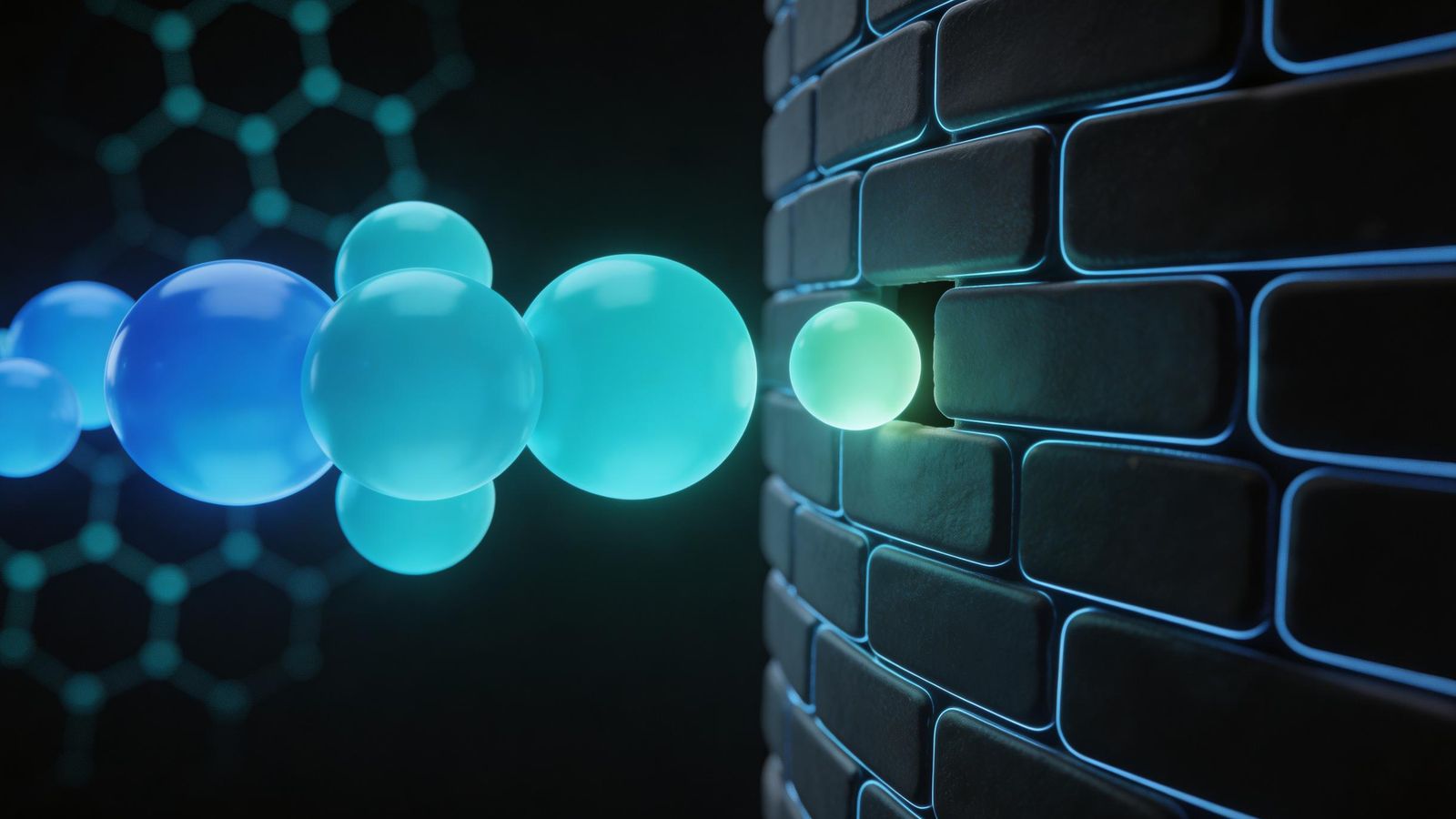
Beautiful mechanism. Now let's look at the actual engineering. There's a rough rule in dermatology — Bos and Meinardi, 2000 — that a molecule needs to be under about 500 daltons to cross intact skin. Argireline weighs around 889, and it's water-loving, while the outer layer of your skin is a lipid brick wall built to repel water-loving things. A 2025 review in the International Journal of Molecular Sciences puts it plainly: permeability is limited, and whether the peptide ever reaches a neuromuscular junction remains uncertain. You're watering a houseplant through a concrete wall.
The human data isn't nothing, though. The famous “up to 30% less wrinkle depth” figure comes from the 2002 paper that introduced the peptide — a handful of volunteers, thirty days, run by the group that designed the molecule. About as independent as a school report written by your mum. There is a better one: a 2013 randomised, placebo-controlled trial, 60 subjects, four weeks on crow's feet, finding measurable reductions in skin roughness. Real trial, but small and short. Something modest may happen at the skin surface — but nobody has shown the peptide gets to the muscle.
The eight questions to ask of any study before you believe its headline. Comes with the other three free guides, for one email.
Get the free guidesRanks 3 and 2 — Matrixyl and GHK-Cu, the boring honest middle
First, a correction to my own video. What I described — palmitoyl oligopeptide plus palmitoyl tetrapeptide-7 — is Matrixyl 3000, the later product. The original Matrixyl is palmitoyl pentapeptide-4: the sequence KTTKS with a palmitic acid tail bolted on to get it through that same lipid barrier. The original is what the trial everybody quotes used.
KTTKS is a fragment of type I procollagen. Think of it as a scrap of demolished collagen on the floor: the fibroblast reads it as evidence that structure has broken down and issues a work order for more. Real feedback loop, not marketing. The evidence is a 2005 double-blind, placebo-controlled, split-face study in 93 women aged 35–55 over twelve weeks, showing significant improvement in fine lines against moisturiser alone. Honestly, though: manufacturer-run, modest effects, and a later review flagged a startling absence of published skin-penetration data for a molecule sold on penetrating skin. And twelve weeks is the floor, not the finish line. To know whether it worked you need a calendar, not a mirror.
GHK-Cu takes second and has its own article here, so I'll keep it tight. GHK is a tripeptide — glycine, histidine, lysine — that occurs naturally in human plasma, declines with age, and binds copper avidly. The copper isn't decoration: lysyl oxidase, the enzyme that cross-links collagen and elastin into load-bearing fibre rather than loose strands, is copper-dependent. The headline claim, that GHK shifts the expression of thousands of human genes, traces to a widely cited review written by the researcher who has spent his career on GHK. Not disqualifying. Not independent either.
Rank 1 — CJC-1295 and Ipamorelin, and why the top of the list is its weakest point
The mechanism is the best-characterised here. CJC-1295 is an analogue of the first 29 amino acids of growth hormone-releasing hormone, engineered to latch onto serum albumin so the enzyme that normally shreds it can't — stretching its half-life from minutes to days. Ipamorelin is a selective agonist at the ghrelin receptor, a separate circuit into the same pituitary cells. Two accelerator pedals, two cables, one engine. The human data is real, too: a randomised, placebo-controlled trial in healthy adults, published in 2006, showed a single injection of CJC-1295 raised mean growth hormone several-fold for six days or more.
So what did that trial measure? Hormones. Concentrations in blood. It did not measure a face. There is no published human trial of these two run together with any appearance endpoint — no wrinkle depth, no dermal thickness, no hair density, no blinded before-and-after photography. None. The number one slot rests on a plausible mechanism plus a very large pile of forum anecdote.
Raising a hormone is not the same as improving a face — and on this list, only the boring topicals have ever been tested on faces.
Judged purely on evidence for how you look, this stack belongs below Matrixyl, which at least has a placebo-controlled facial trial behind it. It holds the top spot only on mechanistic ceiling — if anything here could plausibly move skin, hair and body composition at once, it's the growth hormone axis. Defensible argument. Not a demonstrated result, and I should have said so more clearly on camera.
I also called the stack cleaner and more predictable than injected growth hormone. Careful. Once GH is in your blood your tissues can't tell which lever released it, and the fluid retention and joint aches people associate with GH track total exposure, not the elegance of the mechanism. Regulators aren't relaxed either: the FDA has ipamorelin on its Category 2 list of bulk substances that may present significant safety risks in compounding, and the CJC-1295 nomination was withdrawn after the agency flagged raised heart rate and thin clinical data.
The catch that outranks all five
None of these is a licensed medicine for improving your appearance, anywhere. The topicals are regulated as cosmetics, so nobody had to prove they work before they went on sale. The injectables are unlicensed, so quality, identity and sterility rest entirely on a supplier nobody audits — congratulations, you've just been hired as that company's quality and safety manager, unpaid and without a lab. The rules are moving, too: an FDA advisory committee voted on a batch of research peptides in late July 2026, though neither of the two here was among them, and such votes change nothing until the agency writes rules.
The bottom line
Rank these five on evidence rather than excitement and the order nearly inverts. The only ones with placebo-controlled trials measuring actual human faces are the unglamorous topicals — palmitoyl peptides first, argireline a qualified second with a mechanism it has never been shown to reach. GHK-Cu has the richest mechanism, which is why it gets its own piece. The growth hormone stack has the highest ceiling and the emptiest evidence file for looks. Melanotan II earns last place twice over: on the safety signals, and on the fact that regulators already made the call.
None of that is a recommendation to use any of it. It's a map of where the evidence sits, which is the only thing that stops a ranking from being a wish list. This piece reflects the position as of late July 2026. Keep safe, keep skeptical.
Sources
- Bos & Meinardi, The 500 Dalton rule for the skin penetration of chemical compounds and drugs, Exp Dermatol, 2000 — https://pubmed.ncbi.nlm.nih.gov/10839713/
- Zdrada-Nowak et al., Acetyl Hexapeptide-8 in Cosmeceuticals — A Review of Skin Permeability and Efficacy, Int J Mol Sci, 2025 — https://pmc.ncbi.nlm.nih.gov/articles/PMC12193160/
- Wang et al., The anti-wrinkle efficacy of argireline: a randomized, placebo-controlled study, Am J Clin Dermatol, 2013 — https://pubmed.ncbi.nlm.nih.gov/23417317/
- Robinson et al., Topical palmitoyl pentapeptide provides improvement in photoaged human facial skin, Int J Cosmet Sci, 2005 — https://pubmed.ncbi.nlm.nih.gov/18492182/
- Cardones & Grichnik, Alpha-melanocyte-stimulating hormone-induced eruptive nevi, Arch Dermatol, 2009 — https://pubmed.ncbi.nlm.nih.gov/19380666/
- Therapeutic Goods Administration (Australia), Melanotan — illegal therapeutic goods — https://www.tga.gov.au/melanotan-illegal-therapeutic-goods
- Teichman et al., Prolonged stimulation of GH and IGF-I secretion by CJC-1295 in healthy adults, J Clin Endocrinol Metab, 2006 — https://pubmed.ncbi.nlm.nih.gov/16352683/
- FDA, Certain bulk drug substances for use in compounding that may present significant safety risks (Category 2 list) — https://www.fda.gov/drugs/human-drug-compounding/certain-bulk-drug-substances-use-compounding-may-present-significant-safety-risks
Educational and research purposes only — not medical advice. Peptide Corner does not recommend any vendor, source, or dose. Keep safe, keep skeptical.

GHK-Cu And Epitalon: What The Evidence Actually Says About Copper Peptides And Telomeres
The copper peptide and the telomere peptide, graded honestly — real mechanisms, a database lookup masquerading as 4,000 effects, and a Russian trial record nobody has replicated.
PT-141 (Bremelanotide): What The FDA Label And The Phase 3 Trials Actually Show
Bremelanotide is one of the very few peptides carrying a real FDA label, which makes it the rare case where the hype can be checked directly against the trial data.