
Your peptide came from one of four places. Ask which.
There are four systems a peptide can come out of, and each one leaves a different paper trail — or none at all. Here is how to tell which system you are looking at, and the five questions that get you there, without anybody having to name a seller.
In this article ▾

This is the written version of Your Peptide Came From One Of Four Places. Ask Which. — watch it instead if you’d rather.
The question I get more than any other is some version of: where should I actually get this from? I cannot answer it. Not will not — cannot.
But there is a better question underneath it, and almost nobody asks it. Not who sold you the vial. Which of four different systems it came out of. Each one leaves a different paper trail, and one of them leaves none at all. There is a single sentence in the US drug manufacturing regulations that hands you the exact question to put to any of the four, and I have saved it for the end.
First, why I will not point at names. One of my videos was taken down and this channel got a formal warning — not for recommending a seller, but for one link in a description, to a perfectly clean article, that happened to sit on a domain with a shop on it. The video came back on appeal. The warning did not. So I do not name sellers and I do not link domains that sell, and honestly it has made the videos better, because here is who to trust is a worse answer than here is how to tell. I take no money from anybody who sells peptides — no sponsorship, no affiliate deal, no commission and no discount code.
Route one: the compounding pharmacy
A 503A compounding pharmacy is allowed to make you a drug that has never been through FDA approval — but only against a prescription written for you, by name. In exchange it gets an exemption from the new-drug approval rules and, the part people miss, from federal good-manufacturing-practice requirements as well. That is not a free-for-all. The compounding standards and your state board still apply. What is switched off is the federal evidence machine, not the law.
So what does that exemption actually cost you? Look at the date on the vial. For an approved drug the expiry has to be determined by appropriate stability testing: you put batches away in the container the product actually ships in, you assay them as they age, and the date falls out of the data. Take that requirement away and the date still has to come from somewhere, so it comes from a table instead. The US pharmacopoeia’s compounding standard assigns a beyond-use date by what category of preparation it is, not by what happened when somebody aged that formulation in that container. A rule of thumb standing in for a qualification test. Both hand you a number. Only one of them has been to the lab.
I go back and forth on whether a date off a table beats no date at all, or is worse for looking exactly like information when it is not. What is not in doubt is what a limited FDA survey found when it sampled twenty-nine compounded products from twelve pharmacies: ten failed, and nine of those were subpotent — less active ingredient than the label claimed. The comparable figure for commercially manufactured drugs was under two percent. FDA’s own caveats travel with that: small sample, selected for risk, no scorecard for an industry. But look at what failed. Not identity. Not sterility. Potency — the thing a release test exists to catch.
Route two: the outsourcing facility
A 503B outsourcing facility needs no individual prescription. It registers with the FDA, it gets inspected on a risk-based schedule, and it does not get the manufacturing exemption. It runs good manufacturing practice, batch records and all, including release testing before anything ships: a sterility test, and an endotoxin limit that has to be met.
Here is why that lands differently. Good manufacturing practice is not a quality vibe, it is a paperwork obligation. Batch records exist, so when an inspector walks in there is something to inspect — and the FDA publishes what they found. The public register gives you the date of a facility’s last inspection and whether it produced a Form 483, the form an investigator leaves behind when they see something they do not like. So do not just check that a facility is registered. Check what happened the last time somebody looked.
And go easy on what you read into a clean entry. Registered is not approved, and the FDA neither approves nor licenses a pharmacy or a facility. In testimony to Congress it said it had found problematic conditions during the vast majority of the compounding inspections it had run. Registration buys you a witness. It does not buy you a verdict.
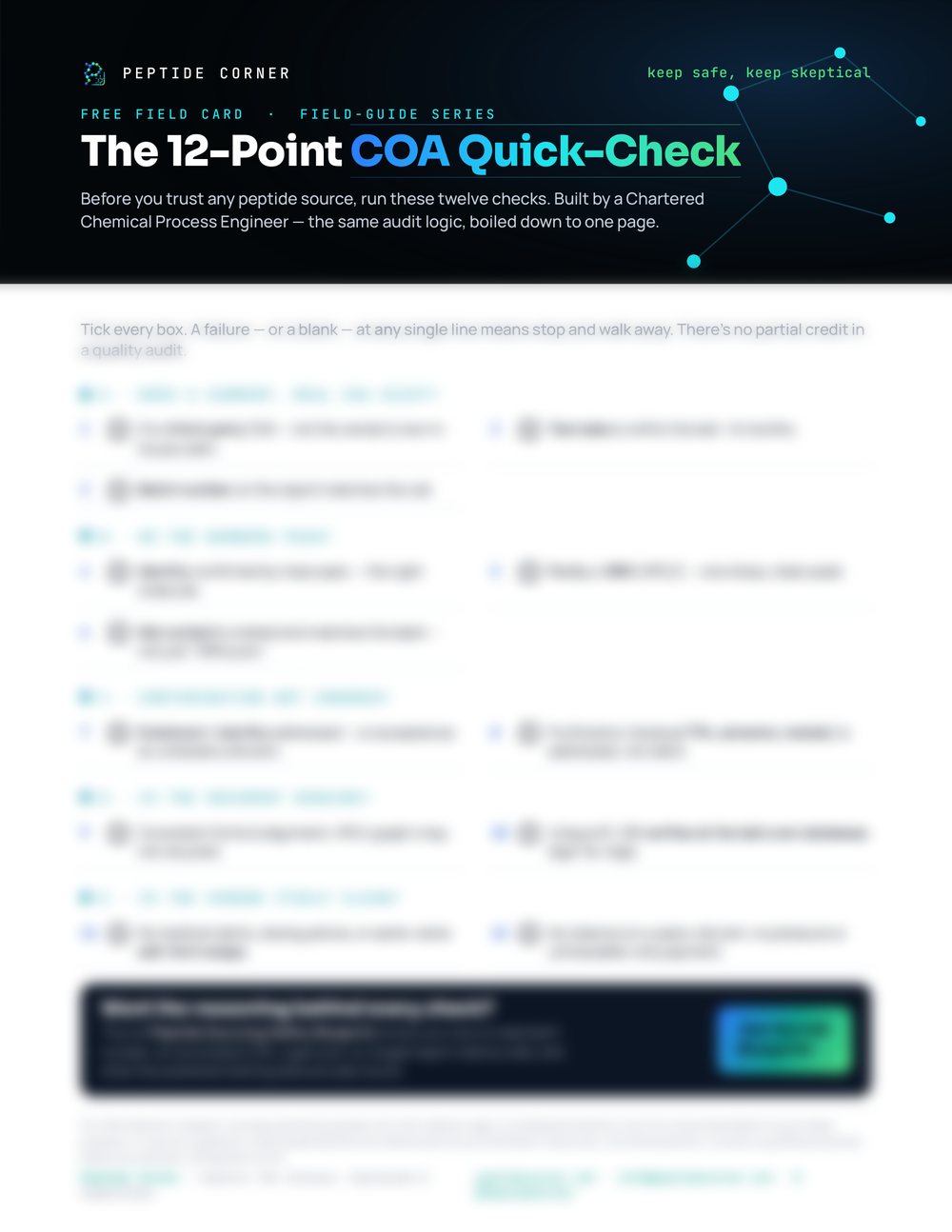
Twelve checks in the order I’d run them on any lab report, and one Pass / Ask / Stop rule. Printable, front and back. Comes with the other three free guides, for one email.
Get the free guidesRoute three: the research-chemical seller
Labelled research use only, not for human consumption. That label is not a legal shield: the FDA has acted against sellers whose own marketing described human effects, on the basis that intended use is judged on objective evidence rather than on what the box says.
But the reason the label does so much quiet work is not what it claims. It is what it switches off. There is a rule that every batch of a drug product purporting to be sterile gets tested for sterility. Sit on that word for a second — purporting. The obligation is triggered by the claim. Make no claim, and there is nothing to test against. The silence is the mechanism.
I had this the wrong way round myself, so let me correct it out loud. Nobody handed that buyer a lighter set of rules. Identity testing, an endotoxin limit, an expiry date that means something — every one of those obligations still exists. The person who was supposed to meet them stepped out of the room, and that label is how they left.
The part that amuses me: research use only is not even a drug term. It is borrowed from the labelling rules for diagnostic devices, and in the regime it came from, the regulator has already written down that the label does not exempt a product from otherwise applicable requirements.
Route four: the shopfront
This is the one that catches people, because it is not a fourth manufacturer at all. It is a shopfront standing in front of one of the first two. The FDA wrote to thirty telehealth firms objecting to branding a compounded product with the telehealth company’s own name in a way that implies they are the compounder. Often they are not.
That matters more than it sounds, because everything I have just told you to check attaches to a facility. The inspection record, the register entry, the batch records — all filed under the name of whoever actually made the thing. A brand is not that name. It is a sign on a building whose address you were never given, and the facility behind it can change between one order and the next. The FDA has described a case where the pharmacy named on a compounded product’s label was not the pharmacy that compounded it. That came to light because somebody was harmed.
What the protections are actually attached to
Here is the thread running under all four routes, and it took me a while to see it. Every protection in this system attaches to a patient. The prescription, the pharmacy standards, the inspection schedule, the labelling requirements — all of it is built around somebody who is being treated. Step outside that category and none of it follows you.
It isn’t that the rules got relaxed for you. It’s that you’re standing somewhere they were never pointed.
For what to do with the paperwork once it is in your hands, the piece on being your own QA department covers the document itself. This one is about which system produced it. There is a printable quick-check among the four free guides on the site if you want the condensed version.
Five questions worth asking
- Which of the four are you? Named, not guessed at.
- Which route qualifies the raw material? A pharmacopoeia monograph, a component of an already-approved drug, or the FDA’s own list of substances permitted for 503A compounding. Those are the only three answers.
- Did the raw material arrive with a certificate from an establishment actually registered with the FDA?
- Show me the release results for this lot — the sterility test and the endotoxin limit. Not a generic specification sheet that could belong to any batch. This lot.
- Which laboratory ran it, and is that exact method on the lab’s published scope? Accreditation is granted per method, not as a stamp on a building, and the directories that list scopes are public.
The bottom line
You will not get a name out of me, and I do not think you should want one. A name goes stale the moment a batch changes. Knowing which system you are standing in does not.
And here is the sentence I promised. It is in the US good-manufacturing regulations, and it governs what a manufacturer may do with a supplier’s certificate. Near enough word for word: a report of analysis may be accepted from the supplier, provided at least one specific identity test is conducted by the manufacturer, and provided the manufacturer establishes the reliability of the supplier’s analyses.
Read that again. Even a fully regulated manufacturer, sitting inside every safeguard described above, is not allowed to simply believe the certificate. It runs its own identity test on top, every time. That is the standard the law sets for professionals who already have every other protection in place, and a reasonable one to hold your own supply to.
Had a certificate sent to you? I read them — peptidecorner.net/coa-read
Sources
- FDA — 503A compounding pharmacy versus 503B outsourcing facility, and which one is required to run good manufacturing practice — https://www.fda.gov/drugs/human-drug-compounding/compounding-and-fda-questions-and-answers
- FDA — information for outsourcing facilities — https://www.fda.gov/drugs/human-drug-compounding/information-outsourcing-facilities
- FDA — the public register of registered outsourcing facilities: last inspection date, and whether it produced a Form 483 — https://www.fda.gov/drugs/human-drug-compounding/registered-outsourcing-facilities
- FDA — bulk drug substances that may be used in compounding under section 503A: the only three answers question two has — https://www.fda.gov/drugs/human-drug-compounding/bulk-drug-substances-used-compounding-under-section-503a-fdc-act
- FDA — current good manufacturing practice guidance for outsourcing facilities: the sterility test and the endotoxin limit before release — https://www.fda.gov/media/88905/download
- FDA, 3 March 2026 — thirty telehealth firms warned over branding a compounded product in a way that implies they are the compounder — https://www.fda.gov/news-events/press-announcements/fda-warns-30-telehealth-companies-against-illegal-marketing-compounded-glp-1s
- FDA — limited survey of compounded drug products: 29 products from 12 pharmacies, 10 failures, nine of them subpotent, against under 2% for commercially manufactured drugs. The survey’s own stated limitations are on the same page — https://www.fda.gov/drugs/human-drug-compounding/report-limited-fda-survey-compounded-drug-products
- FDA testimony to Congress, 29 January 2018 — close to 500 compounding inspections, with problematic conditions found during the vast majority of them — https://www.fda.gov/news-events/congressional-testimony/examining-implementation-compounding-quality-act-01292018
- FDA — a compounded product labelled as compounded by a pharmacy that did not compound it — https://www.fda.gov/drugs/drug-alerts-and-statements/fdas-concerns-unapproved-glp-1-drugs-used-weight-loss
- FDA warning letters, case 729447, 17 June 2026 — a “research use only” label did not change the product’s intended use — https://www.fda.gov/inspections-compliance-enforcement-and-criminal-investigations/compliance-actions-and-activities/warning-letters
- 21 CFR 211.84 — the sentence quoted at the end, in full — https://www.ecfr.gov/current/title-21/chapter-I/subchapter-C/part-211/subpart-E/section-211.84
- 21 CFR 211.137 — an expiry date determined by appropriate stability testing, run in the container the product ships in — https://www.ecfr.gov/current/title-21/chapter-I/subchapter-C/part-211/subpart-G/section-211.137
- 21 CFR 211.167 — testing for each batch of drug product purporting to be sterile — https://www.ecfr.gov/current/title-21/chapter-I/subchapter-C/part-211/subpart-I/section-211.167
- 21 CFR 201.128 — intended use is judged on objective intent — https://www.ecfr.gov/current/title-21/chapter-I/subchapter-A/part-201/subpart-H/section-201.128
- FDA guidance — an in vitro diagnostic labelled “research use only” is not thereby exempt from otherwise applicable clearance, approval or other requirements — https://www.fda.gov/regulatory-information/search-fda-guidance-documents/distribution-in-vitro-diagnostic-products-labeled-research-use-only-or-investigational-use-only
- A2LA accreditation directory — accreditation is granted per method — https://customer.a2la.org/index.cfm?event=directory.index
- ANAB accreditation directory — https://anab.ansi.org/directories/
Educational and research purposes only — not medical advice. Peptide Corner does not recommend any vendor, source, or dose. Keep safe, keep skeptical.


Why the Peptide Gray Market Makes You the QA Department
“Research use only” is not a quality standard — it is the mechanism that moves the entire quality function from an inspected factory onto the buyer.

How to Read a Peptide COA Like an Engineer
A Certificate of Analysis is only as good as your ability to read it. Here’s the two-number test, the forgery tells, and why 99% purity can still mean you got shorted.

Thymogen Has a Mirror Twin Your Lab Report Can’t See
Same two amino acids, same formula, same mass — and two separate national drug registrations pointing opposite ways. The variable a purity number was never built to see.