
It’s not the cold. It’s the interface.
The freezer setting almost everyone uses is cold enough to start the damage and too warm to stop it. Here's what the actual freeze-thaw literature says, and where it runs out.
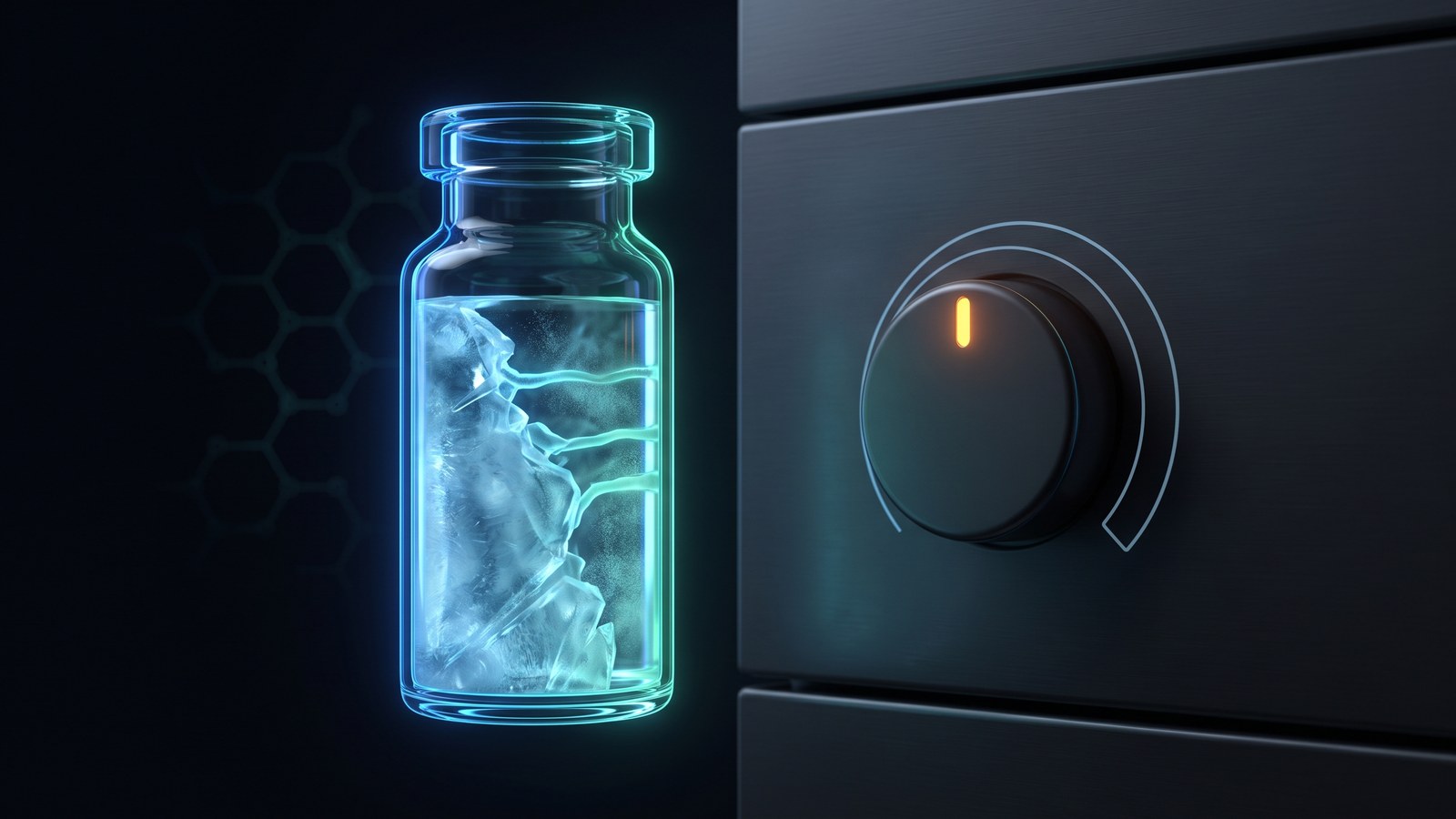
This is the written version of Your Peptide Freezer Has One Temperature That Ruins It — watch it instead if you’d rather.
The most-liked comment on one of my videos told me I was wrong about freezing peptides. Somebody had run their own freeze-thaw testing — freeze it, thaw it, retest it — and the numbers barely moved. So I went back through the actual freezing literature to check, and the honest answer is that we were both partly right. Almost everyone arguing about this, including me until recently, has been arguing about the wrong variable. The thing that does the damage in a freezer isn't the cold. It's what the cold creates.
The theory that doesn't survive contact with chemistry
Here's the forum version of events: the water freezes, ice crystals form, and those crystals physically tear the peptide apart. It sounds mechanically plausible. It's also chemically wrong — ice doesn't carry anywhere near enough energy to break the bonds holding a peptide chain together.
What ice actually does is push everything else out of its way. Water crystallises pure, so as ice forms, every dissolved thing in that vial — peptide included — gets shoved into a shrinking pocket of liquid that hasn't frozen yet. That remaining pocket gets concentrated far beyond its starting strength, and it ends up bordered by an enormous amount of ice surface relative to its size. One piece of work I read on this measured a muscle protein rather than anything injectable — food science, not pharmaceutical science, so I'm reading it for the mechanism rather than for a number that transfers — and it quantified that ice-water interfacial area directly across two different freezing routes. The route that produced the larger interface produced more damage to the protein. That's the pattern worth remembering: more interface, more harm, and the cold itself isn't what's doing it.
The pH swing nobody mentions
Here's the part I didn't know until I started reading properly. A lot of injectable solutions are buffered with phosphate salts, and phosphate buffers don't freeze evenly. One of the two salts crystallises out of solution before the other does, and once it's gone, what's left behind is chemically unbalanced. Measured directly, a solution that started at a normal body pH of about 7.4 dropped to roughly 4.2 once frozen — a swing of about four whole pH units, which is roughly the gap between blood and vinegar.
Then you thaw it, everything redissolves, and the pH goes straight back to where it started. There's a study that looked specifically at whether that frozen-state acidification leaves any lasting mark, and it found none in the freeze-dried solid it measured. Worth being precise about what was and wasn't tested there — that's a freeze-dried powder, not a liquid you've thawed back out — but it points the same reassuring way. Whatever happens to the chemistry while it's frozen appears to leave no fingerprint you could detect afterwards, even by testing the pH once it's liquid again.
The freezer's dead zone
This is the finding that actually changed my mind about where the real risk sits. One industrial team froze the same antibody two different ways: at minus eighty degrees it stayed stable, at minus twenty it aggregated. Same molecule, same buffer, same number of freeze-thaw cycles — and they specifically tested whether the cold itself was the cause, and ruled it out. A second, independent group ran a similar comparison on antibodies out to twelve months and found the same divide: storage cold enough to reach the glass transition point prevented aggregation completely, while minus twenty and minus ten degrees did not.
What seems to matter is contact with ice, and how much freedom molecules still have to move while everything around them is frozen. Below a certain temperature, the whole frozen mass turns glassy and effectively locks in place — nothing moves enough to keep reacting. Above that temperature, you've still made ice, and everything left in the concentrated liquid pocket is mobile enough to keep interacting with that ice surface. Minus eighty degrees sits below that line. A standard kitchen freezer, running at around minus eighteen degrees, sits above it.
Put plainly: a domestic freezer is cold enough to make ice, concentrate whatever's dissolved in the vial, and swing the pH — and nowhere near cold enough to stop any of that from continuing to react. It's a temperature that was chosen for frozen peas, not for a folded protein.
The water you mixed it with
The second thing almost nobody mentions is what's in the water itself. Bacteriostatic water is bacteriostatic because it contains a preservative — benzyl alcohol — and that preservative isn't a passive bystander during a freeze. One recent study on a therapeutic protein found that benzyl alcohol made freeze-thaw damage measurably worse, and traced part of the effect to how it changes ice formation: it encourages finer ice crystals, and finer crystals mean more total ice surface for the same volume of liquid. More interface, by the same mechanism as before, just turned up. The study's own authors recommended avoiding frozen storage of anything containing it. A separate, independent study — on a different protein again, an interferon rather than an antibody — found the same preservative destabilising, and the damage got worse as the protein's own concentration dropped.
Which leads to the last piece. Across several separate studies on proteins, the more dilute the solution, the worse the freeze-thaw damage tended to be. One found a concentrated solution effectively protected itself against repeated cycles, while a dilute version of the same protein couldn't be protected without carefully choosing the buffer. Another found that starting dilute produced substantial concentration effects during freezing that a strong starting solution mostly avoided. None of that was measured on a short peptide. But the reasoning I'd draw from it — and I want to be clear that this is my inference, not something anyone has measured directly — is that reconstituting a small vial into a larger volume than necessary, just to make the dosing arithmetic easier, quietly produces a more dilute, and by that same pattern a more fragile, solution than a smaller volume would.
Where the evidence actually runs out
Here's the honesty I owe you before drawing any conclusion. Every study I've just described was run on an antibody, an interferon, or a growth hormone — large, folded molecules with enough three-dimensional structure that a surface like an ice-water interface can pull them apart. A peptide chain of only fifteen amino acids, or one of just three, has barely any folded structure to lose in the first place. There's almost nothing there to unfold.
So I went looking for freeze-thaw data actually run on the short peptides people buy and use. I didn't find thin evidence. I found essentially none — nobody appears to have run the experiment. Which means anyone confidently telling you what freezing does to one of these short peptides is extrapolating from a molecule roughly forty times the size. Until I read all of this properly, that included me.
That gap cuts against overconfidence in both directions, and it's exactly why I want to correct something a commenter proposed publicly: the idea of nudging a future dose upward to compensate for suspected freeze damage they couldn't otherwise measure. Please don't do that. There is no measured number for these short peptides to compensate against — not a percentage, not a fraction, nothing — so adjusting anything upward isn't correcting for a known loss. It's guessing once about the damage and then guessing again about the fix, and compounding both guesses.
The bottom line
Freezing isn't a single state you either avoid or accept. It's a process, and the damage traced through every study above comes from the interface that process creates — the ice-water surface, the pH swing, the preservative's own contribution to ice structure — not simply from how cold the vial gets.
Minus eighty is defensible. The fridge is defensible. Minus eighteen is the one place cold enough to start the process and too warm to stop it — and it's the one almost everyone is using.
Whichever storage temperature you land on, the variable that seems to matter most, on the evidence that exists, isn't the temperature itself — it's how many times the material makes the trip between frozen and thawed. I've written up the fridge side of this question separately, including the thirty-day rule people quote for a mixed vial, in a companion piece. And if you'd rather have reasoning like this written down properly than pieced together from a comment section, it's part of what's covered across the site's three free guides.
Sources
- Lu, Domingo-Yenes, Cohen & Grzincic, Journal of Pharmaceutical Sciences, 2025 — the study behind the dead-zone section: a bispecific antibody aggregated during freeze-thaw and storage at −20 °C but not at −80 °C, and protein interaction with ice is the main driver — https://doi.org/10.1016/j.xphs.2025.103711
- Bluemel et al., International Journal of Pharmaceutics: X, 2021 — the independent second group: storage below the glass transition completely prevented antibody aggregation and particle formation, while −20 °C and −10 °C did not, out to twelve months — https://doi.org/10.1016/j.ijpx.2021.100108
- Thorat & Suryanarayanan, Pharmaceutical Research, 2019 — where the four-pH-unit figure comes from: on freezing phosphate-buffered saline, a shift of about four units was observed as one buffer salt crystallised out — https://doi.org/10.1007/s11095-019-2619-2
- Gómez, Pikal & Rodríguez-Hornedo, Pharmaceutical Research, 2001 — the measurement itself: from a starting pH of 7.4, 50 and 100 mM phosphate solutions reached pH 4.2 at −10 °C — https://doi.org/10.1023/a:1011082911917
- Vetráková, Vykoukal & Heger, International Journal of Pharmaceutics, 2017 — is there a pH-memory effect? The large acidification measured on freezing was not detected in the dried solid afterwards. Note what this does and does not test: it measures the freeze-dried solid, not a thawed solution — https://doi.org/10.1016/j.ijpharm.2017.08.005
- Chen et al., International Journal of Biological Macromolecules, 2025 — the interface measurement: two freezing routes with quantified ice-water interfacial areas, and the larger area produced more denaturation. Food-science myofibrillar protein, so read it for mechanism rather than for a peptide number — https://doi.org/10.1016/j.ijbiomac.2025.140672
- Xu, Yang, Liu, Qian & Fang, International Journal of Pharmaceutics, 2025 — the benzyl alcohol paper: it synergistically worsened freeze-thaw damage, partly through micro-ice-crystal formation increasing the destabilising ice-water interface, and the authors recommend avoiding frozen storage of products containing it — https://doi.org/10.1016/j.ijpharm.2025.126433
- Zhang et al., Pharmaceutical Research, 2011 — the cycle-count finding: aggregation increased with the number of freeze-thaw cycles and decreased with protein concentration — https://doi.org/10.1007/s11095-011-0538-y
- Sonje, Thakral, Krueger & Suryanarayanan, Molecular Pharmaceutics, 2021 — the concentration effect: at 1,000 µg/mL the protein had a pronounced self-stabilising effect and did not aggregate after five freeze-thaw cycles, while at 10 and 100 µg/mL irreversible aggregation could only be avoided by choosing the buffer carefully — https://doi.org/10.1021/acs.molpharmaceut.1c00666
- Bluemel et al., Pharmaceutical Research, 2020 — the dilution study: at low initial concentration cryoconcentration was substantial, while high initial concentration suppressed it almost completely — https://doi.org/10.1007/s11095-020-02886-w
- Lam, Patapoff & Nguyen, Pharmaceutical Research, 1997 — benzyl alcohol again, independently, on a different molecule: it destabilised recombinant human interferon-gamma, and the loss was accelerated at lower protein concentration — https://doi.org/10.1023/a:1012190120061
Educational and research purposes only — not medical advice. Peptide Corner does not recommend any vendor, source, or dose. Keep safe, keep skeptical.

Peptide Storage: The 30-Day Rule Measures the Wrong Thing
It is 28, not 30, and it is a sterility rule for a punctured vial — not a statement about your molecule. Where the number really comes from.
Your Peptide Arrived Warm. That’s Not the Real Problem.
A melted ice pack is not a verdict. How the pharmaceutical industry actually measures heat exposure — and why the thing doing the damage is probably in your kitchen.
Reconstitution Maths Isn’t the Hard Part — The Clock After It Is
Milligrams, millilitres and syringe units are three scales for one vial — which is the whole reason the maths feels hard. Here is the ratio, the trap that doubles a dose without moving the plunger, and why degradation is the real constraint.