
Thymogen has a mirror twin your lab report can’t see
Two dipeptides built from the same two amino acids are registered in Russia as two different medicines pointing in opposite directions — one switches the immune system on, the other switches it off. Neither mass spectrometry nor an ordinary purity column can tell them apart. Here is why handedness is a manufacturing variable your certificate does not measure.
In this article ▾
- Two amino acids, two national registrations
- Why a mirror matters: the glove
- Mass spectrometry cannot see this, by design
- HPLC is better than its reputation — until it isn’t
- What the rulebooks actually say
- So what does this mean for the vial in your fridge?
- When somebody flips it on purpose
- The bottom line, and the step where it happens

This is the written version of Thymogen Has A Mirror Twin Your Lab Report Can’t See — watch it instead if you’d rather.
Two vials. Each one holds the same two amino acids stuck together — glutamic acid, and tryptophan. Same ingredients, same formula, same mass. Put them on a balance and you get the same number twice.
And yet one of them is registered in Russia as a medicine that switches your immune system on. The other is registered to switch it off.
I read industrial paperwork for a living, and this is a case where the paperwork goes blind. Not because anybody lied on it. Because the thing that makes those two vials different is not a thing a certificate of analysis was ever built to measure.
Two amino acids, two national registrations
The first vial is a dipeptide called Thymogen. It is glutamic acid joined to tryptophan, and both residues are left-handed — L-Glu-L-Trp. It was pulled out of a calf thymus extract decades ago and has been a registered medicine in Russia since 2009, as an immune stimulant.
The second vial is called Thymodepressin. Same two amino acids, except both are right-handed. It was registered in Russia in 2008, as an immune suppressant — used for psoriasis, for autoimmune conditions, and to protect bone marrow during chemotherapy.
Worth being precise here, because precision is the whole point of this article. They are not a perfect mirror pair. The linking bond moves as well as the handedness: it hangs off the side arm of the glutamic acid rather than the main one — γ instead of α. So they are a near-mirror. That makes the story more interesting, not less, and it is the detail most write-ups get wrong.
Two amino acids. Two separate national drug registrations. Opposite instructions to your immune system.
Why a mirror matters: the glove
Hold your hands up in front of you. Same bones, same fingers, same everything — and you cannot get your left glove onto your right hand. That is chirality: a shape whose mirror image cannot be laid on top of it.
Now build the same peptide out of right-handed amino acids. Every atom is the same. Every bond type is the same. The molecular weight is identical to the fourth decimal place. It just does not fit the glove any more.
And here is the genuinely strange part — sometimes it fits a different glove instead. Which is what Thymodepressin appears to do. The molecule did not stop working. It started doing something else.
Twelve checks in the order I’d run them on any lab report, and one Pass / Ask / Stop rule. Printable, front and back. Comes with the other three free guides, for one email.
Get the free guidesMass spectrometry cannot see this, by design
Mass spec is the test most people treat as the final word on identity. It measures mass. Two mirror-image molecules have exactly the same mass.
The shift is not small. It is zero. Mass spec cannot see a full inversion at all, ever, and no better instrument fixes that — it is not a sensitivity problem, it is a category problem. You are asking a scale to tell you which hand you are holding.
HPLC is better than its reputation — until it isn’t
This is where most explanations overreach, so let me be fair to the column.
If one amino acid in a chain is flipped, the result is a diastereomer — a genuinely different shape. It interacts with the column differently and comes off at a different retention time. Ordinary reversed-phase HPLC usually does catch that.
Where an achiral column goes blind is when the whole molecule is inverted. Then the two really are true mirror images, they behave identically in an achiral environment, and they come off the column at the same moment as a single peak. Which is precisely the Thymogen and Thymodepressin case.
So “HPLC cannot see D-amino acids” is wrong as a general claim. The accurate version is narrower and more useful: a single flip is usually visible; a full inversion is not. Seeing it deliberately takes a chiral method — a chiral stationary phase, or derivatisation with something like Marfey’s reagent to turn the pair into diastereomers first.
What the rulebooks actually say
Here is the part that surprised me. The US pharmacopoeia treats chirality as an identity attribute rather than a purity one — which is defensible chemistry, and it also means it is not a routine line item on a purity panel.
And the FDA’s guidance on impurities in certain highly purified synthetic peptide drug products defines peptide-related impurities as insertions, deletions and modifications. Read the whole document. D-amino acids are not mentioned once.
I am not saying anybody is breaking a rule. I am saying the rule does not ask the question. Those are different complaints, and only one of them is fixable by reading your paperwork more carefully.
So what does this mean for the vial in your fridge?
Two things, and they pull in opposite directions.
- A single flipped residue. A decent chromatography method will usually show it — but it turns up as an unnamed extra peak, not as a wrong-handed molecule, and only if the method was built to separate it in the first place. You would see that something was there. You would not be told what.
- A fully inverted molecule. Both headline numbers come back perfect. The mass matches. The purity matches.
Which is the whole argument in one line: a certificate can be completely truthful and still never have answered the question of which hand you are holding — and the test that would answer it is not on a routine panel. If you want the plain-English version of what a certificate is and is not telling you, the COA quick-check card is one of the four free guides.
Chirality is a variable in peptide manufacturing, and it is not a variable your paperwork measures.
When somebody flips it on purpose
None of this makes a flipped residue automatically damage. Somebody does it deliberately, and it works beautifully.
Vasopressin is the hormone that tells your kidneys to hold on to water. Take it, flip a single amino acid near the end from left-handed to right-handed, trim one group off the front, and you get desmopressin — a more potent, more selective drug that has been in clinical use for decades.
So a flipped amino acid is not a defect. It is a lever. The problem is when nobody knows the lever has been pulled.
The bottom line, and the step where it happens
Which brings us to where handedness actually goes wrong in manufacturing: the coupling step — the moment one amino acid is joined to the next. Certain residues are far more prone to flipping while that reaction runs, and cysteine is the worst offender.
Published work has measured cysteine racemisation at 5.2 to 12.3% under ordinary conditions. In one documented case, with the wrong base, it reached roughly 50% — half the molecule inverted in a single step. The figure the industry actually aims for is under 1%.
That is the honest shape of it. Not a scandal, not a scare, and not a claim that anything on the gray market has been shown to fail this way — no survey of gray-market peptide chirality exists, and I am not going to invent one. It is a real manufacturing variable, with a measured failure range, that your purity number was never designed to report on.
Had a certificate sent to you? I read them — peptidecorner.net/coa-read
Sources
- Deigin et al., “Peptide ligands of the immune system” (Thymogen = L-Glu-L-Trp, Russian registration 2009; Thymodepressin = γ-D-Glu-D-Trp, registration 2008; the explicit α-bond vs γ-bond distinction), Int J Mol Sci, 2024;25(9):5042 — https://doi.org/10.3390/ijms25095042
- Molecules, 2021;26(21):6550 — Thymodepressin as an immunosuppressor: psoriasis, autoimmune cytopenias, and myeloprotection during antitumour therapy — https://doi.org/10.3390/molecules26216550
- Bulletin of Experimental Biology and Medicine, 2008 — the γ-D-Glu-D-Trp naming — https://doi.org/10.1007/s10517-008-0234-z
- Bai, Sheeley & Sweedler, “Analysis of endogenous D-amino acid-containing peptides” (zero mass shift between enantiomers; achiral reversed-phase HPLC resolves diastereomers but not enantiomers), Bioanalytical Reviews, 2009 — https://doi.org/10.1007/s12566-009-0001-2
- Journal of Peptide Science, 2012 — approximately 50% cysteine racemisation measured with N-methylmorpholine as base — https://doi.org/10.1002/psc.2407
- Journal of Peptide Science, 2007 — cysteine racemisation of 5.2–12.3% under ordinary coupling conditions — https://doi.org/10.1002/psc.879
- Journal of Peptide Science, 2013 — the under-1.0% acceptability threshold for racemisation — https://doi.org/10.1002/psc.2585
- Biopolymers, 2016 — desmopressin as deamino-vasopressin carrying a D-Arg8 substitution — https://doi.org/10.1002/bip.22825
Educational and research purposes only — not medical advice. Peptide Corner does not recommend any vendor, source, or dose. Keep safe, keep skeptical.


How to Read a Peptide COA Like an Engineer
A Certificate of Analysis is only as good as your ability to read it. Here’s the two-number test, the forgery tells, and why 99% purity can still mean you got shorted.

Your Peptide Looks Fine. That Proves Absolutely Nothing.
Cloudy, floaters, colour, smell — the four checks everyone runs. What visual inspection can and cannot detect, according to the people who do it professionally.
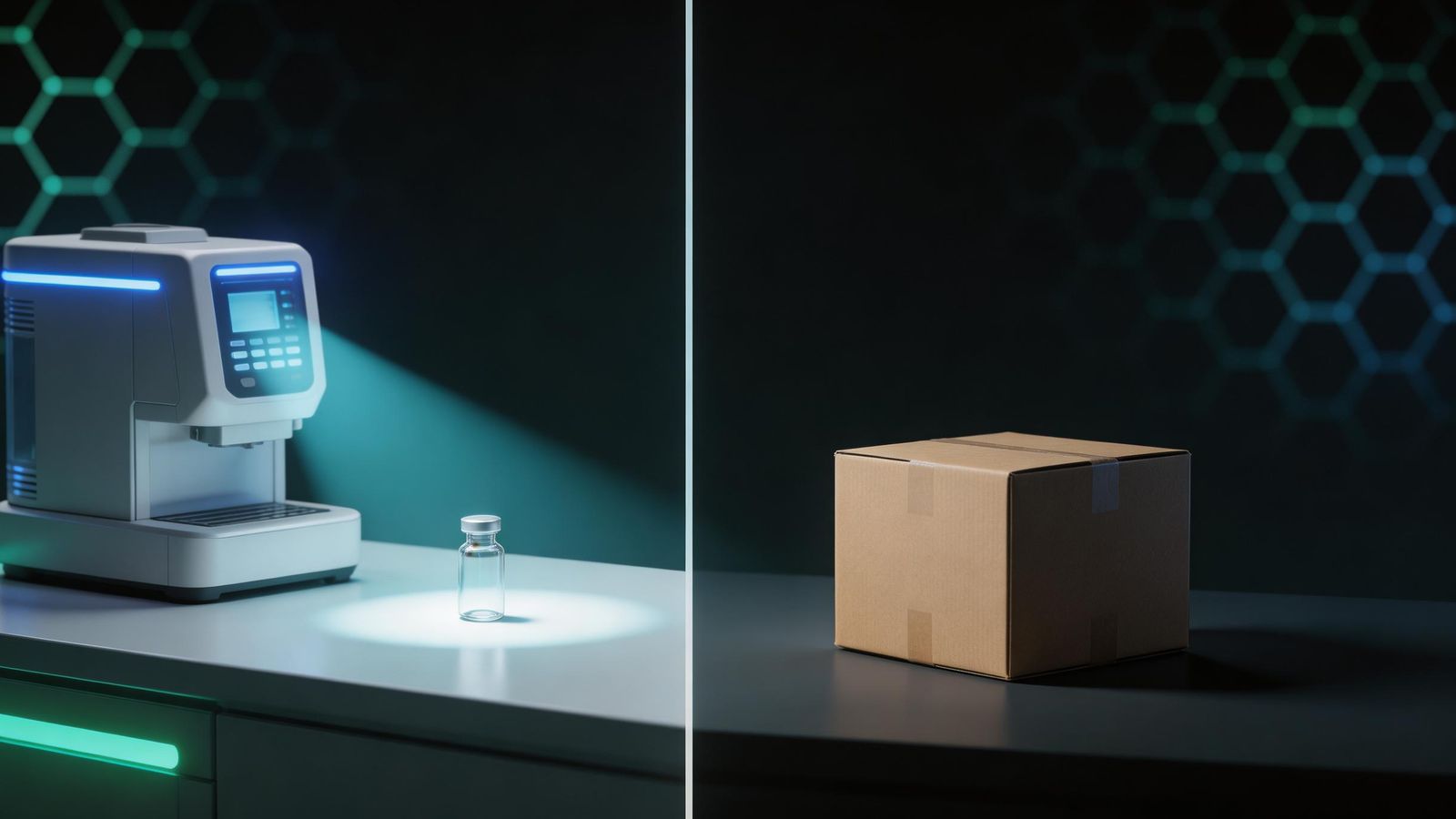
Why the Peptide Gray Market Makes You the QA Department
“Research use only” is not a quality standard — it is the mechanism that moves the entire quality function from an inspected factory onto the buyer.